Godfrey Stephanie S
School of Veterinary and Life Sciences, Murdoch University, 90 South Street, Murdoch 6150, Western Australia, Australia.
Int J Parasitol Parasites Wildl. 2013 Sep 18;2:235-45. doi: 10.1016/j.ijppaw.2013.09.001. eCollection 2013 Dec.
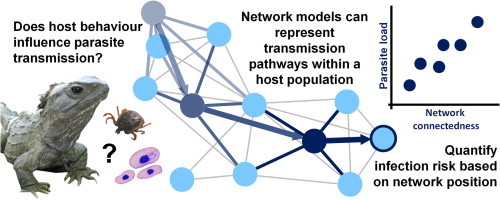
Social network analysis has recently emerged as a popular tool for understanding disease transmission in host populations. Although social networks have most extensively been applied to modelling the transmission of diseases through human populations, more recently the method has been applied to wildlife populations. The majority of examples from wildlife involve modelling the transmission of contagious microbes (mainly viruses and bacteria), normally in context of understanding wildlife disease epidemics. However, a growing number of studies have used networks to explore the ecology of parasite transmission in wildlife populations for a range of endemic parasites representing a diversity of life cycles and transmission methods. This review addresses the application of network models in representing the transmission of parasites with more complex life cycles, and illustrates the way in which this approach can be used to answer ecological questions about the transmission of parasites in wildlife populations.
社会网络分析最近已成为理解宿主种群中疾病传播的一种流行工具。尽管社会网络已最广泛地应用于模拟疾病在人类种群中的传播,但最近该方法也已应用于野生动物种群。野生动物的大多数例子都涉及模拟传染性微生物(主要是病毒和细菌)的传播,通常是在理解野生动物疾病流行的背景下。然而,越来越多的研究使用网络来探索野生动物种群中一系列具有不同生命周期和传播方式的地方性寄生虫的传播生态学。本综述探讨了网络模型在表示具有更复杂生命周期的寄生虫传播方面的应用,并说明了如何使用这种方法来回答有关野生动物种群中寄生虫传播的生态学问题。