East Marion L, Kurze Christoph, Wilhelm Kerstin, Benhaiem Sarah, Hofer Heribert
Department of Evolutionary Ecology, Leibniz Institute for Zoo and Wildlife Research, Alfred-Kowalke-Str. 17, 10315 Berlin, Germany.
Department of Evolutionary Ecology, Leibniz Institute for Zoo and Wildlife Research, Alfred-Kowalke-Str. 17, 10315 Berlin, Germany ; Institute of Biology, Freie Universität Berlin, Philippstr. 13, 10115 Berlin, Germany.
Int J Parasitol Parasites Wildl. 2013 Sep 18;2:257-65. doi: 10.1016/j.ijppaw.2013.09.003. eCollection 2013 Dec.
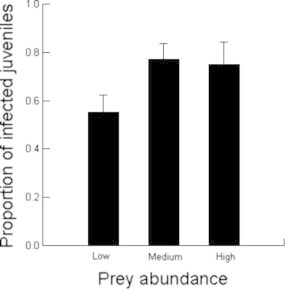
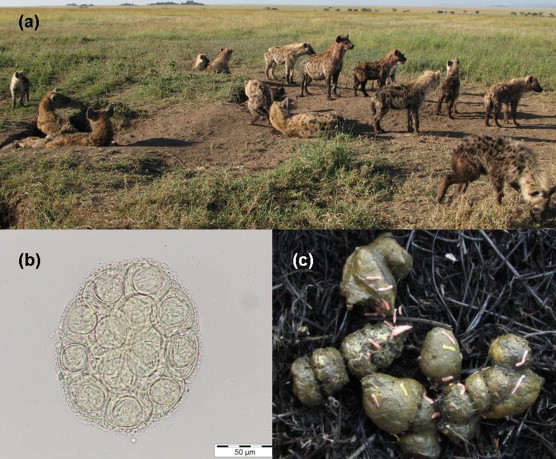
We provide the first genetic sequence data for a Dipylidium species from a wild carnivore plus an analysis of the effects of ecological, demographic, physiological and behavioural factors on Dipylidium sp. infection prevalence in a social carnivore, the spotted hyaena (Crocuta crocuta), in the Serengeti National Park, Tanzania. Our sequence data from a mitochondrial gene fragment (1176 base pair long) had a similarity of between 99% and 89% to Dipylidium caninum. We determined infection prevalence in 146 faecal samples from 124 known animals in three social groups (termed clans) using molecular screening and Dipylidium proglottid presence. Our analysis revealed significantly higher infection prevalence in juveniles (55%) than adults (15.8%), indicating that predominantly juveniles maintained infection in clans. The likelihood of infection in juveniles significantly: (1) increased as the number of adults and older juveniles (>6 months) at communal dens increased, implying a positive relationship between this factor and the size of the intermediate host (probably a flea species) population at communal dens; (2) decreased as the number of younger juveniles (<6 months) increased, suggesting that the chance of susceptible juveniles ingesting infected fleas during self-grooming declined as the number of infected fleas per younger juvenile declined; and (3) decreased during periods of low prey abundance in clan territories when an increased reliance on long-distances foraging excursions reduces the number of clan members visiting communal dens, possibly resulting in a decline in flea populations at dens. Long-distance foraging also increases the intervals (in days) between nursing visits by lactating females to their offspring. Lengthy intervals between milk intake by infected juveniles may reduce adult Dipylidium fecundity and hence decrease infection prevalence in the den flea population. Our study provides useful insights into Dipylidium epidemiology in a social carnivore population subject to large fluctuations in prey abundance.
我们提供了首个来自野生食肉动物的双殖孔绦虫属物种的基因序列数据,并分析了生态、种群统计学、生理和行为因素对坦桑尼亚塞伦盖蒂国家公园的群居食肉动物斑鬣狗(学名:Crocuta crocuta)感染双殖孔绦虫属物种的患病率的影响。我们从线粒体基因片段(长度为1176个碱基对)获得的序列数据与犬复孔绦虫的相似度在99%至89%之间。我们通过分子筛查和双殖孔绦虫节片的存在情况,确定了来自三个群居群体(称为氏族)中124只已知动物的146份粪便样本中的感染患病率。我们的分析显示,幼年斑鬣狗(55%)的感染患病率显著高于成年斑鬣狗(15.8%),这表明在氏族中主要是幼年斑鬣狗维持着感染。幼年斑鬣狗感染的可能性显著:(1)随着群居洞穴中成年斑鬣狗和年龄较大的幼年斑鬣狗(>6个月)数量的增加而增加,这意味着该因素与群居洞穴中中间宿主(可能是某种跳蚤)种群数量呈正相关;(2)随着年龄较小的幼年斑鬣狗(<6个月)数量的增加而降低,这表明当每只年龄较小的幼年斑鬣狗身上感染的跳蚤数量减少时,易感幼年斑鬣狗在自我梳理毛发时摄入受感染跳蚤的几率也会下降;(3)在氏族领地内猎物丰富度较低的时期会降低,此时对远距离觅食远足的依赖增加,减少了访问群居洞穴的氏族成员数量,这可能导致洞穴中跳蚤种群数量下降。远距离觅食还会增加哺乳期雌性斑鬣狗看望其后代的间隔时间(以天为单位)。受感染的幼年斑鬣狗摄入乳汁的间隔时间延长,可能会降低成年双殖孔绦虫的繁殖力,从而降低洞穴中跳蚤种群的感染患病率。我们的研究为受猎物丰富度大幅波动影响的群居食肉动物种群中的双殖孔绦虫流行病学提供了有用的见解。