Fendler Wojciech, Rizzo Manfredi, Borowiec Maciej, Malachowska Beata, Antosik Karolina, Szadkowska Agnieszka, Banach Maciej, Urbanska-Kosinska Malgorzata, Szopa Magdalena, Malecki Maciej, Mlynarski Wojciech
Department of Pediatrics, Oncology, Hematology and Diabetology, Medical University of Lodz, 36/50 Sporna Str., 91-738, Lodz, Poland.
Acta Diabetol. 2014 Aug;51(4):625-32. doi: 10.1007/s00592-014-0567-1. Epub 2014 Feb 19.
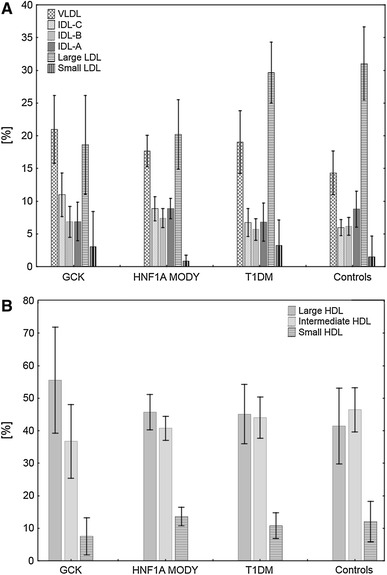
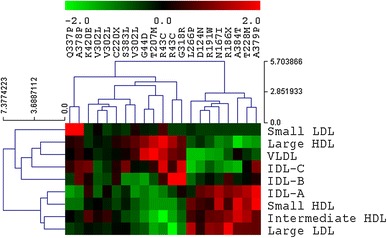
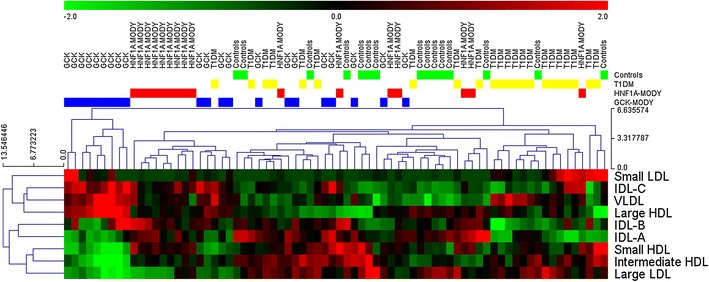
Patients with diabetes caused by single-gene mutations generally exhibit an altered course of diabetes. Those with mutations of the glucokinase gene (GCK-MODY) show good metabolic control and low risk of cardiovascular complications despite paradoxically lowered high-density lipoprotein (HDL) cholesterol levels. In order to investigate the matter, we analyzed the composition of low-density lipoprotein (LDL) and HDL subpopulations in such individuals. The LipoPrint(©) system (Quantimetrix, USA) based on non-denaturing, linear polyacrylamide gel electrophoresis was used to separate and measure LDL and HDL subclasses in fresh-frozen serum samples from patients with mutations of glucokinase or HNF1A, type 1 diabetes (T1DM) and healthy controls. Fresh serum samples from a total of 37 monogenic diabetes patients (21 from GCK-MODY and 16 from HNF1A-MODY), 22 T1DM patients and 15 healthy individuals were measured in this study. Concentrations of the small, highly atherogenic LDL subpopulation were similar among the compared groups. Large HDL percentage was significantly higher in GCK-MODY than in control (p = 0.0003), T1DM (p = 0.0006) and HNF1A-MODY groups (p = 0.0246). Patients with GCK-MODY were characterized by significantly lower intermediate HDL levels than controls (p = 0.0003) and T1DM (p = 0.0005). Small, potentially atherogenic HDL content differed significantly with the GCK-MODY group showing concentrations of that subfraction from control (p = 0.0096), T1DM (p = 0.0193) and HNF1A-MODY (p = 0.0057) groups. Within-group heterogeneity suggested the existence of potential gene-gene or gene-environment interactions. GCK-MODY is characterized by a strongly protective profile of HDL cholesterol subpopulations. A degree of heterogeneity within the groups suggests the existence of interactions with other genetic or clinical factors.
由单基因突变引起的糖尿病患者通常表现出糖尿病病程的改变。那些携带葡萄糖激酶基因(GCK-MODY)突变的患者尽管高密度脂蛋白(HDL)胆固醇水平反常降低,但仍表现出良好的代谢控制和较低的心血管并发症风险。为了研究这一问题,我们分析了此类个体中低密度脂蛋白(LDL)和HDL亚群的组成。基于非变性线性聚丙烯酰胺凝胶电泳的LipoPrint(©)系统(美国Quantimetrix公司)用于分离和测量来自葡萄糖激酶或HNF1A突变患者、1型糖尿病(T1DM)患者及健康对照者的新鲜冷冻血清样本中的LDL和HDL亚类。本研究共检测了37例单基因糖尿病患者(21例GCK-MODY患者和16例HNF1A-MODY患者)、22例T1DM患者和15例健康个体的新鲜血清样本。在比较的各组中,小的、具有高度致动脉粥样硬化性的LDL亚群浓度相似。GCK-MODY组中大型HDL的百分比显著高于对照组(p = 0.0003)、T1DM组(p = 0.0006)和HNF1A-MODY组(p = 0.0246)。GCK-MODY患者的中间HDL水平显著低于对照组(p = 0.0003)和T1DM组(p = 0.0005)。小的、潜在致动脉粥样硬化性的HDL含量在GCK-MODY组与对照组(p = 0.0096)、T1DM组(p = 0.0193)和HNF1A-MODY组(p = 0.0057)之间存在显著差异。组内异质性提示存在潜在的基因-基因或基因-环境相互作用。GCK-MODY的特征是HDL胆固醇亚群具有很强的保护作用。各组内的一定程度异质性提示存在与其他遗传或临床因素的相互作用。