Department of Internal Medicine, Seoul National University Hospital, Seoul, Korea.
Department of Internal Medicine, Uijeongbu St. Mary's Hospital, College of Medicine, The Catholic University of Korea, Uijeongbu, Korea.
Diabetes Metab J. 2020 Oct;44(5):627-639. doi: 10.4093/dmj.2020.0214. Epub 2020 Oct 21.
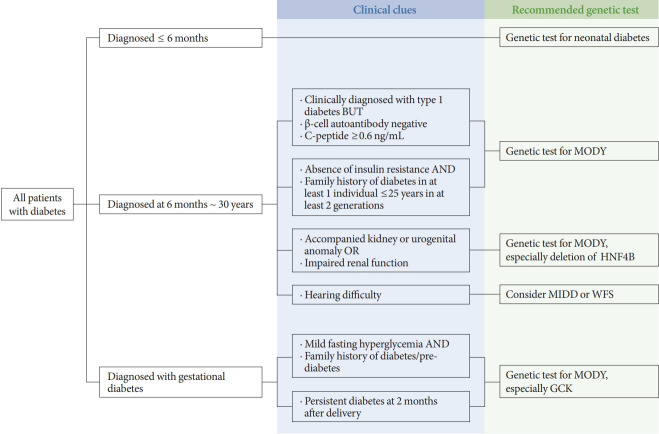
Monogenic diabetes, including maturity-onset diabetes of the young, neonatal diabetes, and other rare forms of diabetes, results from a single gene mutation. It has been estimated to represent around 1% to 6% of all diabetes. With the advances in genome sequencing technology, it is possible to diagnose more monogenic diabetes cases than ever before. In Korea, 11 studies have identified several monogenic diabetes cases, using Sanger sequencing and whole exome sequencing since 2001. The recent largest study, using targeted exome panel sequencing, found a molecular diagnosis rate of 21.1% for monogenic diabetes in clinically suspected patients. Mutations in glucokinase (GCK), hepatocyte nuclear factor 1α (HNF1A), and HNF4A were most commonly found. Genetic diagnosis of monogenic diabetes is important as it determines the therapeutic approach required for patients and helps to identify affected family members. However, there are still many challenges, which include a lack of simple clinical criterion for selecting patients for genetic testing, difficulties in interpreting the genetic test results, and high costs for genetic testing. In this review, we will discuss the latest updates on monogenic diabetes in Korea, and suggest an algorithm to screen patients for genetic testing. The genetic tests and non-genetic markers for accurate diagnosis of monogenic diabetes will be also reviewed.
单基因糖尿病,包括青年发病成年型糖尿病、新生儿糖尿病和其他罕见类型的糖尿病,是由单个基因突变引起的。据估计,它占所有糖尿病的 1%至 6%。随着基因组测序技术的进步,现在可以诊断出比以往更多的单基因糖尿病病例。自 2001 年以来,韩国已有 11 项研究使用桑格测序和全外显子组测序确定了几个单基因糖尿病病例。最近规模最大的一项研究使用靶向外显子组测序,在临床疑似患者中单基因糖尿病的分子诊断率为 21.1%。最常见的突变发生在葡萄糖激酶 (GCK)、肝细胞核因子 1α (HNF1A) 和 HNF4A 基因上。单基因糖尿病的遗传诊断很重要,因为它决定了患者所需的治疗方法,并有助于识别受影响的家庭成员。然而,仍然存在许多挑战,包括缺乏用于选择患者进行基因检测的简单临床标准、解释基因检测结果的困难以及基因检测的高成本。在这篇综述中,我们将讨论韩国单基因糖尿病的最新研究进展,并提出一个用于筛选患者进行基因检测的算法。还将回顾单基因糖尿病的基因检测和非遗传标志物的准确诊断。