Mina Michael J, McCullers Jonathan A, Klugman Keith P
mBio. 2014 Feb 18;5(1):e01040-13. doi: 10.1128/mBio.01040-13.
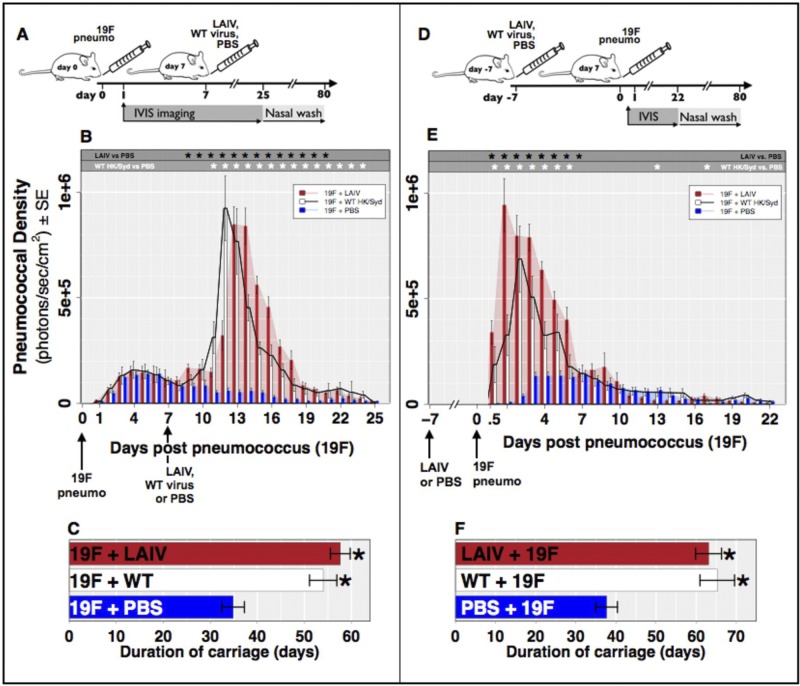
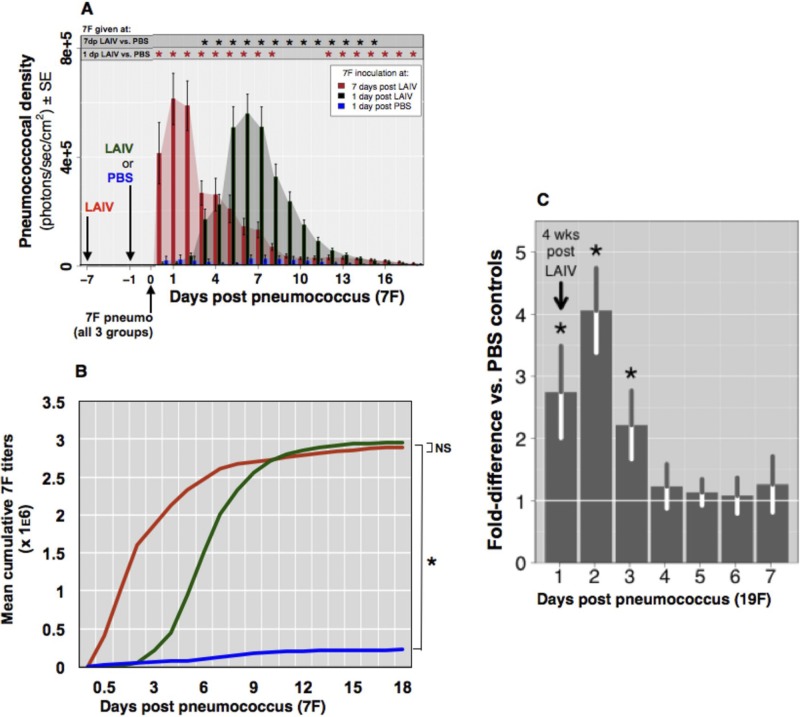
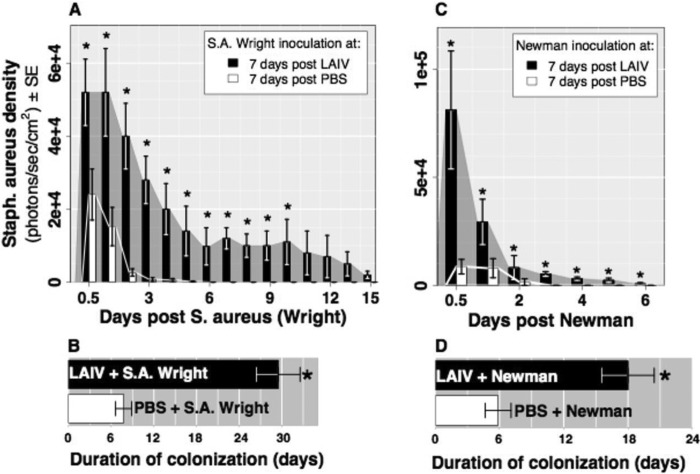
Community interactions at mucosal surfaces between viruses, like influenza virus, and respiratory bacterial pathogens are important contributors toward pathogenesis of bacterial disease. What has not been considered is the natural extension of these interactions to live attenuated immunizations, and in particular, live attenuated influenza vaccines (LAIVs). Using a mouse-adapted LAIV against influenza A (H3N2) virus carrying the same mutations as the human FluMist vaccine, we find that LAIV vaccination reverses normal bacterial clearance from the nasopharynx and significantly increases bacterial carriage densities of the clinically important bacterial pathogens Streptococcus pneumoniae (serotypes 19F and 7F) and Staphylococcus aureus (strains Newman and Wright) within the upper respiratory tract of mice. Vaccination with LAIV also resulted in 2- to 5-fold increases in mean durations of bacterial carriage. Furthermore, we show that the increases in carriage density and duration were nearly identical in all aspects to changes in bacterial colonizing dynamics following infection with wild-type (WT) influenza virus. Importantly, LAIV, unlike WT influenza viruses, had no effect on severe bacterial disease or mortality within the lower respiratory tract. Our findings are, to the best of our knowledge, the first to demonstrate that vaccination with a live attenuated viral vaccine can directly modulate colonizing dynamics of important and unrelated human bacterial pathogens, and does so in a manner highly analogous to that seen following wild-type virus infection.
Following infection with an influenza virus, infected or recently recovered individuals become transiently susceptible to excess bacterial infections, particularly Streptococcus pneumoniae and Staphylococcus aureus. Indeed, in the absence of preexisting comorbidities, bacterial infections are a leading cause of severe disease during influenza epidemics. While this synergy has been known and is well studied, what has not been explored is the natural extension of these interactions to live attenuated influenza vaccines (LAIVs). Here we show, in mice, that vaccination with LAIV primes the upper respiratory tract for increased bacterial growth and persistence of bacterial carriage, in a manner nearly identical to that seen following wild-type influenza virus infections. Importantly, LAIV, unlike wild-type virus, did not increase severe bacterial disease of the lower respiratory tract. These findings may have consequences for individual bacterial disease processes within the upper respiratory tract, as well as bacterial transmission dynamics within LAIV-vaccinated populations.
在黏膜表面,像流感病毒这样的病毒与呼吸道细菌病原体之间的群落相互作用是导致细菌性疾病发病的重要因素。尚未被考虑的是这些相互作用自然延伸至减毒活疫苗接种,尤其是减毒活流感疫苗(LAIV)。使用一种针对甲型流感病毒(H3N2)的小鼠适应型LAIV,其携带与人类FluMist疫苗相同的突变,我们发现接种LAIV会逆转鼻咽部正常的细菌清除,并显著增加临床上重要的细菌病原体肺炎链球菌(血清型19F和7F)和金黄色葡萄球菌(纽曼菌株和赖特菌株)在小鼠上呼吸道中的细菌携带密度。接种LAIV还导致细菌携带的平均持续时间增加了2至5倍。此外,我们表明,携带密度和持续时间的增加在各个方面与野生型(WT)流感病毒感染后细菌定殖动态的变化几乎相同。重要的是,与WT流感病毒不同,LAIV对下呼吸道的严重细菌性疾病或死亡率没有影响。据我们所知,我们的发现首次证明接种减毒活病毒疫苗可直接调节重要且不相关的人类细菌病原体的定殖动态,并且其方式与野生型病毒感染后所见的方式高度相似。
感染流感病毒后,受感染或近期康复的个体暂时易患额外的细菌感染,尤其是肺炎链球菌和金黄色葡萄球菌。事实上,在没有预先存在的合并症的情况下,细菌感染是流感流行期间严重疾病的主要原因。虽然这种协同作用已为人所知并得到充分研究,但尚未探索这些相互作用自然延伸至减毒活流感疫苗(LAIV)的情况。在这里,我们在小鼠中表明,接种LAIV会使上呼吸道为细菌生长增加和细菌携带的持续存在做好准备,其方式与野生型流感病毒感染后所见的方式几乎相同。重要的是,与野生型病毒不同,LAIV不会增加下呼吸道的严重细菌性疾病。这些发现可能对上呼吸道内的个体细菌性疾病过程以及接种LAIV人群中的细菌传播动态产生影响。