Department of Family Medicine, Kandong Sacred Hospital, Hallym University College of Medicine, Seoul, Korea.
Department of Pediatrics, Kyung Hee University School of Medicine, Seoul, Korea.
J Korean Med Sci. 2014 Feb;29(2):172-5. doi: 10.3346/jkms.2014.29.2.172. Epub 2014 Jan 28.
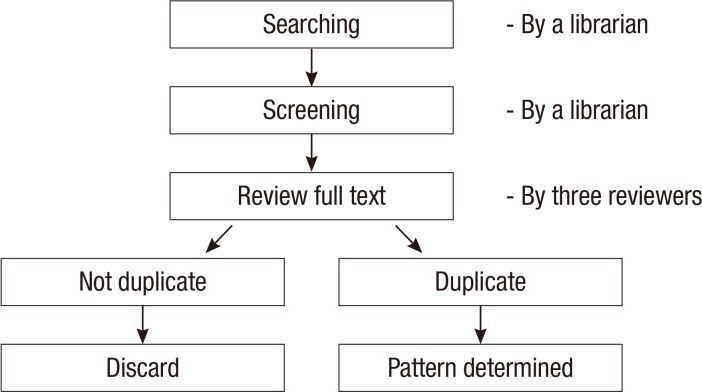
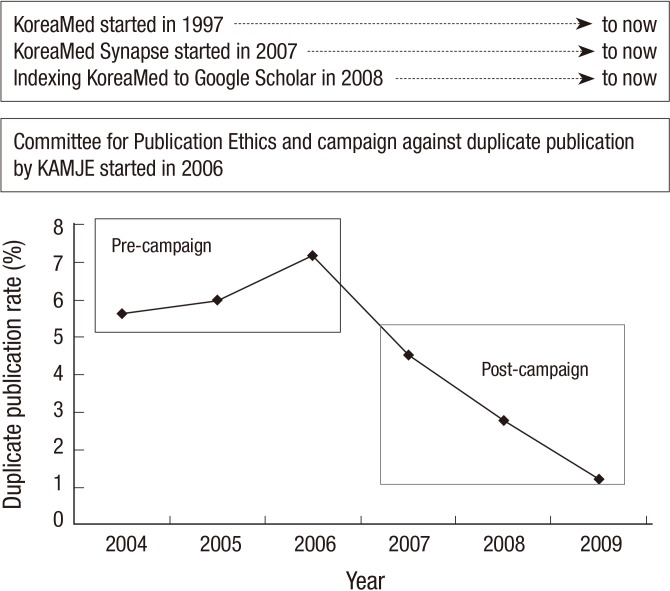
The purpose of this study was to examine trends in duplicate publication in Korean medical articles indexed in the KoreaMed database from 2004 to 2009, before and after a campaign against scientific misconduct launched by the Korean Association of Medical Journal Editors in 2006. The study covered period from 2007 to 2012; and 5% of the articles indexed in KoreaMed were retrieved by random sampling. Three authors reviewed full texts of the retrieved articles. The pattern of duplicate publication, such as copy, salami slicing (fragmentation), and aggregation (imalas), was also determined. Before the launching ethics campaign, the national duplication rate in medical journals was relatively high: 5.9% in 2004, 6.0% in 2005, and 7.2% in 2006. However, duplication rate steadily declined to 4.5% in 2007, 2.8% in 2008, and 1.2 % in 2009. Of all duplicated articles, 53.4% were classified as copies, 27.8% as salami slicing, and 18.8% as aggregation (imalas). The decline in duplicate publication rate took place as a result of nationwide campaigns and monitoring by KoreaMed and KoreaMed Synapse, starting from 2006.
本研究旨在考察 2004 年至 2009 年韩国医学期刊编辑协会(Korean Association of Medical Journal Editors)发起打击科研不端行为运动前后,韩国医学文献数据库(KoreaMed)中索引的韩国医学文章中重复发表的趋势。研究时间跨度为 2007 年至 2012 年;通过随机抽样检索了 KoreaMed 中索引的 5%的文章。三位作者对检索到的文章全文进行了审查。还确定了重复发表的模式,如复制、切片(碎片化)和聚合(imalas)。在开展道德运动之前,医学期刊的全国重复率相对较高:2004 年为 5.9%,2005 年为 6.0%,2006 年为 7.2%。然而,重复率稳步下降,2007 年降至 4.5%,2008 年降至 2.8%,2009 年降至 1.2%。在所有重复发表的文章中,53.4%被归类为复制,27.8%为切片,18.8%为聚合(imalas)。自 2006 年以来,通过 KoreaMed 和 KoreaMed Synapse 开展的全国性运动和监测导致重复发表率下降。