MediCC!, Medical Communications Consultants, LLC Chapel Hill, North Carolina, USA.
PLoS One. 2013 Jul 8;8(7):e68397. doi: 10.1371/journal.pone.0068397. Print 2013.
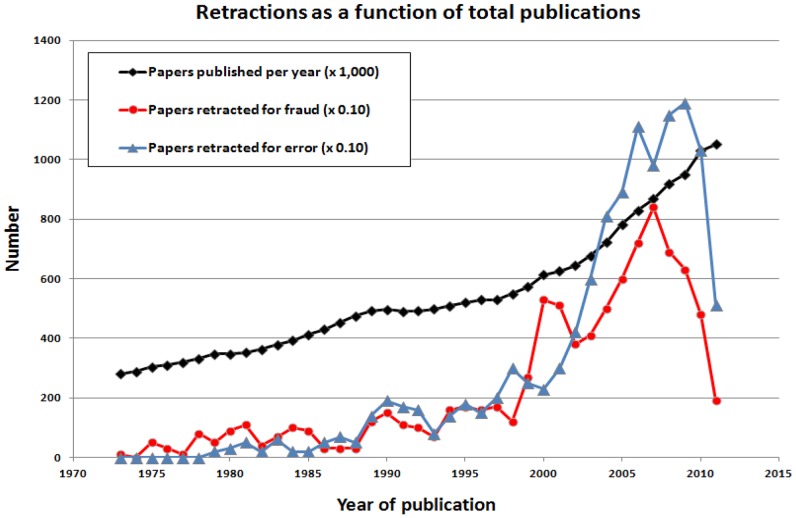
The number of retracted scientific publications has risen sharply, but it is unclear whether this reflects an increase in publication of flawed articles or an increase in the rate at which flawed articles are withdrawn.
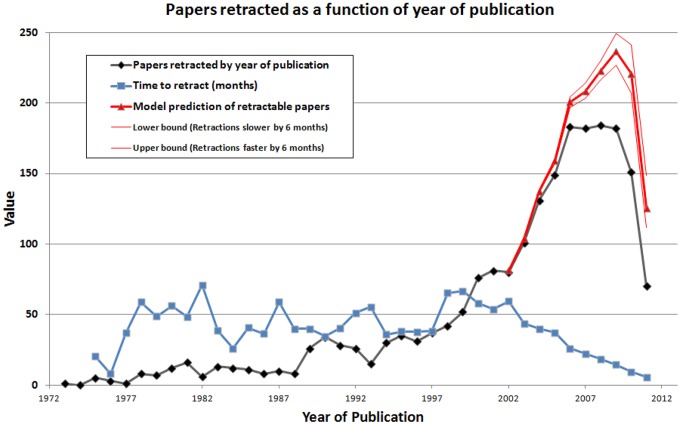
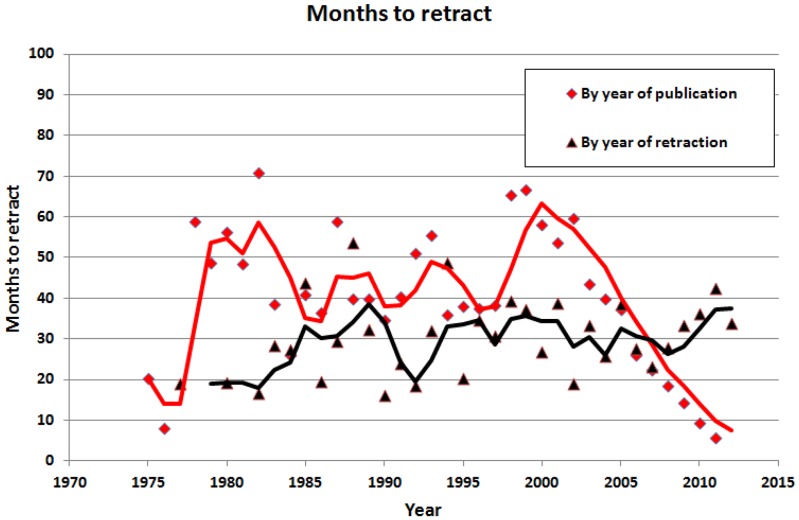
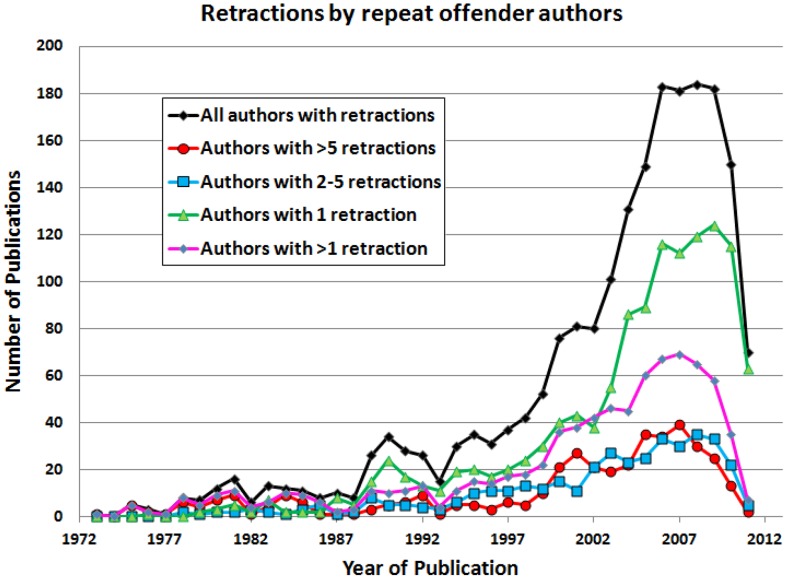
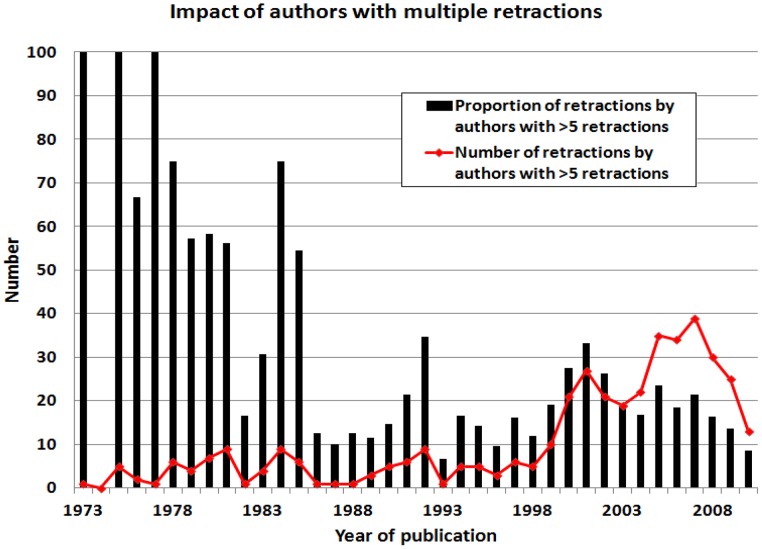
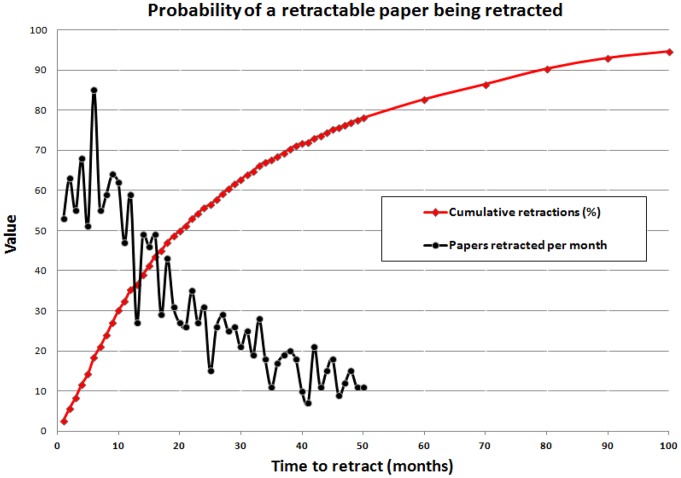
We examined the interval between publication and retraction for 2,047 retracted articles indexed in PubMed. Time-to-retraction (from publication of article to publication of retraction) averaged 32.91 months. Among 714 retracted articles published in or before 2002, retraction required 49.82 months; among 1,333 retracted articles published after 2002, retraction required 23.82 months (p<0.0001). This suggests that journals are retracting papers more quickly than in the past, although recent articles requiring retraction may not have been recognized yet. To test the hypothesis that time-to-retraction is shorter for articles that receive careful scrutiny, time-to-retraction was correlated with journal impact factor (IF). Time-to-retraction was significantly shorter for high-IF journals, but only ∼1% of the variance in time-to-retraction was explained by increased scrutiny. The first article retracted for plagiarism was published in 1979 and the first for duplicate publication in 1990, showing that articles are now retracted for reasons not cited in the past. The proportional impact of authors with multiple retractions was greater in 1972-1992 than in the current era (p<0.001). From 1972-1992, 46.0% of retracted papers were written by authors with a single retraction; from 1993 to 2012, 63.1% of retracted papers were written by single-retraction authors (p<0.001).
The increase in retracted articles appears to reflect changes in the behavior of both authors and institutions. Lower barriers to publication of flawed articles are seen in the increase in number and proportion of retractions by authors with a single retraction. Lower barriers to retraction are apparent in an increase in retraction for "new" offenses such as plagiarism and a decrease in the time-to-retraction of flawed work.
被撤回的科学出版物数量急剧增加,但目前尚不清楚这是反映了有缺陷的文章的发表数量增加,还是反映了有缺陷的文章被撤回的速度加快。
我们检查了在 PubMed 中索引的 2047 篇被撤回的文章的发表和撤回之间的间隔。从文章发表到撤回的时间(从文章发表到撤回的时间)平均为 32.91 个月。在 2002 年或之前发表的 714 篇被撤回的文章中,撤回需要 49.82 个月;在 2002 年之后发表的 1333 篇被撤回的文章中,撤回需要 23.82 个月(p<0.0001)。这表明期刊现在比过去更快地撤回论文,尽管最近需要撤回的论文可能还没有被发现。为了检验时间到撤回的时间更短是因为文章受到更仔细的审查的假设,我们将时间到撤回的时间与期刊影响因子(IF)进行了相关性分析。高 IF 期刊的时间到撤回的时间明显较短,但时间到撤回的方差仅约 1%可以用增加的审查来解释。第一份因抄袭而被撤回的文章发表于 1979 年,第一份因重复发表而被撤回的文章发表于 1990 年,这表明现在的文章因过去未引用的原因而被撤回。在 1972-1992 年,有多篇文章被撤回的作者的影响比例大于当前时代(p<0.001)。在 1972-1992 年,46.0%的撤回论文是由只有一篇撤回论文的作者撰写的;从 1993 年到 2012 年,63.1%的撤回论文是由只有一篇撤回论文的作者撰写的(p<0.001)。
被撤回的文章数量的增加似乎反映了作者和机构行为的变化。有一篇撤回论文的作者的数量和比例的增加表明,有缺陷的文章发表的门槛降低了。对新违规行为(如抄袭)的撤回速度加快,有缺陷的工作的撤回时间缩短,这表明撤回的门槛降低了。