NIHR Nottingham Hearing Biomedical Research Unit, School of Medicine, University of Nottingham Nottingham, UK.
Front Neurosci. 2014 Feb 5;8:7. doi: 10.3389/fnins.2014.00007. eCollection 2014.
To investigate the effect of sensitivity to temporal fine structure (TFS) on subjective measures of hearing aid outcome.
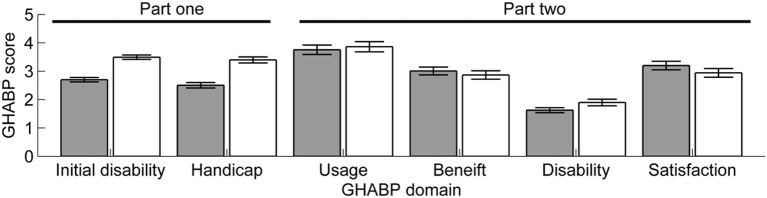
Prior to receiving hearing aids, participants completed a test to assess sensitivity to TFS and two self-assessment questionnaires; the Glasgow Hearing Aid Benefit Profile (GHABP), and the Speech, Spatial and Qualities of hearing (SSQ-A). Follow-up appointments, comprised three self-assessment questionnaires; the GHABP, the SSQ-B, and the International Outcome Inventory for Hearing Aid Outcomes (IOI-HA).
75 adults were recruited from direct referral clinics.
Two thirds of participants were found to have good sensitivity to TFS; listeners with good sensitivity to TFS rated their hearing abilities higher at pre-fitting (SSQ-A) than those with poor sensitivity to TFS. At follow-up, participants with good sensitivity to TFS showed a smaller improvement on SSQ-B over listeners with poor sensitivity to TFS. Among the questionnaires, only the SSQ showed greater sensitivity to measure subjective differences between listeners with good and poor sensitivity to TFS.
The clinical identification of a patient's ability to process TFS information at an early stage in the treatment pathway could prove useful in managing expectations about hearing aid outcomes.
探讨对时间精细结构(TFS)的敏感度对助听器效果主观评估的影响。
在佩戴助听器之前,参与者完成了一项 TFS 敏感度测试和两份自我评估问卷,即格拉斯哥助听器效果概况(GHABP)和言语、空间和听力质量(SSQ-A)。随访预约包括三份自我评估问卷,即 GHABP、SSQ-B 和助听器效果国际问卷(IOI-HA)。
从直接转诊诊所招募了 75 名成年人。
三分之二的参与者被发现对 TFS 有较好的敏感度;对 TFS 敏感度较好的听众在预适配时(SSQ-A)对自己的听力能力评价高于对 TFS 敏感度较差的听众。在随访中,对 TFS 敏感度较好的参与者在 SSQ-B 上的改善程度小于对 TFS 敏感度较差的听众。在这些问卷中,只有 SSQ 更能敏感地测量对 TFS 敏感度较好和较差的听众之间的主观差异。
在治疗过程的早期阶段,临床识别患者处理 TFS 信息的能力可能有助于管理对助听器效果的期望。