PG "Epigenetics and Structural Plasticity", Institute of Biology, Otto von Guericke University Magdeburg Magdeburg, Germany ; Center for Behavioral Brain Sciences Magdeburg, Germany.
PG "Epigenetics and Structural Plasticity", Institute of Biology, Otto von Guericke University Magdeburg Magdeburg, Germany ; Department of Zoology/Developmental Neurobiology, Institute of Biology, Otto von Guericke University Magdeburg Magdeburg, Germany.
Front Neurosci. 2014 Feb 5;8:11. doi: 10.3389/fnins.2014.00011. eCollection 2014.
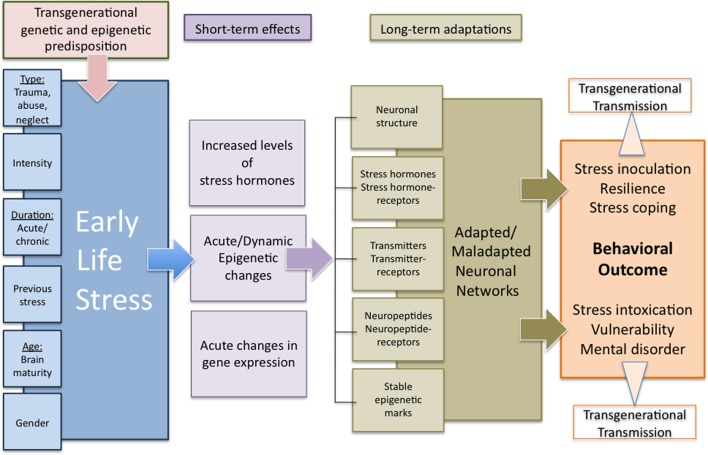
Environmental influences such as perinatal stress have been shown to program the developing organism to adapt brain and behavioral functions to cope with daily life challenges. Evidence is now accumulating that the specific and individual effects of early life adversity on the functional development of brain and behavior emerge as a function of the type, intensity, timing and the duration of the adverse environment, and that early life stress (ELS) is a major risk factor for developing behavioral dysfunctions and mental disorders. Results from clinical as well as experimental studies in animal models support the hypothesis that ELS can induce functional "scars" in prefrontal and limbic brain areas, regions that are essential for emotional control, learning and memory functions. On the other hand, the concept of "stress inoculation" is emerging from more recent research, which revealed positive functional adaptations in response to ELS resulting in resilience against stress and other adversities later in life. Moreover, recent studies indicate that early life experiences and the resulting behavioral consequences can be transmitted to the next generation, leading to a transgenerational cycle of adverse or positive adaptations of brain function and behavior. In this review we propose a unifying view of stress vulnerability and resilience by connecting genetic predisposition and programming sensitivity to the context of experience-expectancy and transgenerational epigenetic traits. The adaptive maturation of stress responsive neural and endocrine systems requires environmental challenges to optimize their functions. Repeated environmental challenges can be viewed within the framework of the match/mismatch hypothesis, the outcome, psychopathology or resilience, depends on the respective predisposition and on the context later in life.
环境影响,如围产期应激,已被证明可使发育中的机体编程,以适应大脑和行为功能,从而应对日常生活中的挑战。现在有越来越多的证据表明,早期生活逆境对大脑和行为功能的特定和个体影响,是作为环境的类型、强度、时间和持续时间的函数而出现的,并且早期生活应激(ELS)是导致行为功能障碍和精神障碍的主要危险因素。来自临床和动物模型的实验研究结果支持了以下假说,即 ELS 可以在前额叶和边缘脑区诱导功能性“疤痕”,这些脑区对情绪控制、学习和记忆功能至关重要。另一方面,“应激接种”的概念也来自于最近的研究,该研究揭示了 ELS 会导致功能性的积极适应,从而增强了对以后生活中应激和其他逆境的抵抗力。此外,最近的研究表明,早期的生活经历和由此产生的行为后果可以传递给下一代,导致大脑功能和行为的代际不良或积极适应的循环。在这篇综述中,我们通过将遗传易感性和编程敏感性与经验预期和跨代表观遗传特征的背景联系起来,提出了一种关于应激易感性和弹性的统一观点。应激反应性神经和内分泌系统的适应性成熟需要环境挑战来优化其功能。在匹配/不匹配假说的框架内,可以看待反复的环境挑战,其结果是精神病理学或弹性,取决于各自的易感性和以后生活中的环境。