Departments of Internal Medicine and Pediatrics, University of Pennsylvania, Philadelphia, PA, USA,
AIDS Behav. 2014 Jul;18(7):1199-223. doi: 10.1007/s10461-014-0729-8.
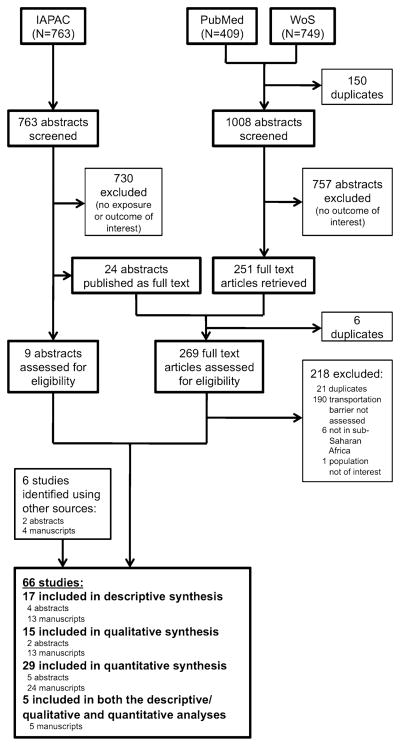
Difficulty obtaining reliable transportation to clinic is frequently cited as a barrier to HIV care in sub-Saharan Africa (SSA). Numerous studies have sought to characterize the impact of geographic and transportation-related barriers on HIV outcomes in SSA, but to date there has been no systematic attempt to summarize these findings. In this systematic review, we summarized this body of literature. We searched for studies conducted in SSA examining the following outcomes in the HIV care continuum: (1) voluntary counseling and testing, (2) pre-antiretroviral therapy (ART) linkage to care, (3) loss to follow-up and mortality, and (4) ART adherence and/or viral suppression. We identified 34 studies containing 52 unique estimates of association between a geographic or transportation-related barrier and an HIV outcome. There was an inverse effect in 23 estimates (44 %), a null association in 26 (50 %), and a paradoxical beneficial impact in 3 (6 %). We conclude that geographic and transportation-related barriers are associated with poor outcomes across the continuum of HIV care.
在撒哈拉以南非洲(SSA),难以获得可靠的交通工具前往诊所经常被认为是艾滋病护理的障碍。许多研究都试图描述地理和交通相关障碍对 SSA 中艾滋病毒结果的影响,但迄今为止,还没有人系统地试图总结这些发现。在本系统评价中,我们总结了这部分文献。我们搜索了在 SSA 进行的研究,以了解 HIV 护理连续体中的以下结果:(1)自愿咨询和检测,(2)抗逆转录病毒治疗(ART)前与护理的联系,(3)失访和死亡,以及(4)ART 依从性和/或病毒抑制。我们确定了 34 项研究,其中包含 52 项关于地理或交通相关障碍与艾滋病毒结果之间关联的独特估计。在 23 项估计中有负效应(44%),26 项无关联(50%),3 项有相反的有益影响(6%)。我们的结论是,地理和交通相关的障碍与艾滋病毒护理连续体中的不良结果有关。