Liu Qi, Zhao Shilin, Su Pei-Fang, Yu Shyr
BMC Syst Biol. 2013;7 Suppl 5(Suppl 5):S7. doi: 10.1186/1752-0509-7-S5-S7. Epub 2013 Dec 9.
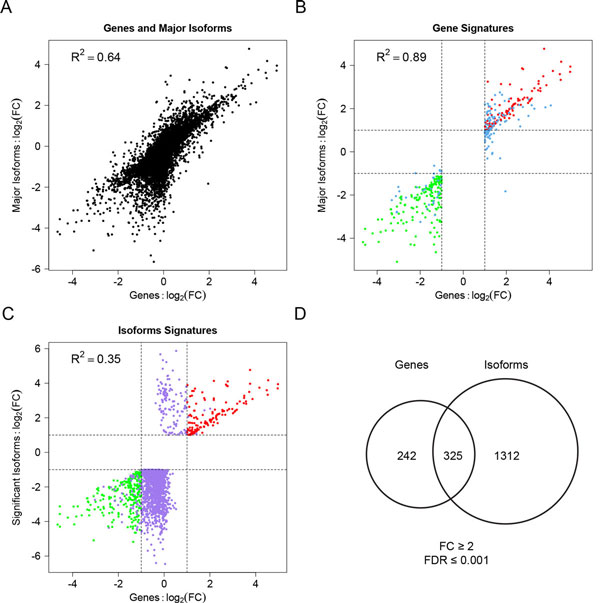
Identification of expression alternations between early and late stage cancers is helpful for understanding cancer development and progression. Much research has been done focusing on stage-dependent gene expression profiles. In contrast, relatively fewer studies on isoform expression profiles have been performed due to the difficulty of quantification and noisy splicing. Here we conducted both gene- and isoform-level analysis on RNA-seq data of 234 stage I and 81 stage IV kidney renal clear cell carcinoma patients, aiming to uncover the stage-dependent expression signatures and investigate the advantage of isoform expression profiling for identifying advanced stage cancers and predicting clinical outcome.
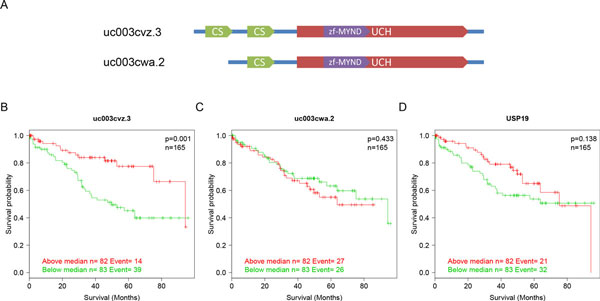
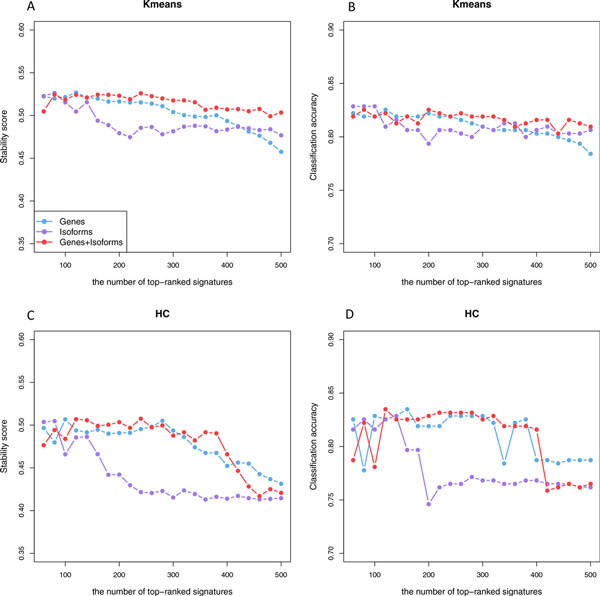
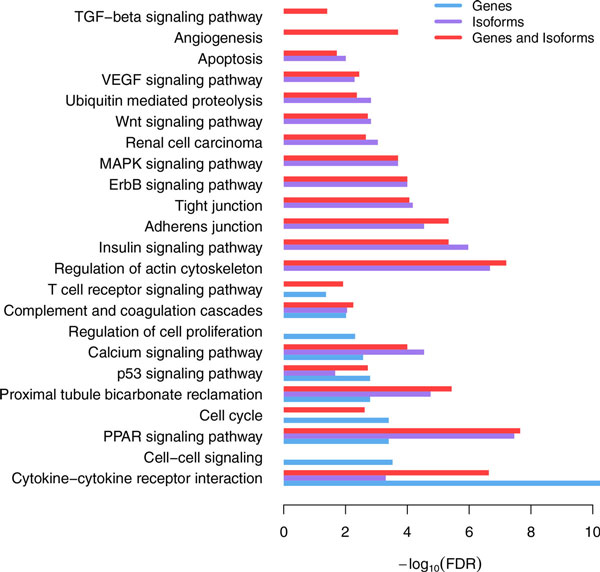
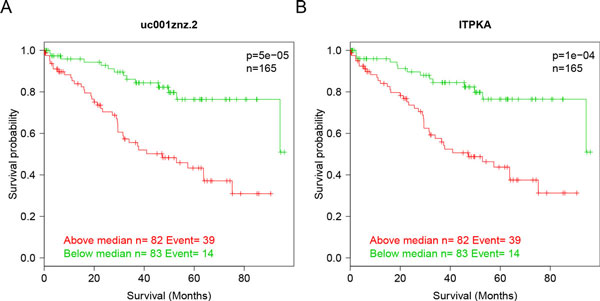
Both gene and isoform expression signatures are useful for distinguishing cancer stages. They provide common and unique information associated with cancer progression and metastasis. Combining gene and isoform signatures even improves the classification performance and reveals additional important biological processes, such as angiogenesis and TGF--beta signaling pathway. Moreover, expression abundance of a number of genes and isoforms is predictive of the risk of cancer death in an independent dataset, such as gene and isoform expression of ITPKA, the expression of a functional important isoform of UPS19.
Isoform expression profiling provides unique and important information which cannot be detected by gene expression profiles. Combining gene and isoform expression signatures helps to identify advanced stage cancers, predict clinical outcome, and present a comprehensive view of cancer development and progression.
识别早期和晚期癌症之间的表达变化有助于理解癌症的发展和进展。许多研究聚焦于分期依赖性基因表达谱。相比之下,由于定量困难和剪接噪声,对异构体表达谱的研究相对较少。在此,我们对234例I期和81例IV期肾透明细胞癌患者的RNA测序数据进行了基因和异构体水平分析,旨在揭示分期依赖性表达特征,并研究异构体表达谱在识别晚期癌症和预测临床结局方面的优势。
基因和异构体表达特征均有助于区分癌症分期。它们提供了与癌症进展和转移相关的共同和独特信息。结合基因和异构体特征甚至可提高分类性能,并揭示其他重要的生物学过程,如血管生成和转化生长因子-β信号通路。此外,在一个独立数据集中,许多基因和异构体的表达丰度可预测癌症死亡风险,如ITPKA的基因和异构体表达、UPS19一个功能重要异构体的表达。
异构体表达谱提供了基因表达谱无法检测到的独特且重要的信息。结合基因和异构体表达特征有助于识别晚期癌症、预测临床结局,并全面呈现癌症的发展和进展。