Empirical Musicology Group, School of the Arts and Media, University of New South Wales Sydney, NSW, Australia.
Applied Music Research Centre, Roehampton University Roehampton Lane, London, UK.
Front Psychol. 2014 Feb 6;5:38. doi: 10.3389/fpsyg.2014.00038. eCollection 2014.
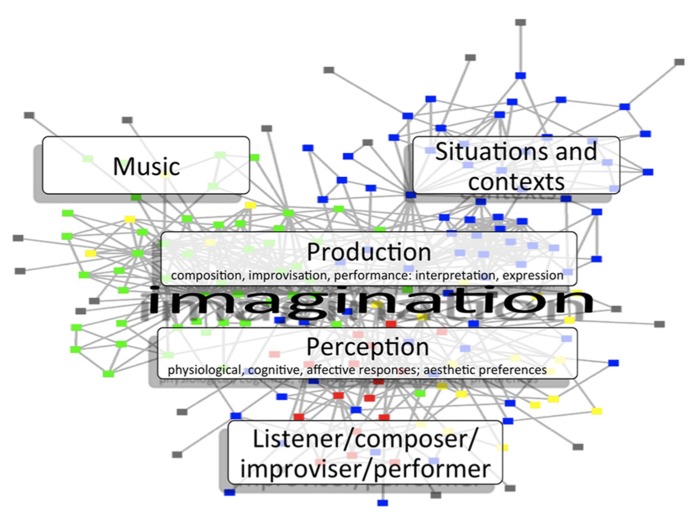
This paper examines the idea that attraction to music is generated at a cognitive level through the formation and activation of networks of interlinked "nodes." Although the networks involved are vast, the basic mechanism for activating the links is relatively simple. Two comprehensive cognitive-behavioral models of musical engagement are examined with the aim of identifying the underlying cognitive mechanisms and processes involved in musical experience. A "dynamical minimalism" approach (after Nowak, 2004) is applied to re-interpret musical engagement (listening, performing, composing, or imagining any of these) and to revise the latest version of the reciprocal-feedback model (RFM) of music processing. Specifically, a single cognitive mechanism of "spreading activation" through previously associated networks is proposed as a pleasurable outcome of musical engagement. This mechanism underlies the dynamic interaction of the various components of the RFM, and can thereby explain the generation of positive affects in the listener's musical experience. This includes determinants of that experience stemming from the characteristics of the individual engaging in the musical activity (whether listener, composer, improviser, or performer), the situation and contexts (e.g., social factors), and the music (e.g., genre, structural features). The theory calls for new directions for future research, two being (1) further investigation of the components of the RFM to better understand musical experience and (2) more rigorous scrutiny of common findings about the salience of familiarity in musical experience and preference.
本文探讨了这样一种观点,即对音乐的吸引力是通过形成和激活相互关联的“节点”网络在认知层面产生的。尽管涉及的网络非常庞大,但激活链接的基本机制相对简单。本文考察了两种综合的音乐参与认知-行为模型,旨在确定音乐体验中涉及的潜在认知机制和过程。应用“动态简约主义”方法(源自 Nowak,2004)重新解释音乐参与(聆听、演奏、创作或想象其中任何一种),并修订音乐处理的最新版本——互惠反馈模型(RFM)。具体而言,提出了一种通过先前关联的网络进行“扩散激活”的单一认知机制,作为音乐参与的愉悦结果。该机制是 RFM 各个组成部分动态交互的基础,从而可以解释听众音乐体验中积极情感的产生。这包括源自参与音乐活动的个体的特征(无论是听众、作曲家、即兴演奏者还是演奏者)、情境和背景(例如,社会因素)以及音乐(例如,流派、结构特征)的体验决定因素。该理论呼吁为未来的研究指明新的方向,其中两个是(1)进一步研究 RFM 的组成部分,以更好地理解音乐体验,(2)更严格地审查关于音乐体验和偏好中熟悉度的突出性的常见发现。