Chmiel Anthony, Schubert Emery
The MARCS Institute for Brain, Behaviour and Development, Western Sydney University, Sydney, NSW, Australia.
Empirical Musicology Laboratory, School of the Arts and Media, University of New South Wales, Sydney, NSW, Australia.
Front Psychol. 2020 Aug 21;11:1920. doi: 10.3389/fpsyg.2020.01920. eCollection 2020.
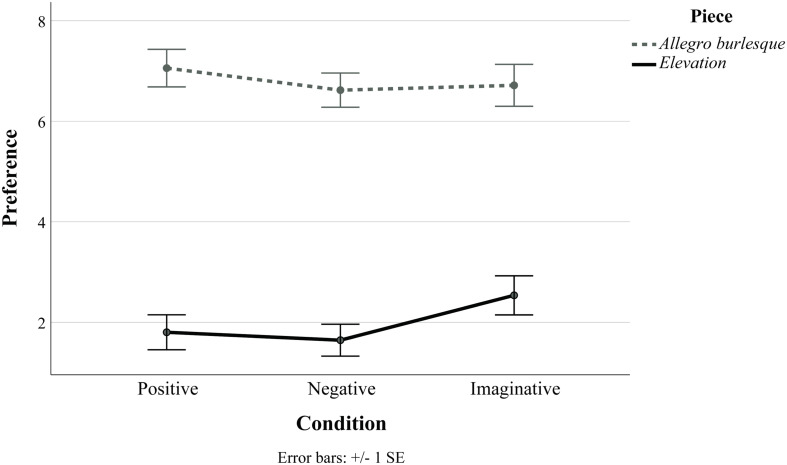
Does accompanying information ("framing") such as in a program note influence our preference for music? To date the findings have been mixed, although a small body of research has suggested that when framing accompanies music considered unusual (characterized by extreme complexity and extreme unfamiliarity), the music may be preferred compared to when no such framing occurs. A literature review (study 1) revealed that for 50% of experiments where valenced framing (positive negative suggestions of prestige) was manipulated, positive framing was accompanied by significantly higher ratings of preference and/or quality judgements. However, only one example contained music that could be considered unusual (atonal music). We therefore conducted two follow-up experiments, with each examining the influence of valenced framing historical framing (accompanying historical details) for music intended to be unusual. Study 2 manipulated framing for an excerpt using atonal music, although we were unable to find evidence that positively valenced historical framing increased preference for this piece. A surprising finding in study 2 was that our active control-requiring the participant to engage imaginatively with the music-produced a significant increase in preference. Subsequently, in study 3 we examined the same three framing conditions and included both an unusual excerpt (free jazz) as well as an over-familiar, typical excerpt for comparison (being a repeatedly pre-exposed classical piano piece). Study 3 produced no significant differences in preference ratings between the two historical conditions, although a positive impact of imagination was again evident. We concluded that the impact of historical framing may be highly subjective and not of favorable consequence to the typical listener. Furthermore, while imaginative engagement appears a fruitful avenue for further preference research, it has been largely ignored.
诸如节目说明中的附带信息(“框架”)会影响我们对音乐的偏好吗?迄今为止,研究结果喜忧参半,不过一小部分研究表明,当“框架”与被认为不寻常的音乐(其特点是极度复杂和极度陌生)相伴出现时,与没有这种“框架”时相比,这种音乐可能更受青睐。一项文献综述(研究1)显示,在50%的对有正负价值倾向的“框架”(关于声望的正负暗示)进行操控的实验中,正向“框架”伴随着明显更高的偏好评分和/或质量判断。然而,只有一个例子包含可被视为不寻常的音乐(无调性音乐)。因此,我们进行了两项后续实验,每项实验都考察了有正负价值倾向的“框架”和历史“框架”(附带历史细节)对旨在显得不寻常的音乐的影响。研究2对一段使用无调性音乐的节选操控了“框架”,不过我们未能找到证据表明正向价值倾向的历史“框架”会增加对该作品的偏好。研究2中的一个惊人发现是,我们的主动控制条件——要求参与者发挥想象力与音乐互动——使偏好显著增加。随后,在研究3中,我们考察了相同的三种“框架”条件,并纳入了一段不寻常的节选(自由爵士乐)以及一段过度熟悉的典型节选(一首反复预先听过的古典钢琴曲)用于比较。研究3在两种历史条件下的偏好评分上没有产生显著差异,不过想象力的积极影响再次显现。我们得出结论,历史“框架”的影响可能高度主观,且对普通听众没有有利影响。此外,虽然富有想象力的参与似乎是进一步进行偏好研究的一条富有成果的途径,但它在很大程度上被忽视了。