Montojo C A, Ibrahim A, Karlsgodt K H, Chow C, Hilton A E, Jonas R K, Vesagas T K, Bearden C E
Semel Institute for Neuroscience and Human Behavior, 760 Westwood Plaza, University of California, Los Angeles, Los Angeles, CA 90095, USA ; Department of Psychology, 1285 Franz Hall, University of California, Los Angeles, Los Angeles, CA 90095, USA.
Semel Institute for Neuroscience and Human Behavior, 760 Westwood Plaza, University of California, Los Angeles, Los Angeles, CA 90095, USA.
Neuroimage Clin. 2014 Jan 31;4:392-402. doi: 10.1016/j.nicl.2014.01.010. eCollection 2014.
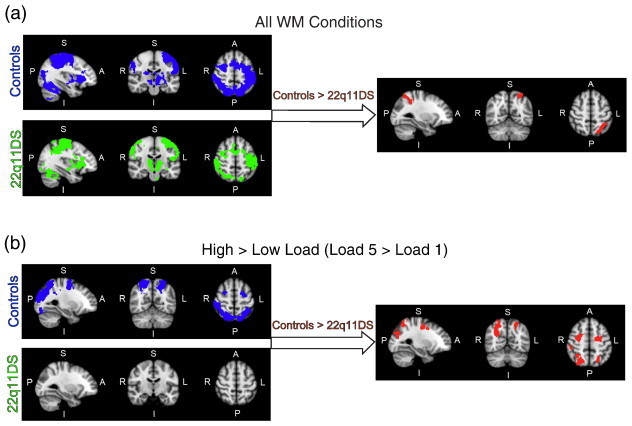
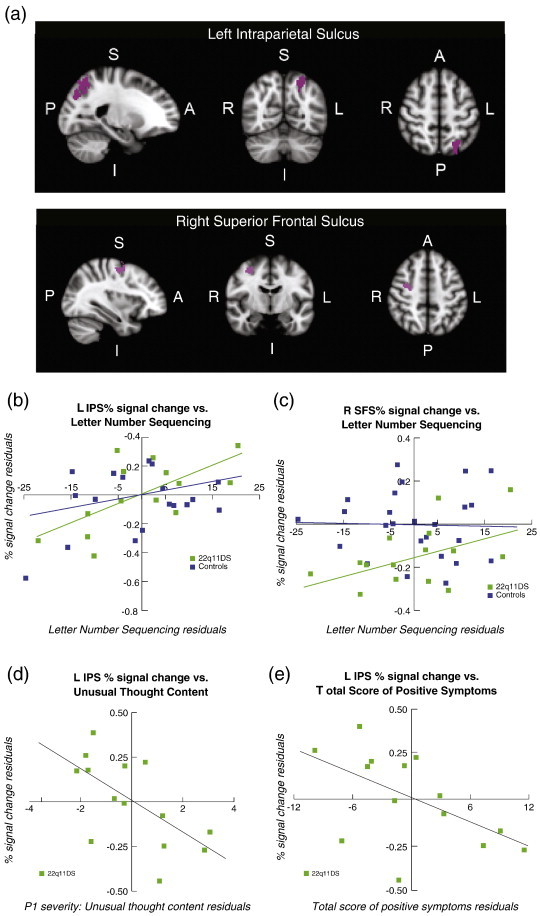
22q11.2 deletion syndrome (22q11DS) is a recurrent genetic mutation that is highly penetrant for psychosis. Behavioral research suggests that 22q11DS patients exhibit a characteristic neurocognitive phenotype that includes differential impairment in spatial working memory (WM). Notably, spatial WM has also been proposed as an endophenotype for idiopathic psychotic disorder, yet little is known about the neurobiological substrates of WM in 22q11DS. In order to investigate the neural systems engaged during spatial WM in 22q11DS patients, we collected functional magnetic resonance imaging (fMRI) data while 41 participants (16 22q11DS patients, 25 demographically matched controls) performed a spatial capacity WM task that included manipulations of delay length and load level. Relative to controls, 22q11DS patients showed reduced neural activation during task performance in the intraparietal sulcus (IPS) and superior frontal sulcus (SFS). In addition, the typical increases in neural activity within spatial WM-relevant regions with greater memory load were not observed in 22q11DS. We further investigated whether neural dysfunction during WM was associated with behavioral WM performance, assessed via the University of Maryland letter-number sequencing (LNS) task, and positive psychotic symptoms, assessed via the Structured Interview for Prodromal Syndromes (SIPS), in 22q11DS patients. WM load activity within IPS and SFS was positively correlated with LNS task performance; moreover, WM load activity within IPS was inversely correlated with the severity of unusual thought content and delusional ideas, indicating that decreased recruitment of working memory-associated neural circuitry is associated with more severe positive symptoms. These results suggest that 22q11DS patients show reduced neural recruitment of brain regions critical for spatial WM function, which may be related to characteristic behavioral manifestations of the disorder.
22q11.2缺失综合征(22q11DS)是一种反复出现的基因突变,对精神病具有高度的外显率。行为研究表明,22q11DS患者表现出一种特征性的神经认知表型,包括空间工作记忆(WM)的差异损伤。值得注意的是,空间WM也被认为是特发性精神病性障碍的一种内表型,但对于22q11DS中WM的神经生物学基础知之甚少。为了研究22q11DS患者在空间WM过程中参与的神经系统,我们收集了功能磁共振成像(fMRI)数据,当时41名参与者(16名22q11DS患者,25名人口统计学匹配的对照)执行了一项空间容量WM任务,该任务包括对延迟长度和负荷水平的操作。相对于对照组,22q11DS患者在顶内沟(IPS)和额上沟(SFS)的任务执行过程中神经激活减少。此外,在22q11DS中未观察到随着记忆负荷增加,空间WM相关区域内神经活动的典型增加。我们进一步研究了WM期间的神经功能障碍是否与行为WM表现相关,通过马里兰大学字母数字排序(LNS)任务进行评估,以及与22q11DS患者的阳性精神病性症状相关,通过前驱综合征结构化访谈(SIPS)进行评估。IPS和SFS内的WM负荷活动与LNS任务表现呈正相关;此外,IPS内的WM负荷活动与异常思维内容和妄想观念的严重程度呈负相关,表明工作记忆相关神经回路的募集减少与更严重的阳性症状相关。这些结果表明,22q11DS患者对空间WM功能至关重要的脑区神经募集减少,这可能与该疾病的特征性行为表现有关。