Li Yue, Modis Yorgo
Department of Molecular Biophysics and Biochemistry, Yale University, 266 Whitney Avenue, New Haven, CT 06520, USA.
Department of Molecular Biophysics and Biochemistry, Yale University, 266 Whitney Avenue, New Haven, CT 06520, USA.
Trends Microbiol. 2014 Apr;22(4):176-82. doi: 10.1016/j.tim.2014.01.008. Epub 2014 Feb 23.
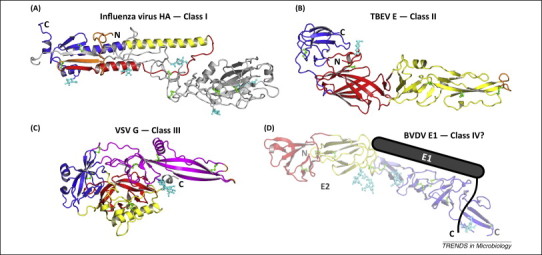
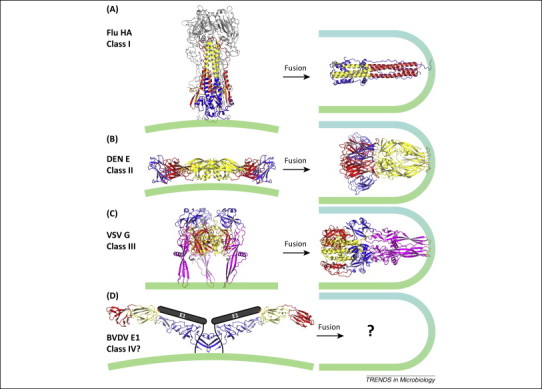
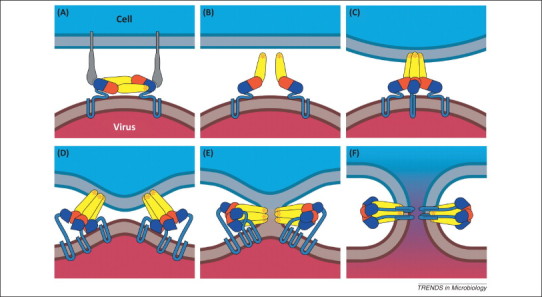
Enveloped viruses must fuse their lipid membrane to a cellular membrane to deliver their genome into the cytoplasm for replication. Viral envelope proteins catalyze this critical membrane fusion event. They fall into three distinct structural classes. In 2013, envelope proteins from a pestivirus and hepatitis C virus were found to have two distinct novel folds. This was unexpected because these viruses are in the same family as flaviviruses, which have class II fusion proteins. We propose that the membrane fusion machinery of the closely related pestiviruses and hepatitis C virus defines a new structural class. This and other recently identified structural relationships between viral fusion proteins shift the paradigm for how these proteins evolved.
包膜病毒必须将其脂质膜与细胞膜融合,以将其基因组传递到细胞质中进行复制。病毒包膜蛋白催化这一关键的膜融合事件。它们分为三个不同的结构类别。2013年,发现瘟病毒和丙型肝炎病毒的包膜蛋白具有两种不同的新型折叠结构。这出乎意料,因为这些病毒与具有II类融合蛋白的黄病毒属于同一科。我们提出,密切相关的瘟病毒和丙型肝炎病毒的膜融合机制定义了一个新的结构类别。病毒融合蛋白之间的这种以及其他最近确定的结构关系改变了这些蛋白进化方式的范例。