Ruggiero Laurie, Riley Barth B, Hernandez Rosalba, Quinn Lauretta T, Gerber Ben S, Castillo Amparo, Day Joseph, Ingram Diana, Wang Yamin, Butler Paula
University of Illinois at Chicago, USA
University of Illinois at Chicago, USA.
West J Nurs Res. 2014 Oct;36(9):1052-73. doi: 10.1177/0193945914522862. Epub 2014 Feb 25.
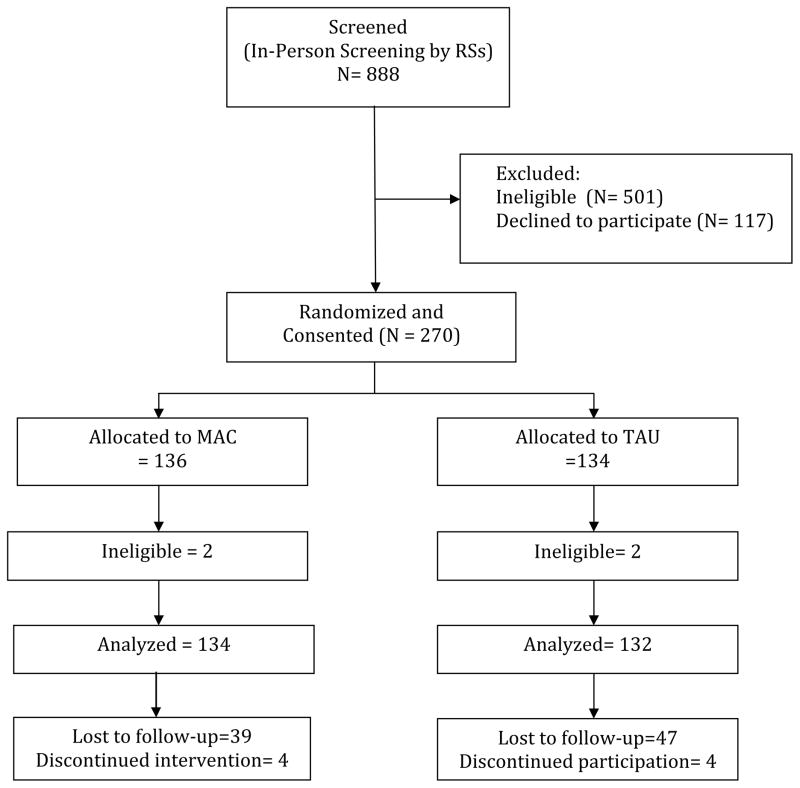
Innovative, culturally tailored strategies are needed to extend diabetes education and support efforts in lower-resourced primary care practices serving racial/ethnic minority groups. A randomized controlled trial (RCT) examined the effect of a diabetes self-care coaching intervention delivered by medical assistants and the joint effect of intervention and ethnicity over time. The randomized repeated-measures design included 270 low-income African American and Hispanic/Latino patients with type 2 diabetes. The 1-year clinic- and telephone-based medical assistant coaching intervention was culturally tailored and guided by theoretical frameworks. A1C was obtained, and a self-care measure was completed at baseline, 6 months, and 12 months. Data were analyzed using mixed-effects models with and without adjustment for covariates. There was a significant overall improvement in mean self-care scores across time, but no intervention effect. Results revealed differences in self-care patterns across racial/ethnic subgroups. No differences were found for A1C levels across time or group.
需要创新的、符合文化特点的策略,以在为种族/族裔少数群体服务的资源较少的初级保健机构中扩大糖尿病教育及支持工作。一项随机对照试验(RCT)研究了由医疗助理提供的糖尿病自我护理指导干预的效果,以及干预和种族随时间的联合效应。随机重复测量设计纳入了270名患有2型糖尿病的低收入非裔美国人和西班牙裔/拉丁裔患者。为期1年的基于诊所和电话的医疗助理指导干预是根据文化特点制定的,并以理论框架为指导。在基线、6个月和12个月时获取糖化血红蛋白(A1C),并完成一项自我护理测量。使用混合效应模型对数据进行分析,分析时对协变量进行了调整和未调整。随时间推移,平均自我护理得分总体上有显著改善,但没有干预效果。结果显示不同种族/族裔亚组的自我护理模式存在差异。不同时间或组间的A1C水平没有差异。