Porro Laura B, Ross Callum F, Iriarte-Diaz Jose, O'Reilly James C, Evans Susan E, Fagan Michael J
Department of Organismal Biology and Anatomy, University of Chicago, 1027 East 57th Street, Chicago, IL 60637, USA School of Earth Sciences, University of Bristol, Wills Memorial Building, Queen's Road, Bristol BS8 1RJ, UK
Department of Organismal Biology and Anatomy, University of Chicago, 1027 East 57th Street, Chicago, IL 60637, USA.
J Exp Biol. 2014 Jun 1;217(Pt 11):1983-92. doi: 10.1242/jeb.096362. Epub 2014 Feb 27.
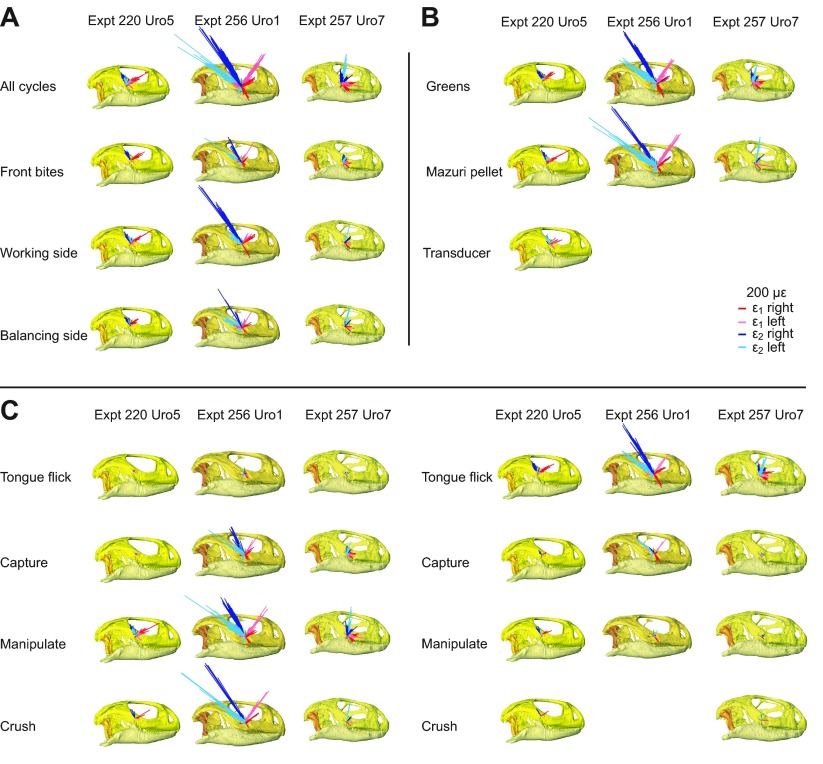
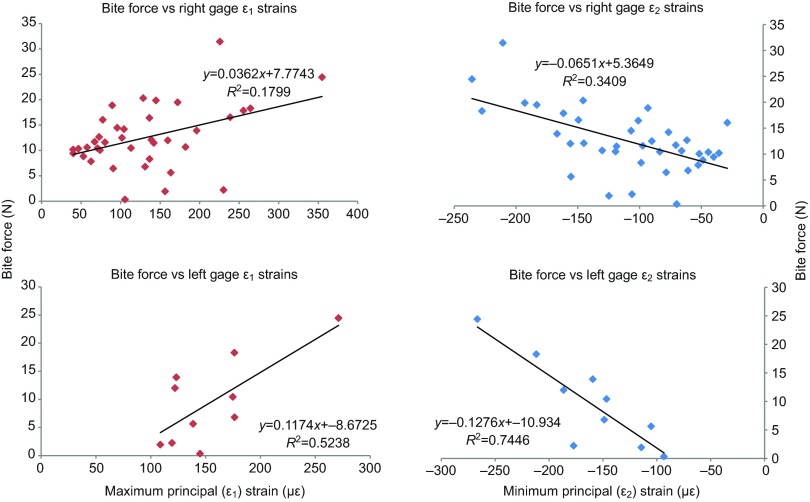
In vivo bone strain data are the most direct evidence of deformation and strain regimes in the vertebrate cranium during feeding and can provide important insights into skull morphology. Strain data have been collected during feeding across a wide range of mammals; in contrast, in vivo cranial bone strain data have been collected from few sauropsid taxa. Here we present bone strain data recorded from the jugal of the herbivorous agamid lizard Uromastyx geyri along with simultaneously recorded bite force. Principal and shear strain magnitudes in Uromastyx geyri were lower than cranial bone strains recorded in Alligator mississippiensis, but higher than those reported from herbivorous mammals. Our results suggest that variations in principal strain orientations in the facial skeleton are largely due to differences in feeding behavior and bite location, whereas food type has little impact on strain orientations. Furthermore, mean principal strain orientations differ between male and female Uromastyx during feeding, potentially because of sexual dimorphism in skull morphology.
体内骨应变数据是脊椎动物颅骨在进食过程中变形和应变状态的最直接证据,能够为头骨形态提供重要见解。已经在广泛的哺乳动物进食过程中收集了应变数据;相比之下,从少数蜥形类群中收集到了体内颅骨骨应变数据。在此,我们展示了从草食性鬣蜥属蜥蜴盖氏王者蜥的颧骨记录的骨应变数据以及同时记录的咬合力。盖氏王者蜥的主应变和剪应变大小低于密西西比鳄记录的颅骨应变,但高于从草食性哺乳动物报告的应变。我们的结果表明,面部骨骼主应变方向的变化很大程度上是由于进食行为和咬击位置的差异,而食物类型对应变方向影响很小。此外,盖氏王者蜥雌雄个体在进食期间的平均主应变方向不同,这可能是由于头骨形态的两性异形。