Hibar Derrek P, Medland Sarah E, Stein Jason L, Kim Sungeun, Shen Li, Saykin Andrew J, de Zubicaray Greig I, McMahon Katie L, Montgomery Grant W, Martin Nicholas G, Wright Margaret J, Djurovic Srdjan, Agartz Ingrid A, Andreassen Ole A, Thompson Paul M
Imaging Genetics Center, Laboratory of Neuro Imaging, UCLA School of Medicine, Los Angeles, CA, USA.
Queensland Institute of Medical Research, Brisbane, Australia.
Med Image Comput Comput Assist Interv. 2013;16(Pt 2):690-7. doi: 10.1007/978-3-642-40763-5_85.
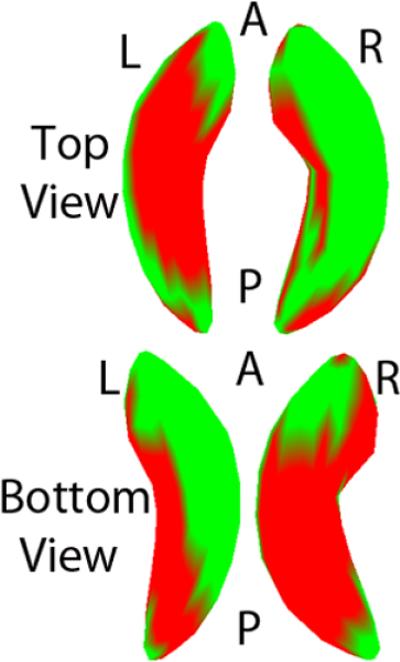
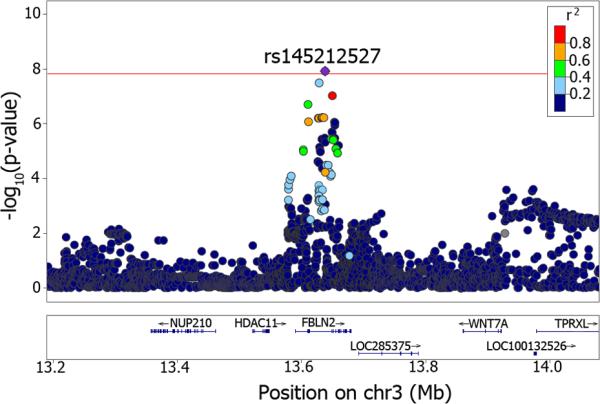
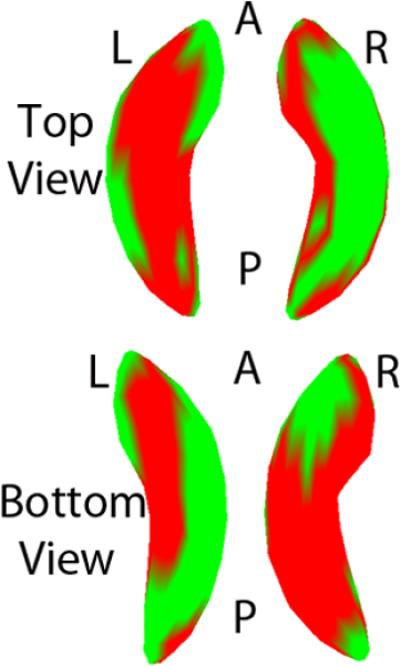
Imaging genetics aims to discover how variants in the human genome influence brain measures derived from images. Genome-wide association scans (GWAS) can screen the genome for common differences in our DNA that relate to brain measures. In small samples, GWAS has low power as individual gene effects are weak and one must also correct for multiple comparisons across the genome and the image. Here we extend recent work on genetic clustering of images, to analyze surface-based models of anatomy using GWAS. We performed spherical harmonic analysis of hippocampal surfaces, automatically extracted from brain MRI scans of 1254 subjects. We clustered hippocampal surface regions with common genetic influences by examining genetic correlations (r(g)) between the normalized deformation values at all pairs of surface points. Using genetic correlations to cluster surface measures, we were able to boost effect sizes for genetic associations, compared to clustering with traditional phenotypic correlations using Pearson's r.
影像遗传学旨在发现人类基因组中的变异如何影响从图像中得出的大脑测量值。全基因组关联扫描(GWAS)可以在基因组中筛查与大脑测量值相关的DNA常见差异。在小样本中,GWAS的效能较低,因为单个基因效应较弱,而且还必须对整个基因组和图像进行多重比较校正。在此,我们扩展了近期关于图像遗传聚类的研究工作,以使用GWAS分析基于表面的解剖模型。我们对从1254名受试者的脑部MRI扫描中自动提取的海马表面进行了球谐分析。我们通过检查所有表面点对处归一化变形值之间的遗传相关性(r(g)),对具有共同遗传影响的海马表面区域进行聚类。与使用皮尔逊相关系数的传统表型相关性进行聚类相比,利用遗传相关性对表面测量值进行聚类,我们能够提高遗传关联的效应大小。