Carrick David, Oldroyd Keith G, McEntegart Margaret, Haig Caroline, Petrie Mark C, Eteiba Hany, Hood Stuart, Owens Colum, Watkins Stuart, Layland Jamie, Lindsay Mitchell, Peat Eileen, Rae Alan, Behan Miles, Sood Arvind, Hillis W Stewart, Mordi Ify, Mahrous Ahmed, Ahmed Nadeem, Wilson Rebekah, Lasalle Laura, Généreux Philippe, Ford Ian, Berry Colin
BHF Glasgow Cardiovascular Research Center, Institute of Cardiovascular and Medical Sciences, University of Glasgow, Glasgow, United Kingdom; West of Scotland Heart and Lung Center, Golden Jubilee National Hospital, Dunbartonshire, United Kingdom.
BHF Glasgow Cardiovascular Research Center, Institute of Cardiovascular and Medical Sciences, University of Glasgow, Glasgow, United Kingdom.
J Am Coll Cardiol. 2014 May 27;63(20):2088-2098. doi: 10.1016/j.jacc.2014.02.530. Epub 2014 Feb 27.
The aim of this study was to assess whether deferred stenting might reduce no-reflow and salvage myocardium in primary percutaneous coronary intervention (PCI) for ST-segment elevation myocardial infarction (STEMI).
No-reflow is associated with adverse outcomes in STEMI.
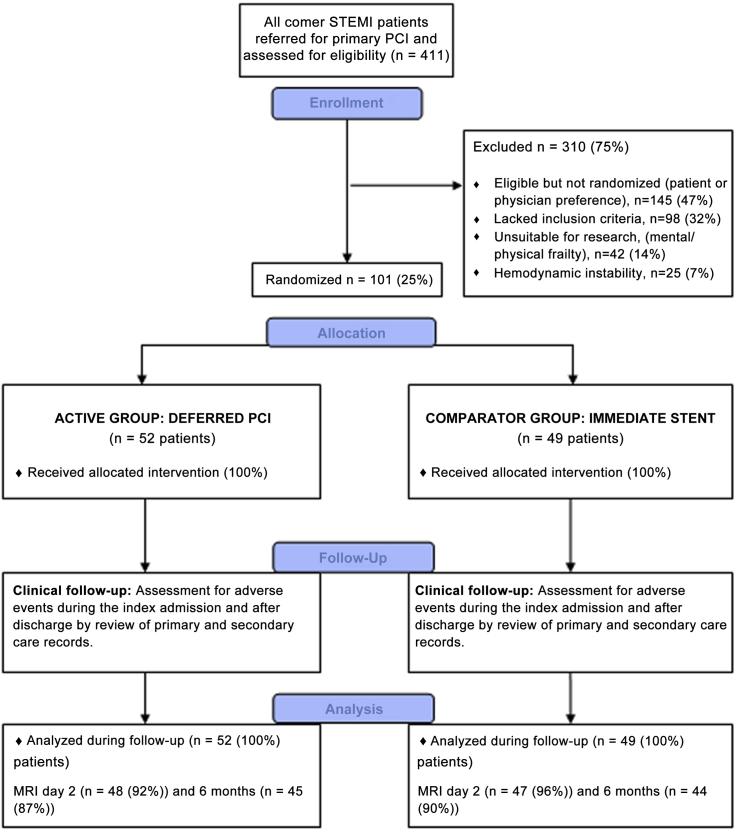
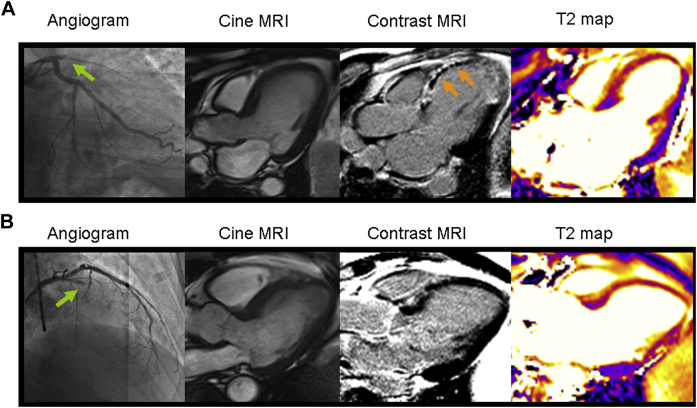
This was a prospective, single-center, randomized, controlled, proof-of-concept trial in reperfused STEMI patients with ≥1 risk factors for no-reflow. Randomization was to deferred stenting with an intention-to-stent 4 to 16 h later or conventional treatment with immediate stenting. The primary outcome was the incidence of no-/slow-reflow (Thrombolysis In Myocardial Infarction ≤2). Cardiac magnetic resonance imaging was performed 2 days and 6 months after myocardial infarction. Myocardial salvage was the final infarct size indexed to the initial area at risk.
Of 411 STEMI patients (March 11, 2012 to November 21, 2012), 101 patients (mean age, 60 years; 69% male) were randomized (52 to the deferred stenting group, 49 to the immediate stenting). The median (interquartile range [IQR]) time to the second procedure in the deferred stenting group was 9 h (IQR: 6 to 12 h). Fewer patients in the deferred stenting group had no-/slow-reflow (14 [29%] vs. 3 [6%]; p = 0.006), no reflow (7 [14%] vs. 1 [2%]; p = 0.052) and intraprocedural thrombotic events (16 [33%] vs. 5 [10%]; p = 0.010). Thrombolysis In Myocardial Infarction coronary flow grades at the end of PCI were higher in the deferred stenting group (p = 0.018). Recurrent STEMI occurred in 2 patients in the deferred stenting group before the second procedure. Myocardial salvage index at 6 months was greater in the deferred stenting group (68 [IQR: 54% to 82%] vs. 56 [IQR: 31% to 72%]; p = 0.031].
In high-risk STEMI patients, deferred stenting in primary PCI reduced no-reflow and increased myocardial salvage. (Deferred Stent Trial in STEMI; NCT01717573).
本研究旨在评估在ST段抬高型心肌梗死(STEMI)的直接经皮冠状动脉介入治疗(PCI)中,延迟支架置入是否可减少无复流现象并挽救心肌。
无复流现象与STEMI的不良预后相关。
这是一项前瞻性、单中心、随机、对照、概念验证试验,纳入有≥1项无复流危险因素的再灌注STEMI患者。随机分为延迟支架置入组(计划在4至16小时后置入支架)或传统立即支架置入治疗组。主要结局为无复流/慢复流(心肌梗死溶栓试验血流分级≤2级)的发生率。在心肌梗死后2天和6个月进行心脏磁共振成像检查。心肌挽救率为最终梗死面积与初始危险面积的比值。
在411例STEMI患者(2012年3月11日至2012年11月21日)中,101例患者(平均年龄60岁;69%为男性)被随机分组(52例至延迟支架置入组,49例至立即支架置入组)。延迟支架置入组第二次手术的中位(四分位间距[IQR])时间为9小时(IQR:6至12小时)。延迟支架置入组发生无复流/慢复流的患者较少(14例[29%]对3例[6%];p = 0.006),无复流患者较少(7例[14%]对1例[2%];p = 0.052),术中血栓形成事件较少(16例[33%]对5例[10%];p = 0.010)。PCI结束时,延迟支架置入组的心肌梗死溶栓试验冠状动脉血流分级更高(p = 0.018)。延迟支架置入组有2例患者在第二次手术前发生复发性STEMI。延迟支架置入组6个月时的心肌挽救指数更高(68[IQR:54%至82%]对56[IQR:31%至72%];p = 0.031)。
在高危STEMI患者中,直接PCI中的延迟支架置入可减少无复流现象并增加心肌挽救。(STEMI延迟支架试验;NCT01717573)