Massachusetts Alzheimer Disease Research Center, Charlestown, MA; Department of Neurology, Massachusetts General Hospital, Boston, MA; Department of Neurology, University of Iowa Hospitals & Clinics, Iowa city, IA.
Ann Neurol. 2014 Apr;75(4):597-601. doi: 10.1002/ana.24125. Epub 2014 Apr 8.
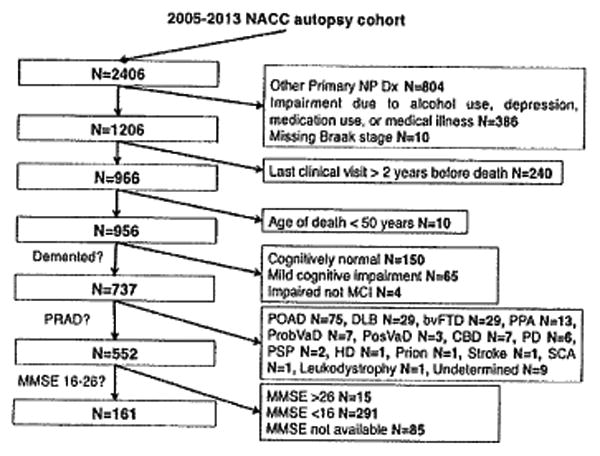
Recently, ~16% of participants in an anti-Aβ passive immunotherapy trial for mild-to-moderate Alzheimer disease (AD) had a negative baseline amyloid positron emission tomography (PET) scan. Whether they have AD or are AD clinical phenocopies remains unknown. We examined the 2005-2013 National Alzheimer's Coordinating Center autopsy database and found that ~14% of autopsied subjects clinically diagnosed with mild-to-moderate probable AD have no or sparse neuritic plaques, which would expectedly yield a negative amyloid PET scan. More than half of these "Aβ-negative" subjects have low neurofibrillary tangle Braak stages. These findings support the implementation of a positive amyloid biomarker as an inclusion criterion in future anti-Aβ drug trials.
最近,轻度至中度阿尔茨海默病(AD)抗 Aβ 被动免疫治疗试验的约 16%参与者基线淀粉样蛋白正电子发射断层扫描(PET)结果为阴性。他们是 AD 患者还是 AD 临床表型仍不清楚。我们研究了 2005-2013 年国家阿尔茨海默病协调中心的尸检数据库,发现约 14%临床诊断为轻度至中度可能 AD 的尸检患者无或少有神经原纤维缠结,这预计会导致淀粉样蛋白 PET 扫描结果为阴性。这些“Aβ 阴性”患者中超过一半的神经纤维缠结 Braak 分期较低。这些发现支持在未来的抗 Aβ 药物试验中实施阳性淀粉样蛋白生物标志物作为纳入标准。