Donnay Gabriel F, Rankin Summer K, Lopez-Gonzalez Monica, Jiradejvong Patpong, Limb Charles J
Department of Otolaryngology-Head and Neck Surgery, Johns Hopkins University School of Medicine, Baltimore, Maryland, United States of America.
PLoS One. 2014 Feb 19;9(2):e88665. doi: 10.1371/journal.pone.0088665. eCollection 2014.
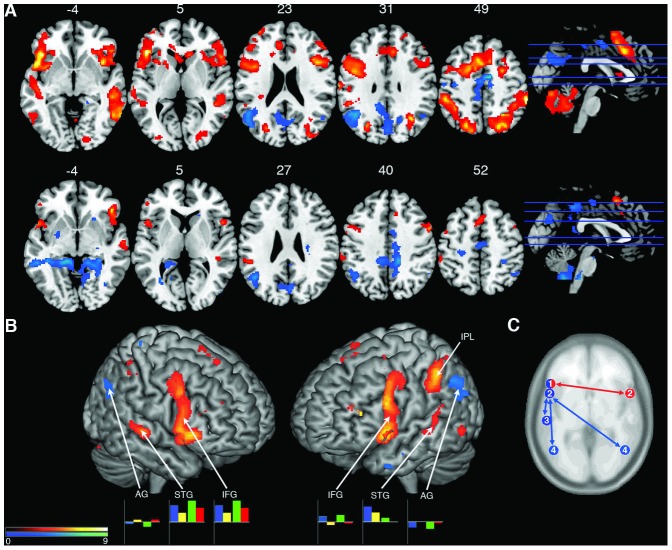
Interactive generative musical performance provides a suitable model for communication because, like natural linguistic discourse, it involves an exchange of ideas that is unpredictable, collaborative, and emergent. Here we show that interactive improvisation between two musicians is characterized by activation of perisylvian language areas linked to processing of syntactic elements in music, including inferior frontal gyrus and posterior superior temporal gyrus, and deactivation of angular gyrus and supramarginal gyrus, brain structures directly implicated in semantic processing of language. These findings support the hypothesis that musical discourse engages language areas of the brain specialized for processing of syntax but in a manner that is not contingent upon semantic processing. Therefore, we argue that neural regions for syntactic processing are not domain-specific for language but instead may be domain-general for communication.
交互式生成音乐表演为交流提供了一个合适的模型,因为与自然语言话语一样,它涉及不可预测、协作且突发的思想交流。在这里,我们表明两位音乐家之间的交互式即兴创作的特点是,与音乐句法元素处理相关的颞周语言区域被激活,包括额下回和颞上回后部,而角回和缘上回失活,这两个脑结构直接参与语言的语义处理。这些发现支持了这样一种假设,即音乐话语会激活大脑中专门用于句法处理的语言区域,但方式并非取决于语义处理。因此,我们认为用于句法处理的神经区域并非语言特有的,而是可能在交流方面具有通用性。