Division of Cardiovascular Medicine, National Cerebral and Cardiovascular Center, Suita City, Osaka, Japan.
Division of Hypertension and Nephrology, National Cerebral and Cardiovascular Center, Suita City, Osaka, Japan.
PLoS One. 2014 Feb 19;9(2):e89057. doi: 10.1371/journal.pone.0089057. eCollection 2014.
Intensive as compared to mild statin therapy has been proven to be superior in improving cardiovascular outcome, whereas the effects of intensive statin therapy on inflammation and lipoprotein biomarkers are not well defined.
This study assigned essential hypertensive patients with dyslipidemia to 6 months administration of mild (1 mg/day, n = 34) or intensive pitavastatin therapy (4 mg/day, n = 29), and various lipid and inflammation biomarkers were measured at baseline, and 3 and 6 months after the start of treatment.
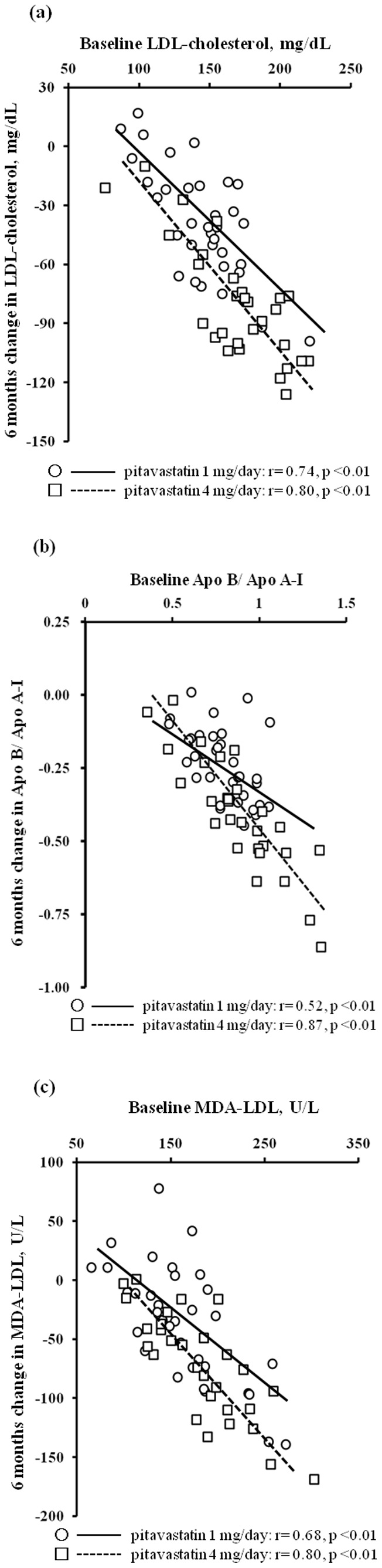
Both pitavastatin doses were well tolerated, and there were no serious treatment-related adverse events. After 6 months, significant improvements in total cholesterol, triglycerides, low-density lipoprotein (LDL-) cholesterol, LDL/high-density lipoprotein cholesterol (LDL/HDL), apolipoproteins B, C-II, and E, apolipoprotein-B/apolipoprotein-A-I (Apo B/Apo A-I), and malondialdehyde (MDA-) LDL were observed in both groups. Compared with the mild pitavastatin group, the intensive pitavastatin therapy showed significantly greater decreases in C reactive protein (F = 3.76, p<0.05), total cholesterol (F = 10.65), LDL-cholesterol (F = 23.37), LDL/HDL (F = 12.34), apolipoproteins B (F = 19.07) and E (F = 6.49), Apo B/Apo A-I (F = 13.26), and MDA-LDL (F = 5.76) (p<0.01, respectively).
Intensive pitavastatin therapy may have a more favorable effect not only in decreasing LDL-cholesterol but also in pleiotropic benefits in terms of improvement of apolipoproteins, inflammation, or oxidation.
与轻度他汀类药物治疗相比,强化他汀类药物治疗已被证明可改善心血管结局,但强化他汀类药物治疗对炎症和脂蛋白生物标志物的影响尚不清楚。
本研究将血脂异常的原发性高血压患者随机分为 6 个月的轻度(1mg/天,n=34)或强化(4mg/天,n=29)匹伐他汀治疗组,并在基线、治疗开始后 3 个月和 6 个月时测量各种血脂和炎症生物标志物。
两种剂量的匹伐他汀均耐受良好,无严重与治疗相关的不良事件。6 个月后,两组患者的总胆固醇、三酰甘油、低密度脂蛋白(LDL)-胆固醇、LDL/高密度脂蛋白胆固醇(LDL/HDL)、载脂蛋白 B、C-II 和 E、载脂蛋白 B/载脂蛋白 A-I(Apo B/Apo A-I)和丙二醛(MDA)-LDL 均显著改善。与轻度匹伐他汀组相比,强化匹伐他汀治疗组 C 反应蛋白(F=3.76,p<0.05)、总胆固醇(F=10.65)、LDL-胆固醇(F=23.37)、LDL/HDL(F=12.34)、载脂蛋白 B(F=19.07)和 E(F=6.49)、Apo B/Apo A-I(F=13.26)和 MDA-LDL(F=5.76)降低更显著(p<0.01)。
强化匹伐他汀治疗不仅可更有效地降低 LDL-胆固醇,而且在改善载脂蛋白、炎症或氧化方面具有更有利的多效性益处。