Li Anzhang, Shao Zongze
School of Life Sciences, Xiamen University, Xiamen, China ; Key Laboratory of Marine Biogenetic Resources-State Key Laboratory Breeding Base, Third Institute of Oceanography, State Oceanic Administration, Collaborative Innovation Center of Deep Sea Biology; Key Laboratory of Marine Biogenetic Resources of Fujian Province, Xiamen, China.
Key Laboratory of Marine Biogenetic Resources-State Key Laboratory Breeding Base, Third Institute of Oceanography, State Oceanic Administration, Collaborative Innovation Center of Deep Sea Biology; Key Laboratory of Marine Biogenetic Resources of Fujian Province, Xiamen, China.
PLoS One. 2014 Feb 28;9(2):e89144. doi: 10.1371/journal.pone.0089144. eCollection 2014.
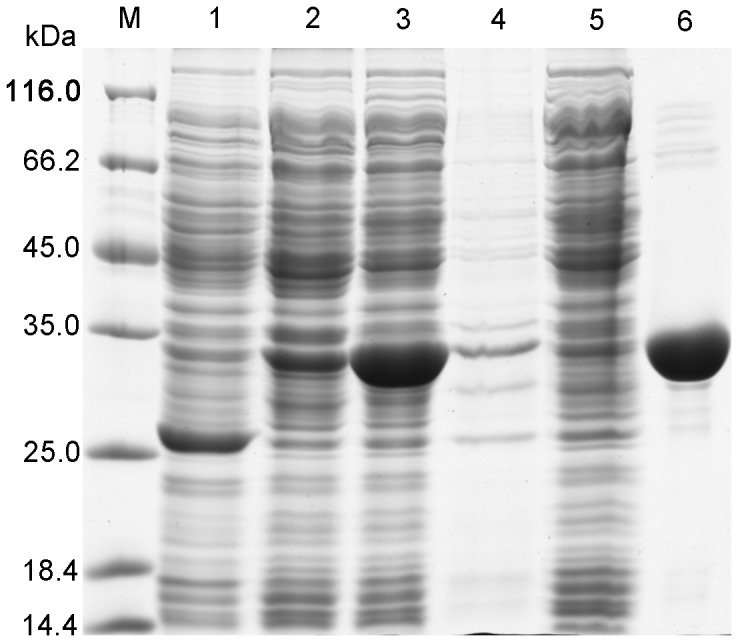
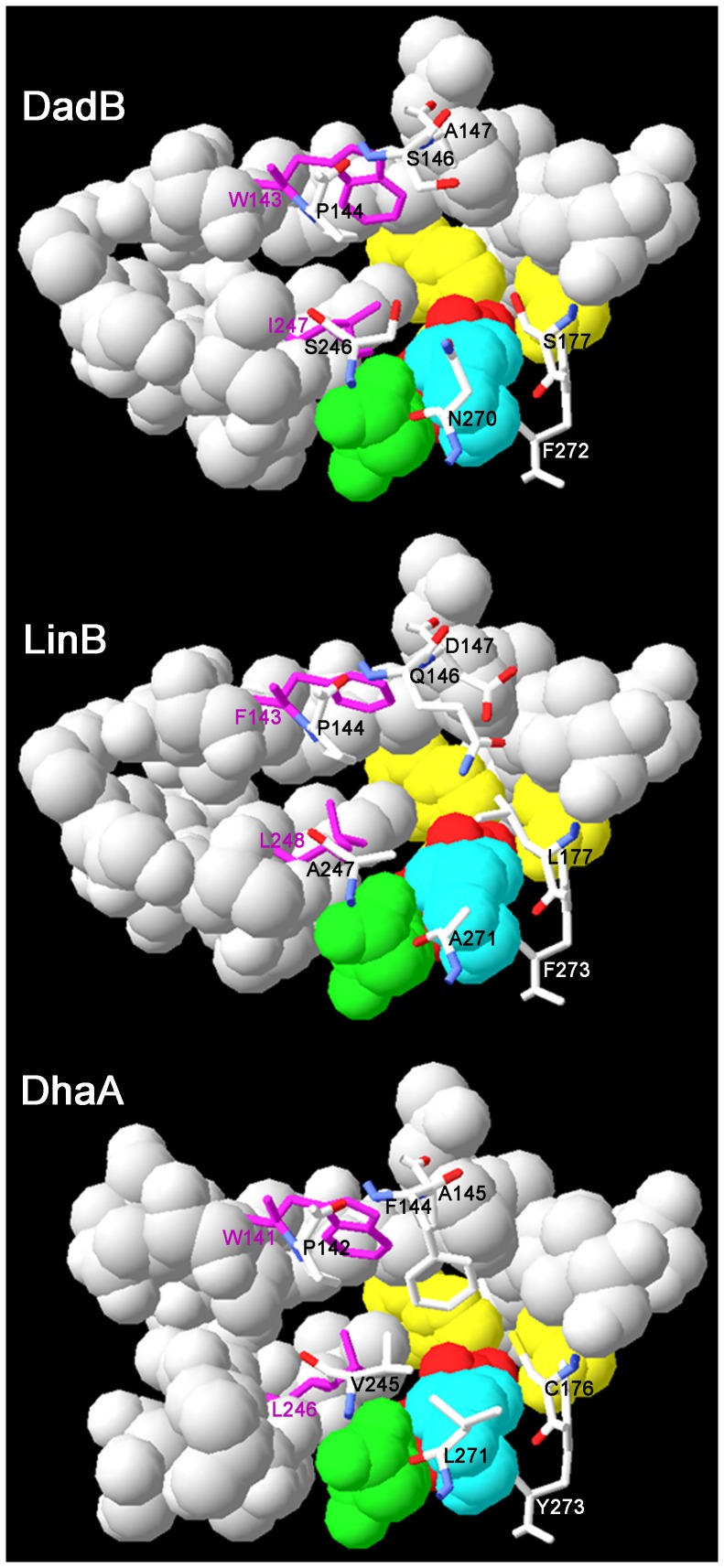
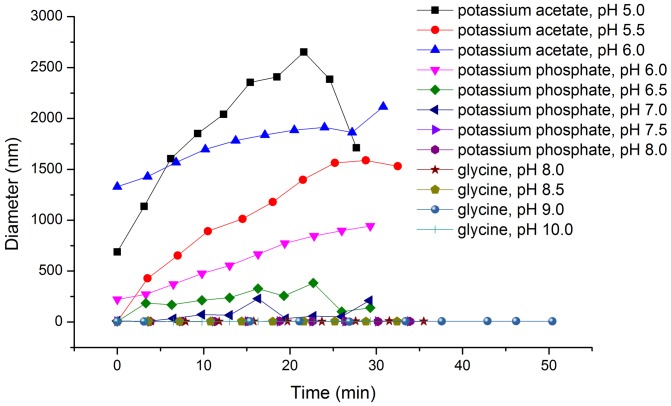
Recently, we found that Alcanivorax bacteria from various marine environments were capable of degrading halogenated alkanes. Genome sequencing of A. dieselolei B-5 revealed two putative haloalkane dehalogenase (HLD) genes, which were supposed to be involved in degradation of halogenated compounds. In this report, we confirm for the first time that the Alcanivorax bacterium encodes a truly functional HLD named DadB. An activity assay with 46 halogenated substrates indicated that DadB possesses broad substrate range and has the highest overall activity among the identified HLDs. DadB prefers brominated substrates; chlorinated alkenes; and the C2-C3 substrates, including the persistent pollutants of 1,2-dichloroethane, 1,2-dichloropropane and 1,2,3-trichloropropane. As DadB displays no detectable activity toward long-chain haloalkanes such as 1-chlorohexadecane and 1-chlorooctadecane, the degradation of them in A. dieselolei B-5 might be attributed to other enzymes. Kinetic constants were determined with 6 substrates. DadB has highest affinity and largest k cat/K m value toward 1,3-dibromopropane (K(m) = 0.82 mM, k(cat)/K(m) = 16.43 mM(-1) · s(-1)). DadB aggregates fast in the buffers with pH ≤ 7.0, while keeps stable in monomer form when pH ≥ 7.5. According to homology modeling, DadB has an open active cavity with a large access tunnel, which is supposed important for larger molecules as opposed to C2-C3 substrates. Combined with the results for other HLDs, we deduce that residue I247 plays an important role in substrate selection. These results suggest that DadB and its host, A. dieselolei B-5, are of potential use for biocatalysis and bioremediation applications.
最近,我们发现来自不同海洋环境的食烷菌属细菌能够降解卤代烷烃。柴油食烷菌B-5的基因组测序揭示了两个假定的卤代烷脱卤酶(HLD)基因,推测它们参与卤代化合物的降解。在本报告中,我们首次证实食烷菌属细菌编码一种真正具有功能的HLD,命名为DadB。对46种卤代底物进行的活性测定表明,DadB具有广泛的底物范围,并且在已鉴定的HLD中具有最高的总体活性。DadB更倾向于溴化底物、氯化烯烃以及C2 - C3底物,包括持久性污染物1,2 - 二氯乙烷、1,2 - 二氯丙烷和1,2,3 - 三氯丙烷。由于DadB对长链卤代烷烃如1 - 氯十六烷和1 - 氯十八烷没有可检测到的活性,柴油食烷菌B-5中它们的降解可能归因于其他酶。用6种底物测定了动力学常数。DadB对1,3 - 二溴丙烷具有最高的亲和力和最大的kcat/Km值(K(m) = 0.82 mM,k(cat)/K(m) = 16.43 mM(-1)·s(-1))。DadB在pH≤7.0的缓冲液中快速聚集,而在pH≥7.5时以单体形式保持稳定。根据同源建模,DadB具有一个开放的活性腔和一个大的进入通道,这对于较大分子(与C2 - C3底物相对)而言应该很重要。结合其他HLD的结果,我们推断残基I247在底物选择中起重要作用。这些结果表明,DadB及其宿主柴油食烷菌B-5在生物催化和生物修复应用中具有潜在用途。