Xu Fei, Chen Gang, Stevens Katherine, Zhou HaiRong, Qi ShengXiang, Wang ZhiYong, Hong Xin, Chen XuPeng, Yang HuaFeng, Wang ChenChen, Ratcliffe Julie
Department of Non-communicable Disease Prevention, Nanjing Municipal Center for Disease Control and Prevention, Nanjing, China ; The School of Public Health, Nanjing Medical University, Nanjing, China.
Flinders Health Economics Group, Flinders University, Adelaide, Australia.
PLoS One. 2014 Feb 20;9(2):e89222. doi: 10.1371/journal.pone.0089222. eCollection 2014.
The Child Health Utility 9D (CHU9D), a new generic preference-based health-related quality of life (HRQoL) instrument, has been validated for use in young people in both the UK and Australia. The main objectives of this study were to examine the feasibility of using a Chinese version of the CHU9D (CHU9D-CHN) to assess HRQoL and to investigate the association of physical activity, homework hours and sleep duration with HRQoL in children and adolescents in Mainland China.
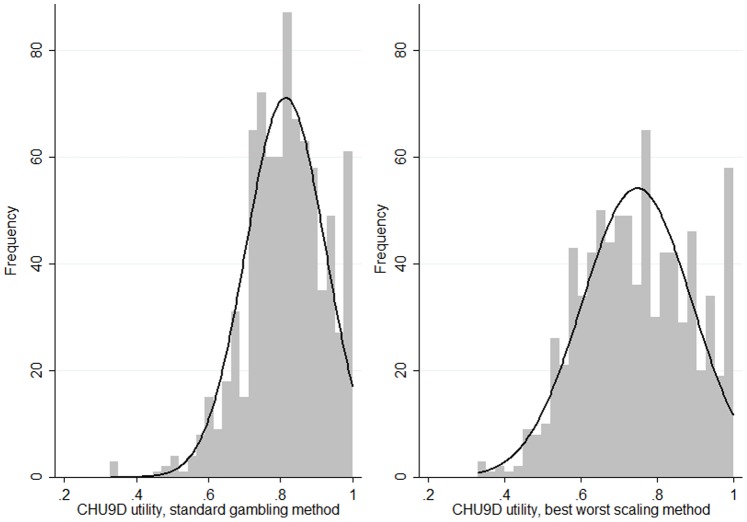
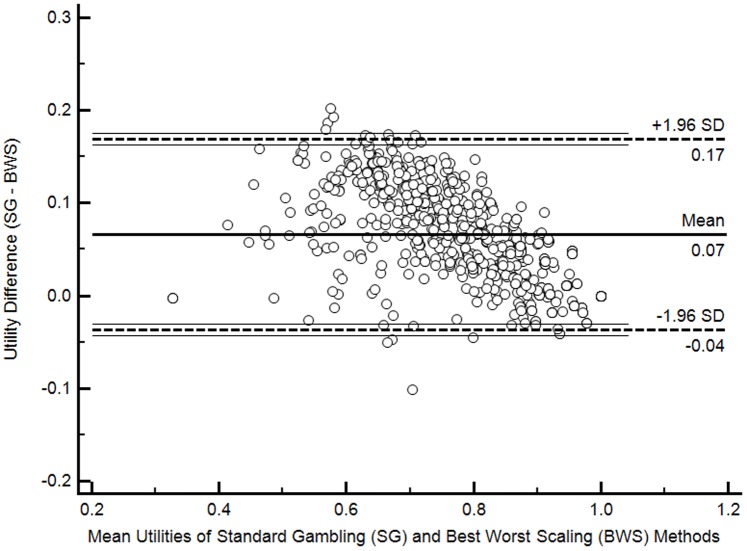
Data were collected using a multi-stage sampling method from grades 4-12 students in May 2013 in Nanjing, China. Consenting participants (N = 815) completed a self-administered questionnaire including the CHU9D-CHN instrument and information on physical activity, homework and sleep duration, self-reported health status, and socio-demographic characteristics. Descriptive and multivariate linear regression analyses were undertaken. CHU9D-CHN utility scores were generated by employing two scoring algorithms currently available for the instrument, the first derived from UK adults utilising the standard gamble (SG) valuation method and the second derived from Australian adolescents utilising the best-worst scaling (BWS) method.
It was found that CHU9D utility scores discriminated well in relation to self-reported health status and that better health status was significantly associated with higher utility scores regardless of which scoring algorithm was employed (both p<0.001). The adjusted mean utilities were significantly higher for physically active than inactive students (0.023 by SG, 0.029 by BWS scoring methods, p<0.05). An additional hour of doing homework and sleep duration were, separately, associated with mean utilities of -0.019 and 0.032 based on SG, and -0.021 and 0.040 according to BWS scoring algorithms (p<0.01).
The CHU9D-CHN shows promise for measuring and valuing the HRQoL of children and adolescents in China. Levels of self-reported physical activity, homework and sleep time were important influencers of utility scores.
儿童健康效用9D量表(CHU9D)是一种新的基于偏好的通用健康相关生活质量(HRQoL)工具,已在英国和澳大利亚的年轻人中得到验证。本研究的主要目的是检验使用中文版CHU9D(CHU9D-CHN)评估HRQoL的可行性,并调查中国大陆儿童和青少年的体育活动、作业时间和睡眠时间与HRQoL之间的关联。
2013年5月,在中国南京采用多阶段抽样方法从4至12年级学生中收集数据。同意参与的参与者(N = 815)完成了一份自我管理问卷,包括CHU9D-CHN量表以及有关体育活动、作业和睡眠时间、自我报告的健康状况和社会人口学特征的信息。进行了描述性和多变量线性回归分析。CHU9D-CHN效用得分通过使用该量表目前可用的两种评分算法生成,第一种源自英国成年人采用的标准博弈(SG)估值方法,第二种源自澳大利亚青少年采用的最佳-最差标度(BWS)方法。
发现CHU9D效用得分在区分自我报告的健康状况方面表现良好,无论采用哪种评分算法,更好的健康状况都与更高的效用得分显著相关(均p<0.001)。体育活动的学生调整后的平均效用显著高于不活动的学生(SG法为0.023,BWS评分法为0.029,p<0.05)。根据SG法,额外一小时的作业时间和睡眠时间分别与平均效用-0.019和0.032相关,根据BWS评分算法分别为-0.021和0.040(p<0.01)。
CHU9D-CHN在测量和评估中国儿童和青少年的HRQoL方面显示出前景。自我报告的体育活动、作业和睡眠时间水平是效用得分的重要影响因素。