Meque Ivete, Dubé Karine, Feldblum Paul J, Clements Archie C A, Zango Arlinda, Cumbe Fidelina, Chen Pai Lien, Ferro Josefo J, van de Wijgert Janneke H
Universidade Católica de Moçambique/Catholic University of Mozambique (UCM), Centro de Investigação de Doenças Infecciosas/Center for Infectious Disease Research (CIDI), Beira, Mozambique.
FHI 360, Clinical Sciences Unit, Durham, North Carolina, United States of America ; United States Military HIV Research Program (MHRP), Henry M. Jackson Foundation for the Advancement of Military Medicine, Inc. (HJF), Bethesda, Maryland, United States of America.
PLoS One. 2014 Feb 24;9(2):e89705. doi: 10.1371/journal.pone.0089705. eCollection 2014.
To estimate the prevalence, incidence and determinants of herpes simplex type 2 (HSV-2) infection, and associations between HSV-2 and incident HIV infection, among women at higher risk for HIV infection in Beira, Mozambique.
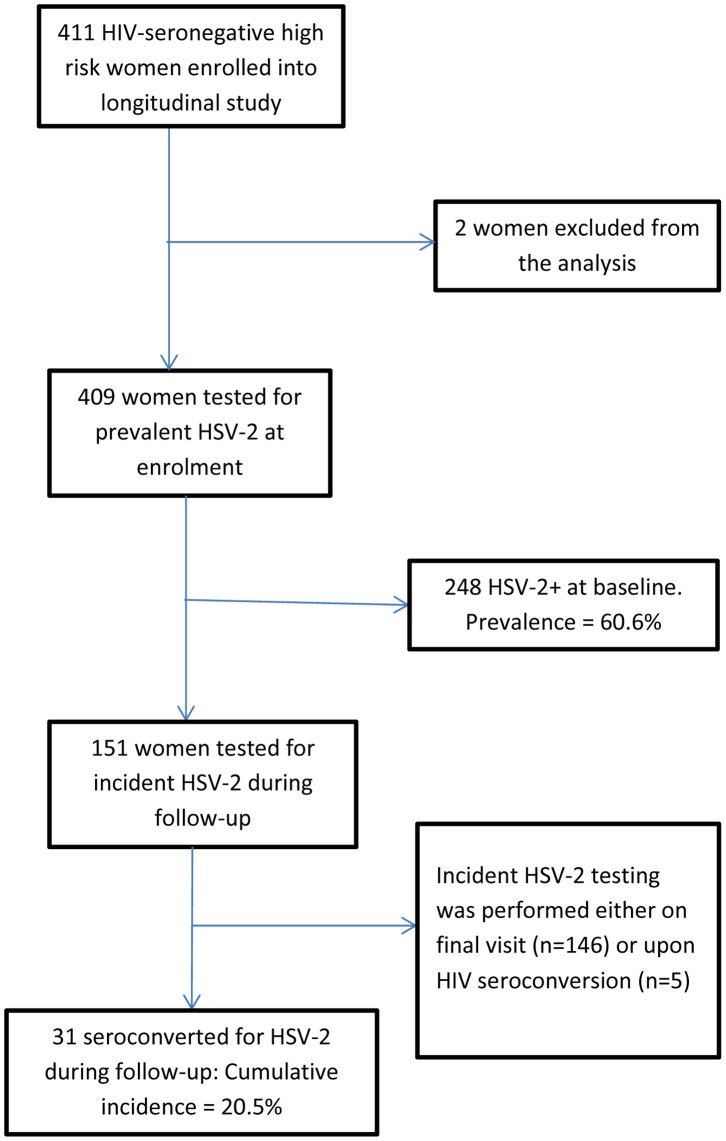
Between 2009 and 2012, 411 women aged 18-35 years at higher risk of HIV acquisition (defined as having had two or more sexual partners in the month prior to study enrollment) were enrolled and followed monthly for one year. At each study visit, they were counseled, interviewed, and tested for HSV-2 and HIV antibodies.
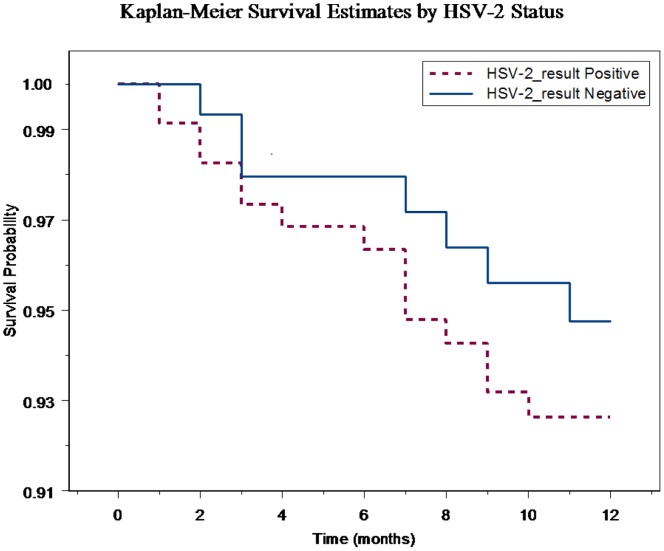
The HSV-2 prevalence at baseline was 60.6% (95% CI: 55.7% -65.4%). Increasing age (aOR = 2.94, 95% CI: 1.74-4.97, P<0.001 and aOR = 3.39, 95% CI: 1.58-7.29, P = 0.002 for age groups of 21-24 and 25-35 years old respectively), lower educational level (aOR = 1.81, 95% CI: 1.09-3.02, P = 0.022), working full time (aOR = 8.56, 95% CI: 1.01-72.53, P = 0.049) and having practiced oral sex (aOR = 3.02, 95% CI: 1.16-7.89, P = 0.024) were strongly associated with prevalent HSV-2 infection. Thirty one participants seroconverted for HSV-2 (20.5%; 95% CI: 14.4% -27.9%) and 22 for HIV during the study period. The frequency of vaginal sex with a casual partner using a condom in the last 7 days was independently associated with incident HSV-2 infection (aOR = 1.91, 95% CI: 1.05-3.47, P = 0.034). Positive HSV-2 serology at baseline was not significantly associated with risk of subsequent HIV seroconversion.
Young women engaging in risky sexual behaviors in Beira had high prevalence and incidence of HSV-2 infection. Improved primary HSV-2 control strategies are urgently needed in Beira.
评估莫桑比克贝拉市感染艾滋病毒风险较高的女性中,2型单纯疱疹病毒(HSV-2)感染的患病率、发病率及决定因素,以及HSV-2与艾滋病毒感染之间的关联。
2009年至2012年期间,招募了411名年龄在18至35岁、感染艾滋病毒风险较高(定义为在研究入组前一个月有两个或更多性伴侣)的女性,并对其进行为期一年的每月随访。在每次研究访视时,对她们进行咨询、访谈,并检测HSV-2和艾滋病毒抗体。
基线时HSV-2患病率为60.6%(95%置信区间:55.7%-65.4%)。年龄增长(21至24岁年龄组的调整后比值比[aOR]=2.94,95%置信区间:1.74-4.97,P<0.001;25至35岁年龄组的aOR=3.39,95%置信区间:1.58-7.29,P=0.002)、教育水平较低(aOR=1.81,95%置信区间:1.09-3.02,P=0.022)、全职工作(aOR=8.56,95%置信区间:1.01-72.53,P=0.049)以及有口交行为(aOR=3.02,95%置信区间:1.16-7.89,P=0.024)与HSV-2感染流行率密切相关。在研究期间,31名参与者HSV-2血清学转换(20.5%;95%置信区间:14.4%-27.9%),22名参与者艾滋病毒血清学转换。过去7天与临时伴侣进行阴道性交时使用避孕套的频率与HSV-2感染发病率独立相关(aOR=1.91,95%置信区间:1.05-3.47,P=0.034)。基线时HSV-2血清学阳性与随后艾滋病毒血清学转换风险无显著关联。
贝拉市有危险性行为的年轻女性HSV-2感染患病率和发病率较高。贝拉市迫切需要改进原发性HSV-2控制策略。