Cieniewicz Brandon, Carpino Nicholas, Krug Laurie T
Molecular and Cellular Biology Program and Department of Molecular Genetics and Microbiology, Stony Brook University, Stony Brook, New York, United States of America.
PLoS One. 2014 Feb 28;9(2):e90196. doi: 10.1371/journal.pone.0090196. eCollection 2014.
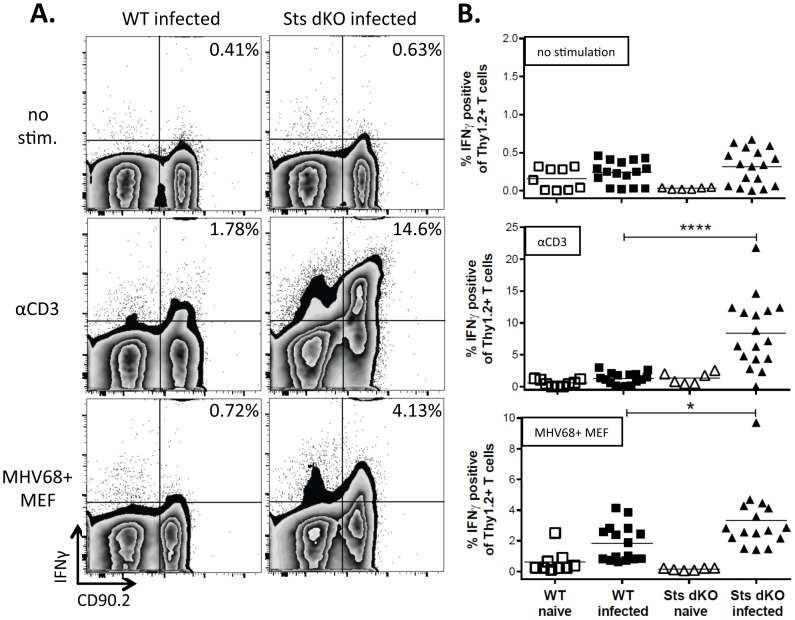
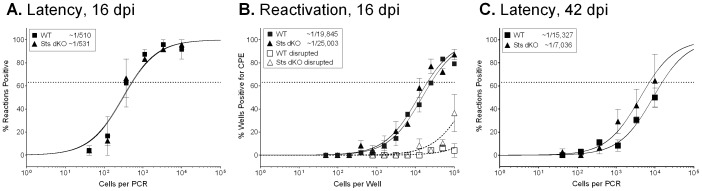
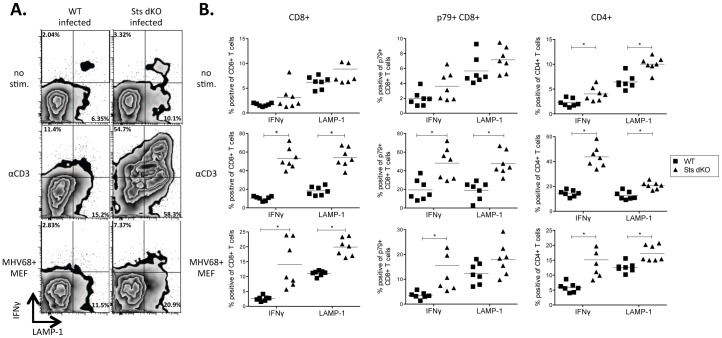
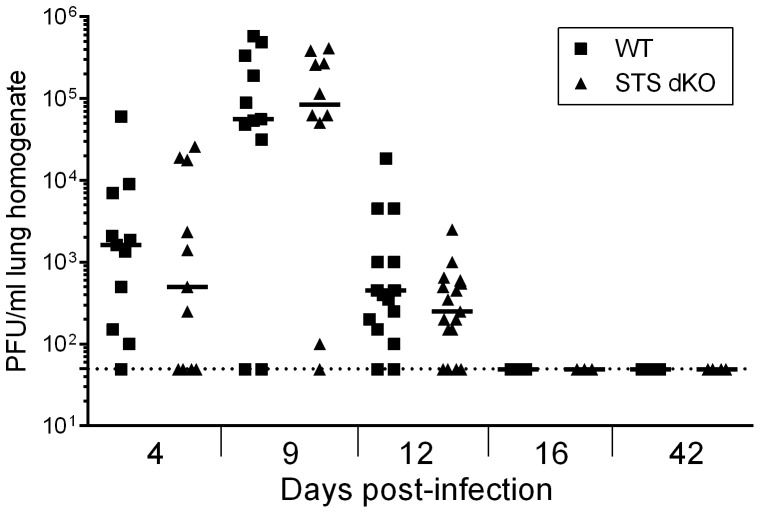
The human gammaherpesviruses establish life-long infections that are associated with the development of lymphomas and neoplasms, especially in immunocompromised individuals. T cells play a crucial role in the control of gammaherpesvirus infection through multiple functions, including the direct killing of infected cells, production of cytokines such as interferon-γ (IFN-γ), and costimulation of B cells. Impaired T cell function in mice infected with murine gammaherpesvirus 68 (MHV68) leads to increased reactivation and pathologies, including a higher incidence of lymphoid hyperplasia. Here we report that the absence of Suppressor of TCR signaling -1 and -2 (Sts-1(-/-)/2(-/-)) during MHV68 infection leads to the generation of T cells with significantly heightened responses. Transient differences in the T and B cell response of infected Sts-1(-/-)/2(-/-) (Sts dKO) mice were also observed when compared to WT mice. However, these alterations in the immune response and the overall absence of Sts-1 and Sts-2 did not impact viral pathogenesis or lead to pathology. Acute lytic replication in the lungs, establishment of latency in the spleen and reactivation from latency in the spleen in the Sts dKO mice were comparable to WT mice. Our studies indicate that Sts-1 and Sts-2 are not required for the immune control of MHV68 in a normal course of gammaherpesvirus infection, but suggest that interference with negative regulators of T cell responses might be further explored as a safe and efficacious strategy to improve adoptive T cell therapy.
人类γ疱疹病毒会引发终身感染,这与淋巴瘤和肿瘤的发生有关,尤其是在免疫功能低下的个体中。T细胞在控制γ疱疹病毒感染过程中发挥着关键作用,其功能多样,包括直接杀伤被感染细胞、产生细胞因子如干扰素-γ(IFN-γ)以及共刺激B细胞。感染鼠γ疱疹病毒68(MHV68)的小鼠中T细胞功能受损会导致病毒再激活增加和出现病变,包括淋巴样增生的发生率更高。在此我们报告,在MHV68感染期间缺乏TCR信号抑制因子-1和-2(Sts-1(-/-)/2(-/-))会导致产生反应显著增强的T细胞。与野生型小鼠相比,还观察到感染Sts-1(-/-)/2(-/-)(Sts双敲除)小鼠的T细胞和B细胞反应存在短暂差异。然而,这些免疫反应的改变以及Sts-1和Sts-2的整体缺失并未影响病毒发病机制或导致病变。Sts双敲除小鼠肺部的急性裂解复制、脾脏中潜伏期的建立以及脾脏中潜伏期后的再激活与野生型小鼠相当。我们的研究表明,在γ疱疹病毒感染的正常过程中,Sts-1和Sts-2并非MHV68免疫控制所必需,但提示干扰T细胞反应的负调节因子可能作为一种安全有效的策略进一步探索,以改善过继性T细胞疗法。