Bergman Jessica M, Hammarlöf Disa L, Hughes Diarmaid
Department of Medical Biochemistry and Microbiology, Uppsala University, Uppsala, Sweden.
PLoS One. 2014 Feb 28;9(2):e90486. doi: 10.1371/journal.pone.0090486. eCollection 2014.
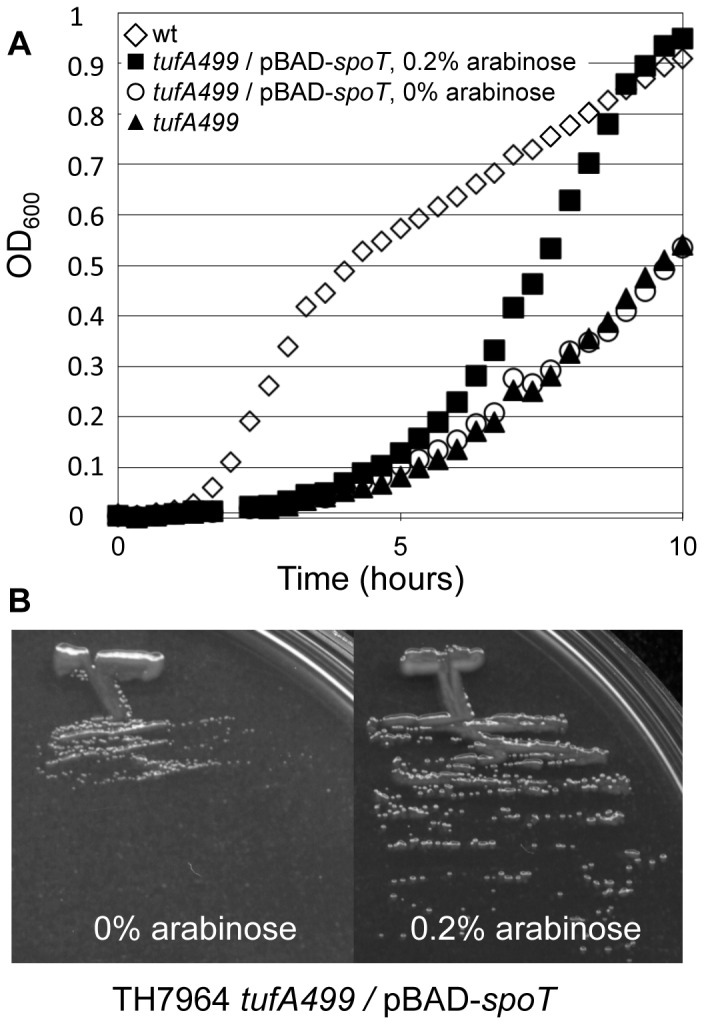
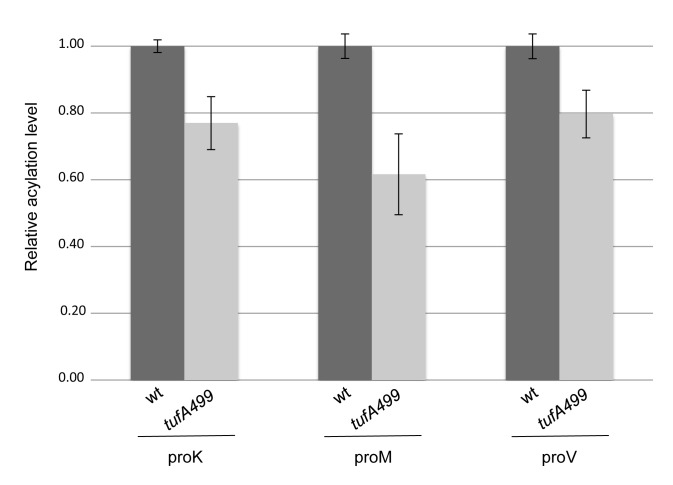
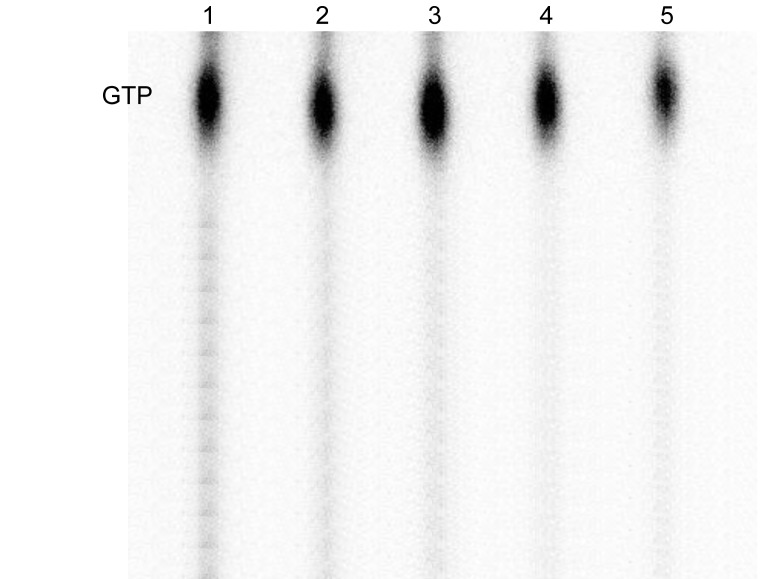
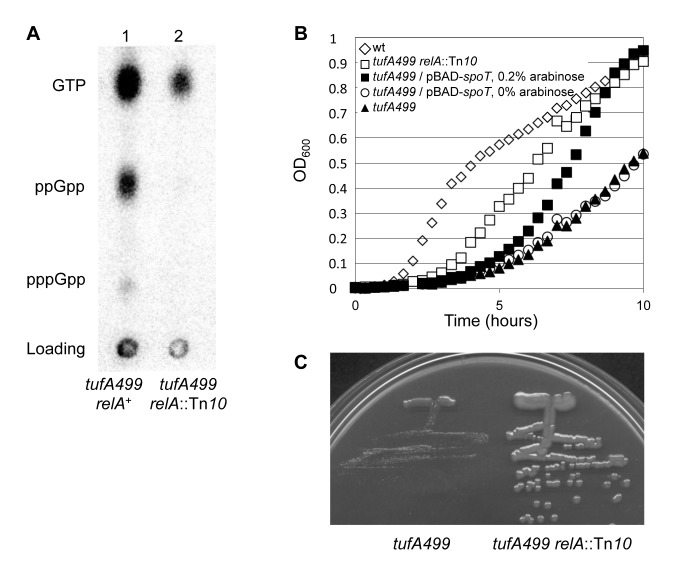
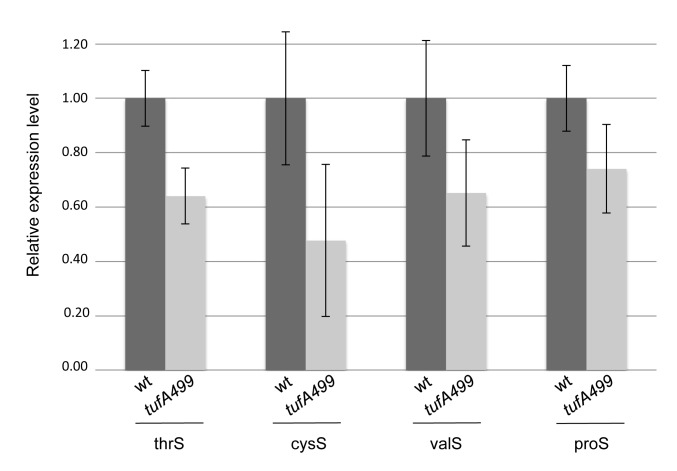
Transcription and translation of mRNA's are coordinated processes in bacteria. We have previously shown that a mutant form of EF-Tu (Gln125Arg) in Salmonella Typhimurium with a reduced affinity for aa-tRNA, causes ribosome pausing, resulting in an increased rate of RNase E-mediated mRNA cleavage, causing extremely slow growth, even on rich medium. The slow growth phenotype is reversed by mutations that reduce RNase E activity. Here we asked whether the slow growth phenotype could be reversed by overexpression of a wild-type gene. We identified spoT (encoding ppGpp synthetase/hydrolase) as a gene that partially reversed the slow growth rate when overexpressed. We found that the slow-growing mutant had an abnormally high basal level of ppGpp that was reduced when spoT was overexpressed. Inactivating relA (encoding the ribosome-associated ppGpp synthetase) also reduced ppGpp levels and significantly increased growth rate. Because RelA responds specifically to deacylated tRNA in the ribosomal A-site this suggested that the tuf mutant had an increased level of deacylated tRNA relative to the wild-type. To test this hypothesis we measured the relative acylation levels of 4 families of tRNAs and found that proline isoacceptors were acylated at a lower level in the mutant strain relative to the wild-type. In addition, the level of the proS tRNA synthetase mRNA was significantly lower in the mutant strain. We suggest that an increased level of deacylated tRNA in the mutant strain stimulates RelA-mediated ppGpp production, causing changes in transcription pattern that are inappropriate for rich media conditions, and contributing to slow growth rate. Reducing ppGpp levels, by altering the activity of either SpoT or RelA, removes one cause of the slow growth and reveals the interconnectedness of intracellular regulatory mechanisms.
在细菌中,mRNA的转录和翻译是相互协调的过程。我们之前已经表明,鼠伤寒沙门氏菌中一种对氨酰-tRNA亲和力降低的EF-Tu突变形式(Gln125Arg)会导致核糖体暂停,从而导致RNase E介导的mRNA切割速率增加,即使在丰富培养基上也会导致生长极其缓慢。降低RNase E活性的突变可逆转这种缓慢生长的表型。在这里,我们询问野生型基因的过表达是否可以逆转缓慢生长的表型。我们鉴定出spoT(编码ppGpp合成酶/水解酶)是一个过表达时能部分逆转缓慢生长速率的基因。我们发现,生长缓慢的突变体具有异常高的基础ppGpp水平,当spoT过表达时该水平会降低。使relA(编码与核糖体相关的ppGpp合成酶)失活也会降低ppGpp水平并显著提高生长速率。由于RelA对核糖体A位点的脱酰基tRNA有特异性反应,这表明tuf突变体相对于野生型具有更高水平的脱酰基tRNA。为了验证这一假设,我们测量了4个tRNA家族的相对酰化水平,发现脯氨酸同工受体在突变菌株中的酰化水平相对于野生型较低。此外,突变菌株中proS tRNA合成酶mRNA的水平显著较低。我们认为,突变菌株中脱酰基tRNA水平的增加会刺激RelA介导的ppGpp产生,导致转录模式发生变化,这种变化在丰富培养基条件下是不合适的,并导致生长速率缓慢。通过改变SpoT或RelA的活性来降低ppGpp水平,消除了缓慢生长的一个原因,并揭示了细胞内调节机制的相互关联性。