Department of System Medicine, University of Rome "Tor Vergata", Via Montpellier 1, 00133 Rome, Italy.
BMC Cancer. 2014 Mar 5;14:151. doi: 10.1186/1471-2407-14-151.
Chemoresistance of glioblastoma multiforme (GBM) has been attributed to the presence within the tumor of cancer stem cells (GSCs). The standard therapy for GBM consists of surgery followed by radiotherapy and the chemotherapeutic agent temozolomide (TMZ). However, TMZ efficacy is limited by O6-methylguanine-DNA-methyltransferase (MGMT) and Mismatch Repair (MMR) functions. Strategies to counteract TMZ resistance include its combination with poly(ADP-ribose) polymerase inhibitors (PARPi), which hamper the repair of N-methylpurines. PARPi are also investigated as monotherapy for tumors with deficiency of homologous recombination (HR). We have investigated whether PARPi may restore GSC sensitivity to TMZ or may be effective as monotherapy.
Ten human GSC lines were assayed for MMR proteins, MGMT and PARP-1 expression/activity, MGMT promoter methylation and sensitivity to TMZ or PARPi, alone and in combination. Since PTEN defects are frequently detected in GBM and may cause HR dysfunction, PTEN expression was also analyzed. The statistical analysis of the differences in drug sensitivity among the cell lines was performed using the ANOVA and Bonferroni's post-test or the non-parametric Kruskal-Wallis analysis and Dunn's post-test for multiple comparisons. Synergism between TMZ and PARPi was analyzed by the median-effect method of Chou and Talalay. Correlation analyses were done using the Spearman's rank test.
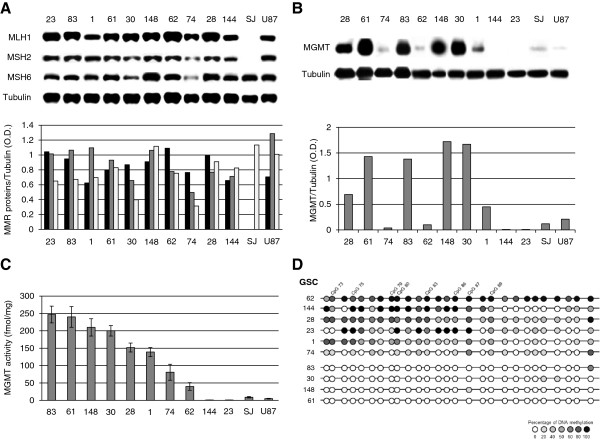
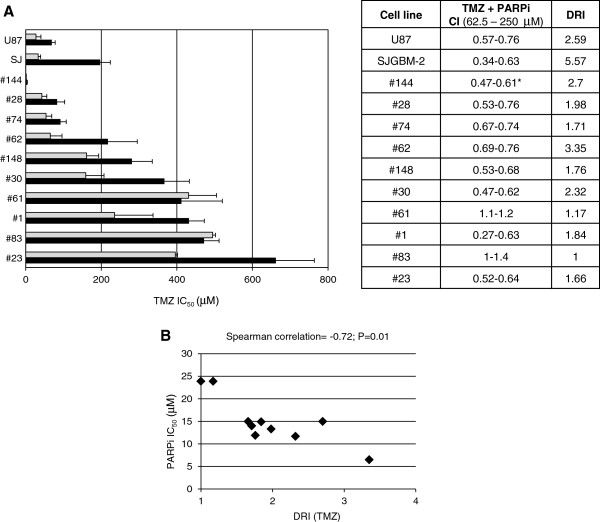
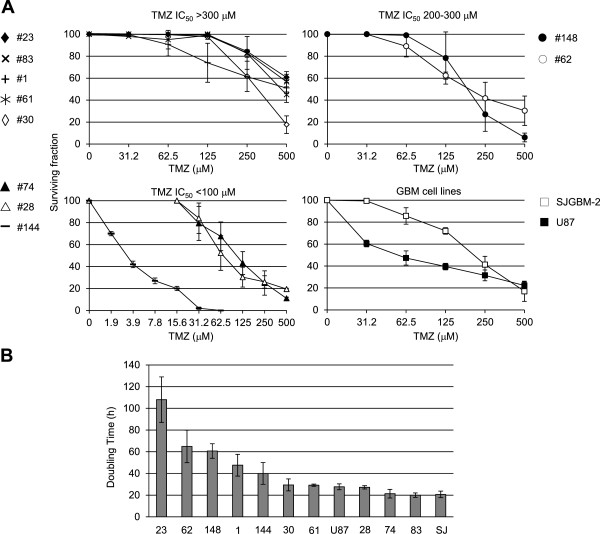
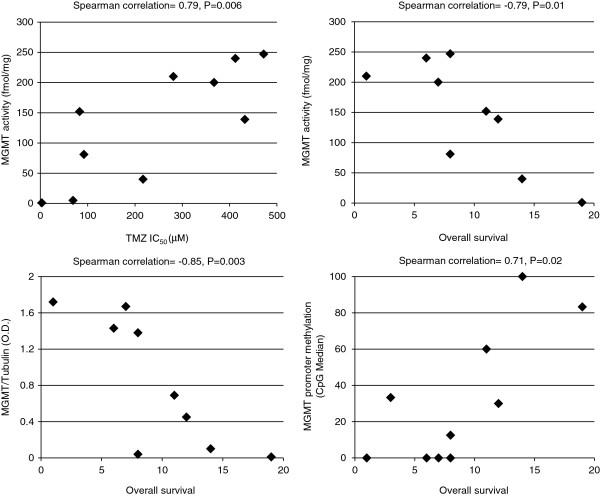
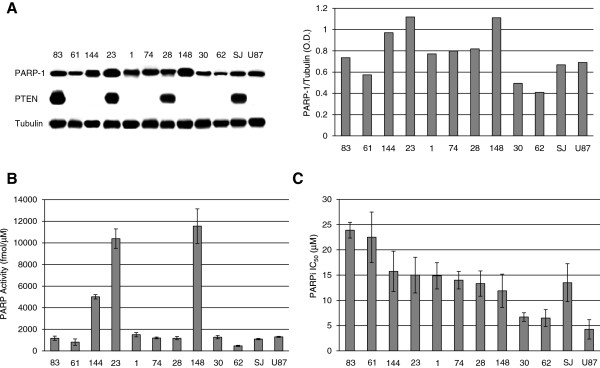
All GSCs were MMR-proficient and resistance to TMZ was mainly associated with high MGMT activity or low proliferation rate. MGMT promoter hypermethylation of GSCs correlated both with low MGMT activity/expression (Spearman's test, P = 0.004 and P = 0.01) and with longer overall survival of GBM patients (P = 0.02). Sensitivity of each GSC line to PARPi as single agent did not correlate with PARP-1 or PTEN expression. Notably, PARPi and TMZ combination exerted synergistic antitumor effects in eight out of ten GSC lines and the TMZ dose reduction achieved significantly correlated with the sensitivity of each cell line to PARPi as single agent (P = 0.01).
The combination of TMZ with PARPi may represent a valuable strategy to reverse GSC chemoresistance.
多形性胶质母细胞瘤(GBM)的化疗耐药性归因于肿瘤内存在癌症干细胞(GSCs)。GBM 的标准治疗包括手术联合放疗和替莫唑胺(TMZ)化疗。然而,TMZ 的疗效受到 O6-甲基鸟嘌呤-DNA-甲基转移酶(MGMT)和错配修复(MMR)功能的限制。对抗 TMZ 耐药的策略包括将其与聚(ADP-核糖)聚合酶抑制剂(PARPi)联合使用,PARPi 可阻碍 N-甲基嘌呤的修复。PARPi 也被作为同源重组(HR)缺陷肿瘤的单药治疗进行研究。我们研究了 PARPi 是否可以恢复 GSC 对 TMZ 的敏感性,或者是否可以作为单药治疗有效。
检测了 10 个人类 GSC 系的 MMR 蛋白、MGMT 和 PARP-1 表达/活性、MGMT 启动子甲基化以及对 TMZ 或 PARPi 的单独和联合敏感性。由于在 GBM 中经常检测到 PTEN 缺陷,并且可能导致 HR 功能障碍,因此还分析了 PTEN 表达。使用方差分析和 Bonferroni 后检验或非参数 Kruskal-Wallis 分析和 Dunn 后检验对细胞系之间药物敏感性差异的差异进行了统计学分析。通过 Chou 和 Talalay 的中值效应法分析 TMZ 和 PARPi 的协同作用。使用 Spearman 秩检验进行相关性分析。
所有 GSCs 均为 MMR 功能正常,TMZ 耐药主要与高 MGMT 活性或低增殖率有关。GSCs 的 MGMT 启动子高甲基化与低 MGMT 活性/表达呈正相关(Spearman 检验,P = 0.004 和 P = 0.01),并且与 GBM 患者的总生存期延长呈正相关(P = 0.02)。每个 GSC 系对 PARPi 作为单一药物的敏感性与 PARP-1 或 PTEN 表达均无相关性。值得注意的是,PARPi 和 TMZ 联合在十个 GSC 系中的八个系中产生协同抗肿瘤作用,TMZ 剂量降低与每个细胞系对 PARPi 作为单一药物的敏感性呈显著相关性(P = 0.01)。
TMZ 与 PARPi 的联合可能是逆转 GSC 化疗耐药性的有价值策略。