Hackermüller Jörg, Reiche Kristin, Otto Christian, Hösler Nadine, Blumert Conny, Brocke-Heidrich Katja, Böhlig Levin, Nitsche Anne, Kasack Katharina, Ahnert Peter, Krupp Wolfgang, Engeland Kurt, Stadler Peter F, Horn Friedemann
Genome Biol. 2014 Mar 4;15(3):R48. doi: 10.1186/gb-2014-15-3-r48.
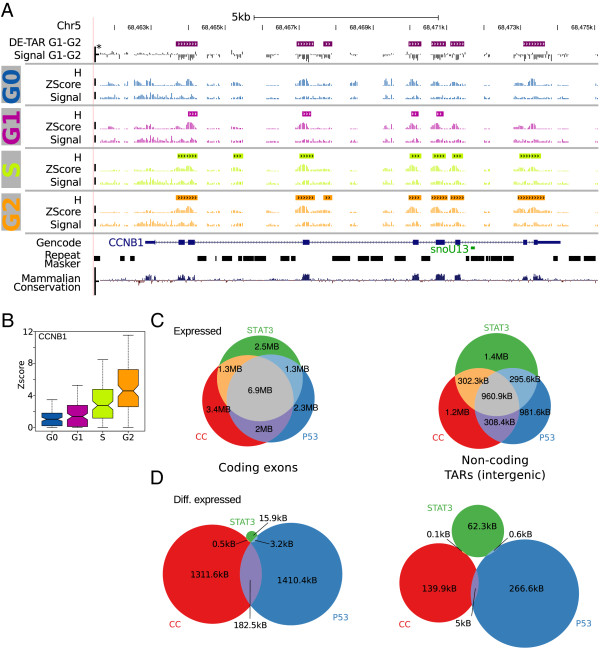
The genome is pervasively transcribed but most transcripts do not code for proteins, constituting non-protein-coding RNAs. Despite increasing numbers of functional reports of individual long non-coding RNAs (lncRNAs), assessing the extent of functionality among the non-coding transcriptional output of mammalian cells remains intricate. In the protein-coding world, transcripts differentially expressed in the context of processes essential for the survival of multicellular organisms have been instrumental in the discovery of functionally relevant proteins and their deregulation is frequently associated with diseases. We therefore systematically identified lncRNAs expressed differentially in response to oncologically relevant processes and cell-cycle, p53 and STAT3 pathways, using tiling arrays.
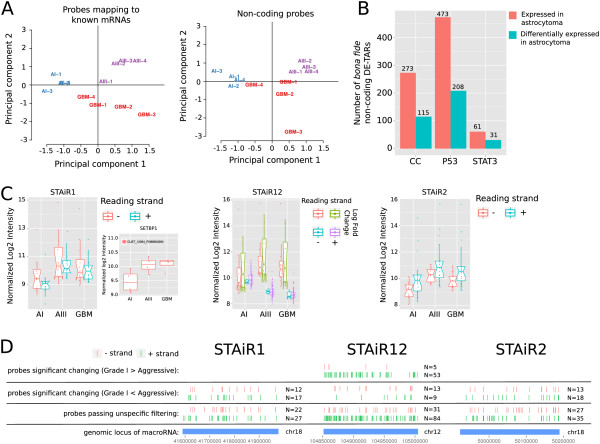
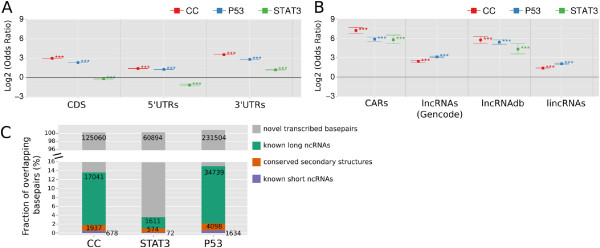
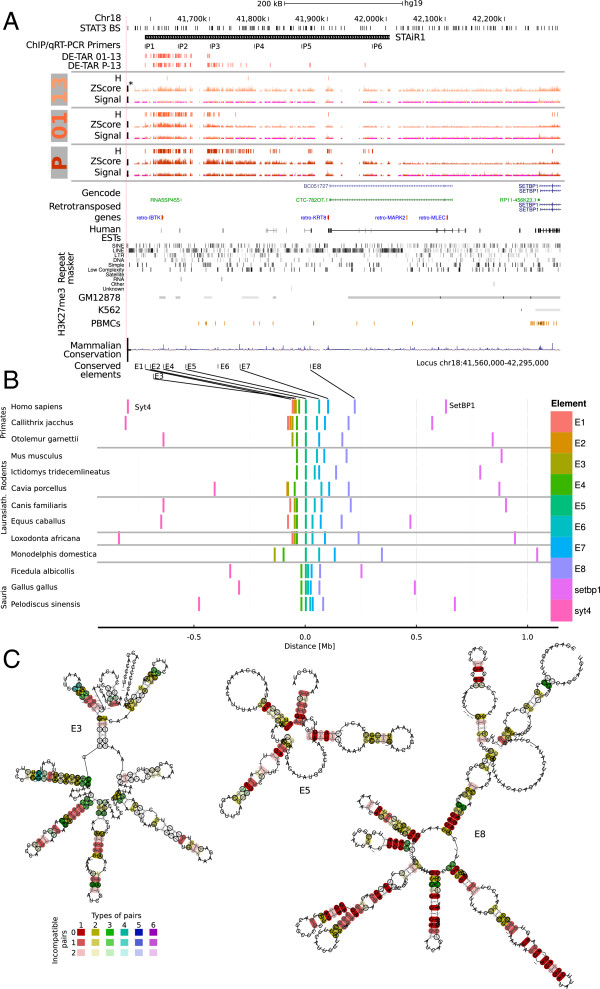
We found that up to 80% of the pathway-triggered transcriptional responses are non-coding. Among these we identified very large macroRNAs with pathway-specific expression patterns and demonstrated that these are likely continuous transcripts. MacroRNAs contain elements conserved in mammals and sauropsids, which in part exhibit conserved RNA secondary structure. Comparing evolutionary rates of a macroRNA to adjacent protein-coding genes suggests a local action of the transcript. Finally, in different grades of astrocytoma, a tumor disease unrelated to the initially used cell lines, macroRNAs are differentially expressed.
It has been shown previously that the majority of expressed non-ribosomal transcripts are non-coding. We now conclude that differential expression triggered by signaling pathways gives rise to a similar abundance of non-coding content. It is thus unlikely that the prevalence of non-coding transcripts in the cell is a trivial consequence of leaky or random transcription events.
基因组被广泛转录,但大多数转录本并不编码蛋白质,而是构成非蛋白质编码RNA。尽管单个长链非编码RNA(lncRNA)的功能报道越来越多,但评估哺乳动物细胞非编码转录输出中的功能范围仍然很复杂。在蛋白质编码领域,在多细胞生物生存所必需的过程中差异表达的转录本有助于发现功能相关的蛋白质,其失调常与疾病相关。因此,我们使用平铺阵列系统地鉴定了在肿瘤相关过程以及细胞周期、p53和STAT3信号通路响应中差异表达的lncRNA。
我们发现高达80%的信号通路触发的转录反应是非编码的。在这些反应中,我们鉴定出具有通路特异性表达模式的非常大的长链非编码RNA,并证明它们可能是连续转录本。长链非编码RNA包含在哺乳动物和蜥形纲动物中保守的元件,其中部分元件具有保守的RNA二级结构。将一种长链非编码RNA与相邻蛋白质编码基因的进化速率进行比较,表明该转录本具有局部作用。最后,在不同分级的星形细胞瘤(一种与最初使用的细胞系无关的肿瘤疾病)中,长链非编码RNA存在差异表达。
先前已表明,大多数表达的非核糖体转录本是非编码的。我们现在得出结论,由信号通路触发的差异表达会产生相似数量的非编码内容。因此,细胞中非编码转录本的普遍存在不太可能是渗漏或随机转录事件的微不足道的结果。