Peters Todd, Chinthakunta Suresh Reddy, Hussain Mir, Khalil Saif
One Brain and Spine Center, Newport Beach, CA, USA.
Globus Medical Inc., Audubon, PA, USA.
Asian Spine J. 2014 Feb;8(1):35-43. doi: 10.4184/asj.2014.8.1.35. Epub 2014 Feb 6.
An in-vitro study.
The current study is aimed at investigating the differences in stability between short posterior fixation (SPF), hybrid posterior fixation (HPF), and long posterior fixation (LPF) with and without anterior column augmentation using calcium phosphate bone cement (CaP) for treating burst fractures (BFs).
The ideal treatment for thoracolumbar BF is controversial regarding the use of short or LPF constructs.
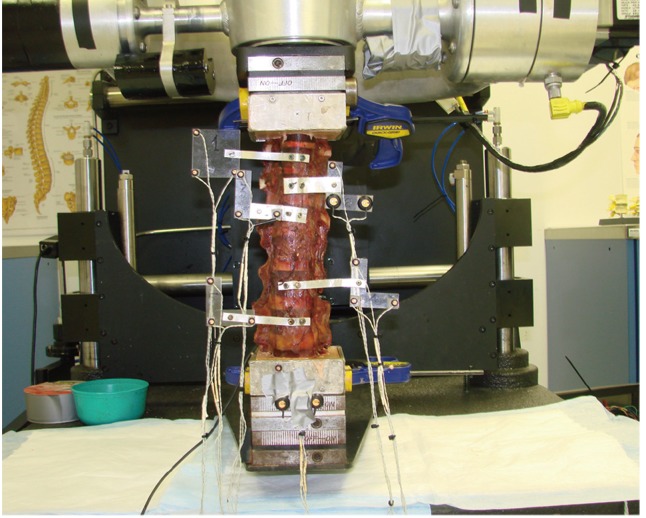
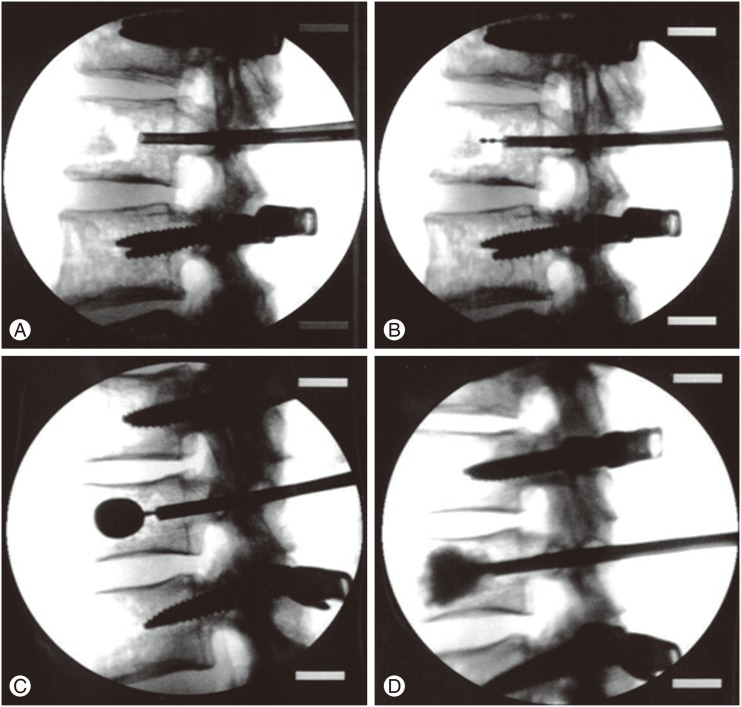
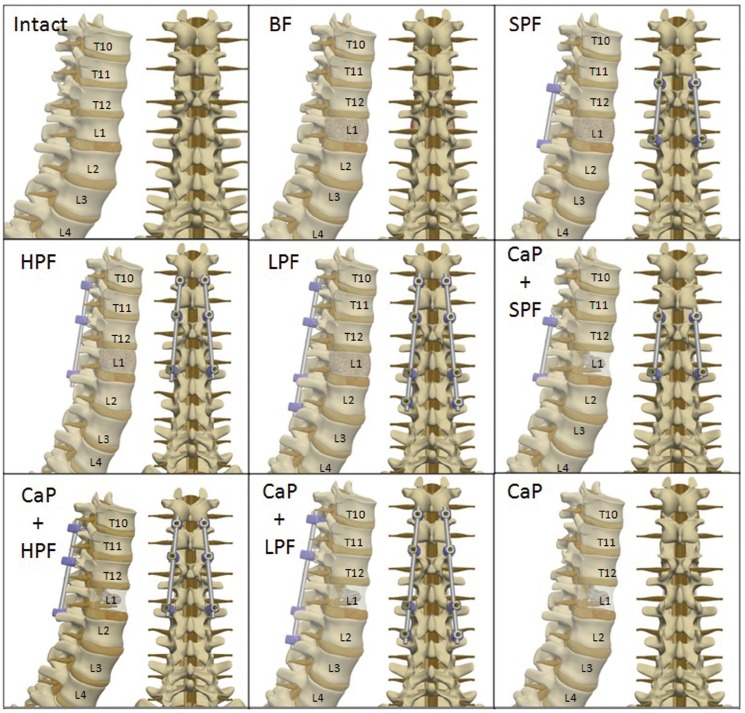
Seven human thoracolumbar spines (T9-L4) were tested on a six degree of freedom spine simulator in three physiologic planes, flexion-extension (FE), lateral bending (LB), and axial rotation (AR). Tested surgical constructs included the following: intact, injury (BF), SPF (T12-L2), HPF (T11-L2), LPF (T11-L3), SPF+CaP, HPF+CaP, LPF+CaP, and CaP alone (CaP). Range of motion (ROM) was recorded at T12-L2 in FE, LB, and AR.
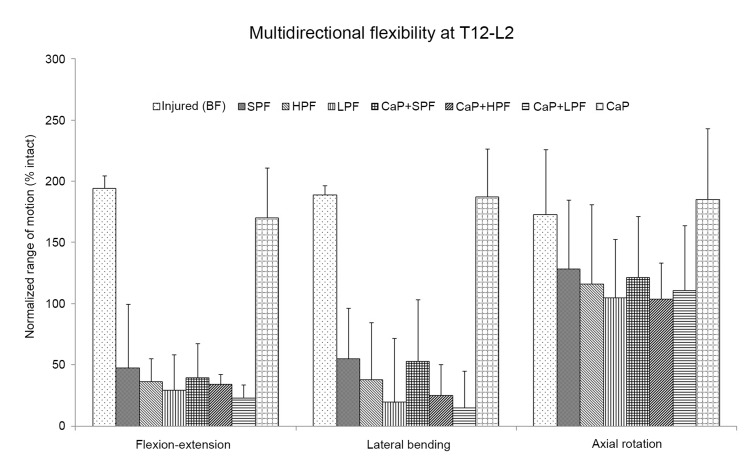
THE REDUCTION IN MEAN ROM TRENDED AS FOLLOWS: LPF>HPF>SPF. Only LPF constructs and HPF with anterior column augmentation significantly reduced mean ROM in FE and LB compared to the intact state. All instrumented constructs (SPF, HPF, and LPF) significantly reduced ROM in FE and LB compared to the injured condition. Furthermore, the instrumented constructs did not provide significant rotational stability. Injecting CaP provided minimal additional stability.
For the injury created, LPF and HPF provided better stability than SPF with and without anterior column augmentation. Therefore, highly unstable fractures may require extended, long or hybrid fusion constructs for optimum stability.
一项体外研究。
本研究旨在调查使用磷酸钙骨水泥(CaP)进行前路椎体增强与不增强的情况下,短节段后路固定(SPF)、混合后路固定(HPF)和长节段后路固定(LPF)治疗爆裂骨折(BFs)时稳定性的差异。
关于胸腰椎爆裂骨折使用短节段或长节段固定结构的理想治疗方法存在争议。
在一个六自由度脊柱模拟器上,于三个生理平面(屈伸(FE)、侧弯(LB)和轴向旋转(AR))对七具人胸腰椎脊柱(T9-L4)进行测试。测试的手术固定结构包括:完整、损伤(BF)、SPF(T12-L2)、HPF(T11-L2)、LPF(T11-L3)、SPF+CaP、HPF+CaP、LPF+CaP以及单纯CaP(CaP)。在T12-L2记录FE、LB和AR方向的活动度(ROM)。
平均ROM的降低趋势如下:LPF>HPF>SPF。与完整状态相比,仅LPF固定结构和前路椎体增强的HPF在FE和LB方向显著降低了平均ROM。与损伤状态相比,所有内固定结构(SPF、HPF和LPF)在FE和LB方向均显著降低了ROM。此外,内固定结构未提供显著的旋转稳定性。注射CaP提供的额外稳定性极小。
对于所造成的损伤,无论有无前路椎体增强,LPF和HPF比SPF提供了更好的稳定性。因此,高度不稳定骨折可能需要延长的、长节段或混合融合固定结构以获得最佳稳定性。