Department of Pharmacy, University Hospital, Besançon, France ; Inserm U645 EA-2284 IFR-133, University of Franche-Comté, Besançon, France.
Department of Pharmacy, University Hospital, Besançon, France.
Onco Targets Ther. 2014 Feb 27;7:365-74. doi: 10.2147/OTT.S56370. eCollection 2014.
The aim of this retrospective clinical study was to assess, in the context of the recent evolution of systemic therapies, the potential effect of targeted therapies on overall survival (OS) of patients with metastatic clear-cell renal cell carcinoma (mccRCC) in daily practice.
All consecutive patients with histologically confirmed mccRCC who received systemic therapy between January 2000 and December 2010 in two oncology treatment centers in our Franche-Comté region in eastern France were included in the analysis. The primary end point was OS. The analysis of prognostic factors was performed using a two-step approach: univariate then multivariate analysis with a stepwise Cox proportional hazards regression model.
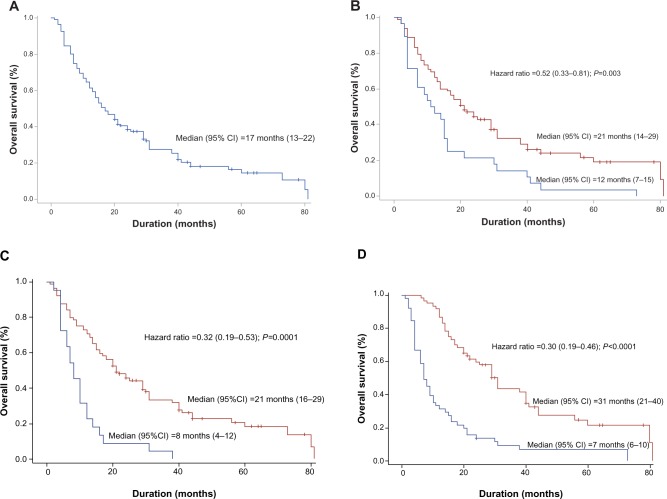
For the entire cohort of 111 patients, the median OS was 17 months (95% confidence interval [CI]; 13-22 months) and the two-year OS was 39%. Three prognostic factors were independent predictors of long survival: prior nephrectomy (hazard ratio =0.38 [0.22-0.64], P<0.0001); systemic therapy by targeted therapy (hazard ratio =0.50 [0.31-0.80], P=0.005); and lack of liver metastasis (hazard ratio =0.43 [0.22-0.82], P=0.002). Median OS was 21 months [14-29 months] for patients who received at least one targeted therapy compared with 12 months [7-15 months] for patients who were treated only by immunotherapy agents (P=0.003).
Our results suggest that targeted therapies are associated with improved OS in comparison with cytokines, which is in line with other publications.
本回顾性临床研究旨在评估在最近的系统治疗进展背景下,靶向治疗对法国东部弗朗什孔泰地区两个肿瘤治疗中心接受系统治疗的转移性透明细胞肾细胞癌(mccRCC)患者的总生存(OS)的潜在影响。
所有组织学证实的 mccRCC 患者均纳入分析,这些患者于 2000 年 1 月至 2010 年 12 月在我们的弗朗什-孔泰地区的两个肿瘤治疗中心接受了系统治疗。主要终点是 OS。采用两步法进行预后因素分析:单变量分析然后是多变量分析,采用逐步 Cox 比例风险回归模型。
对于整个 111 例患者队列,中位 OS 为 17 个月(95%置信区间[CI];13-22 个月),两年 OS 为 39%。三个预后因素是长生存的独立预测因素:先前的肾切除术(风险比[HR]=0.38[0.22-0.64],P<0.0001);靶向治疗的系统治疗(HR=0.50[0.31-0.80],P=0.005);以及无肝转移(HR=0.43[0.22-0.82],P=0.002)。至少接受一种靶向治疗的患者中位 OS 为 21 个月[14-29 个月],而仅接受免疫治疗药物治疗的患者中位 OS 为 12 个月[7-15 个月](P=0.003)。
与细胞因子相比,我们的结果表明靶向治疗与改善 OS 相关,这与其他出版物一致。