Human Engineering Research Laboratories, Department of Veterans Affairs Pittsburgh, PA, USA ; Department of Physical Medicine and Rehabilitation, University of Pittsburgh Pittsburgh, PA, USA ; Department of Bioengineering, University of Pittsburgh Pittsburgh, PA, USA.
Department of Physical Medicine and Rehabilitation, University of Pittsburgh Pittsburgh, PA, USA.
Front Integr Neurosci. 2014 Feb 19;8:17. doi: 10.3389/fnint.2014.00017. eCollection 2014.
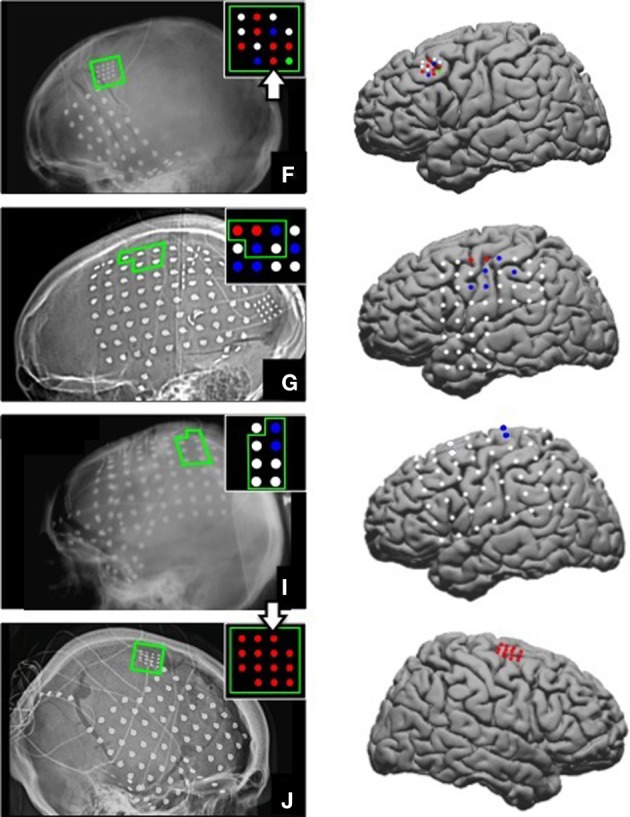
After spinal cord injury (SCI), motor commands from the brain are unable to reach peripheral nerves and muscles below the level of the lesion. Action observation (AO), in which a person observes someone else performing an action, has been used to augment traditional rehabilitation paradigms. Similarly, AO can be used to derive the relationship between brain activity and movement kinematics for a motor-based brain-computer interface (BCI) even when the user cannot generate overt movements. BCIs use brain signals to control external devices to replace functions that have been lost due to SCI or other motor impairment. Previous studies have reported congruent motor cortical activity during observed and overt movements using magnetoencephalography (MEG) and functional magnetic resonance imaging (fMRI). Recent single-unit studies using intracortical microelectrodes also demonstrated that a large number of motor cortical neurons had similar firing rate patterns between overt and observed movements. Given the increasing interest in electrocorticography (ECoG)-based BCIs, our goal was to identify whether action observation-related cortical activity could be recorded using ECoG during grasping tasks. Specifically, we aimed to identify congruent neural activity during observed and executed movements in both the sensorimotor rhythm (10-40 Hz) and the high-gamma band (65-115 Hz) which contains significant movement-related information. We observed significant motor-related high-gamma band activity during AO in both able-bodied individuals and one participant with a complete C4 SCI. Furthermore, in able-bodied participants, both the low and high frequency bands demonstrated congruent activity between action execution and observation. Our results suggest that AO could be an effective and critical procedure for deriving the mapping from ECoG signals to intended movement for an ECoG-based BCI system for individuals with paralysis.
脊髓损伤(SCI)后,大脑发出的运动指令无法到达损伤以下的外周神经和肌肉。动作观察(AO),即一个人观察别人执行动作,已被用于增强传统的康复模式。同样,AO 可用于为基于运动的脑机接口(BCI)推导大脑活动与运动运动学之间的关系,即使用户无法产生明显的运动。BCIs 使用大脑信号来控制外部设备,以替代因 SCI 或其他运动障碍而丧失的功能。使用脑磁图(MEG)和功能磁共振成像(fMRI)的先前研究报告了在观察和明显运动期间一致的运动皮质活动。最近使用皮质内微电极的单单元研究也表明,大量运动皮质神经元在明显运动和观察运动之间具有相似的放电率模式。鉴于对皮层电图(ECoG)为基础的 BCI 的兴趣日益增加,我们的目标是确定是否可以在抓握任务期间使用 ECoG 记录与动作观察相关的皮质活动。具体来说,我们旨在确定在感觉运动节律(10-40 Hz)和高伽马频带(65-115 Hz)中观察到的和执行的运动期间是否存在一致的神经活动,其中包含重要的运动相关信息。我们在身体健全的个体和一名 C4 SCI 完全的参与者中观察到 AO 期间存在显著的与运动相关的高伽马频带活动。此外,在身体健全的参与者中,低频带和高频带都在动作执行和观察之间表现出一致的活动。我们的结果表明,AO 可能是一种有效的、关键的程序,可用于为基于 ECoG 的 BCI 系统从 ECoG 信号中推导到预期运动的映射,用于瘫痪患者。