Institute of Basic Medicine, College of Medicine, National Cheng Kung University, Tainan, Taiwan, Republic of China; Department of Cell Biology and Anatomy, College of Medicine, National Cheng Kung University, Tainan, Taiwan, Republic of China.
Department of Urology, National Cheng Kung University Hospital Douliou Branch, Yunlin, Taiwan, Republic of China.
PLoS One. 2014 Mar 6;9(3):e90243. doi: 10.1371/journal.pone.0090243. eCollection 2014.
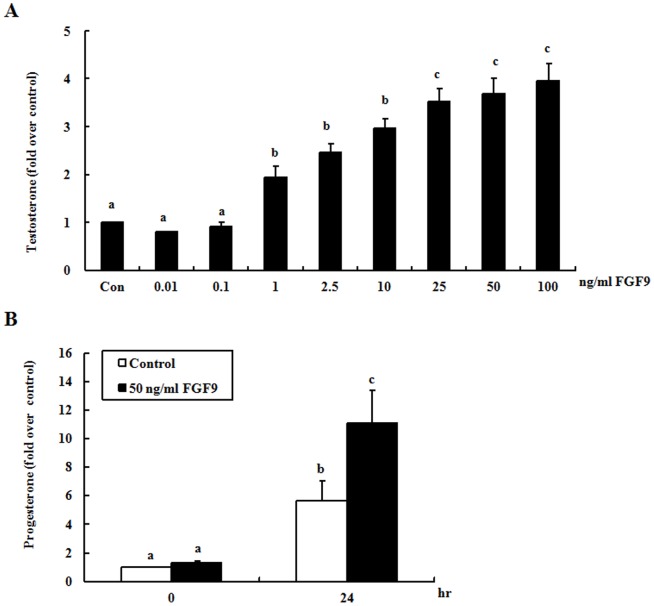
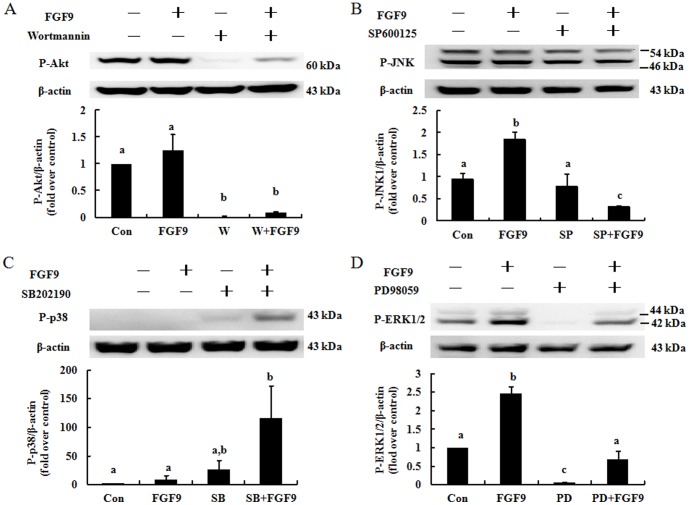
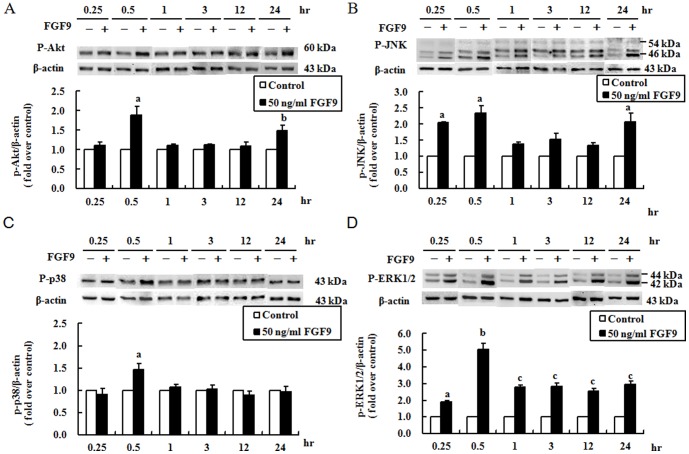
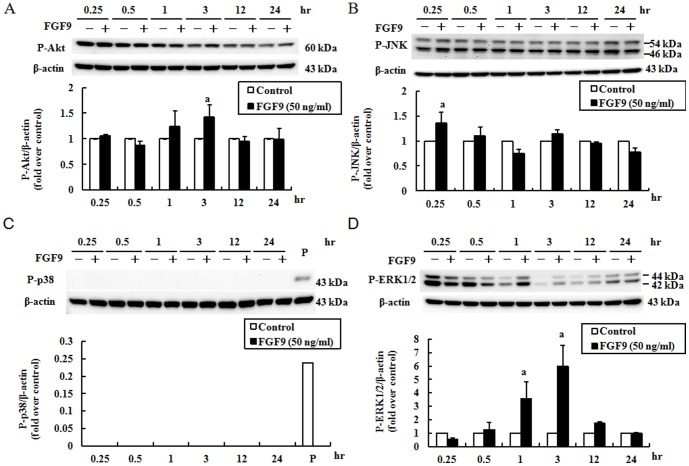
Fibroblast growth factor 9 (FGF9) is a multifunctional polypeptide belonging to the FGF family and has functions related to bone formation, lens-fiber differentiation, nerve development, gap-junction formation and sex determination. In a previous study, we demonstrated that FGF9 stimulates the production of testosterone in mouse Leydig cells. In the present study, we used both primary mouse Leydig cells and MA-10 mouse Leydig tumor cells to further investigate the molecular mechanism of FGF9-stimulated steroidogenesis. Results showed that FGF9 significantly activated steroidogenesis in both mouse primary and tumor Leydig cells (p<0.05). Furthermore, FGF9 significantly induced the expression of phospho-Akt at 0.5 and 24 hr, phospho-JNK at 0.25, 0.5, and 24 hr, phospho-p38 at 0.5 hr, and phospho-ERK1/2 from 0.25 to 24 hr in primary Leydig cells (p<0.05). Also, FGF9 significantly up-regulated the expression of phospho-Akt at 3 hr, phospho-JNK at 0.25 hr, and phospho-ERK1/2 at 1 and 3 hr in MA-10 cells (p<0.05). Using specific inhibitors of Akt, JNK, p38, and ERK1/2, we further demonstrated that the inhibitors of Akt and ERK1/2 significantly suppressed the stimulatory effect of FGF9 on steroidogenesis in mouse Leydig cells. In conclusion, FGF9 specifically activated the Akt and ERK1/2 in normal mouse Leydig cells and the Akt, JNK and ERK1/2 in MA-10 mouse Leydig tumor cells to stimulate steroidogenesis.
成纤维细胞生长因子 9(FGF9)是一种多功能多肽,属于成纤维细胞生长因子家族,具有与骨形成、晶状体纤维分化、神经发育、间隙连接形成和性别决定相关的功能。在之前的研究中,我们证明 FGF9 刺激小鼠 Leydig 细胞产生睾酮。在本研究中,我们使用原代小鼠 Leydig 细胞和 MA-10 小鼠 Leydig 肿瘤细胞进一步研究 FGF9 刺激类固醇生成的分子机制。结果表明,FGF9 显著激活了原代和肿瘤 Leydig 细胞中的类固醇生成(p<0.05)。此外,FGF9 显著诱导了原代 Leydig 细胞中磷酸化 Akt 在 0.5 和 24 小时、磷酸化 JNK 在 0.25、0.5 和 24 小时、磷酸化 p38 在 0.5 小时和磷酸化 ERK1/2 在 0.25 至 24 小时的表达(p<0.05)。同样,FGF9 显著上调了 MA-10 细胞中磷酸化 Akt 在 3 小时、磷酸化 JNK 在 0.25 小时和磷酸化 ERK1/2 在 1 小时和 3 小时的表达(p<0.05)。使用 Akt、JNK、p38 和 ERK1/2 的特异性抑制剂,我们进一步证明 Akt 和 ERK1/2 的抑制剂显著抑制了 FGF9 对小鼠 Leydig 细胞类固醇生成的刺激作用。总之,FGF9 特异性激活了正常小鼠 Leydig 细胞中的 Akt 和 ERK1/2 以及 MA-10 小鼠 Leydig 肿瘤细胞中的 Akt、JNK 和 ERK1/2,以刺激类固醇生成。