Kattula Deepthi, Sarkar Rajiv, Rao Ajjampur Sitara Swarna, Minz Shantidani, Levecke Bruno, Muliyil Jayaprakash, Kang Gagandeep
Department of Gastrointestinal Sciences, Christian Medical College, Vellore, India.
Indian J Med Res. 2014 Jan;139(1):76-82.
BACKGROUND & OBJECTIVES: Soil-transmitted helminths (STH) are a major public health problem in tropical and sub-tropical countries, affecting the physical growth and cognitive development in school-age children. This study was aimed to assess the prevalence and risk factors of STH infection among school children aged 6 -14 yr in Vellore and Thiruvanamalai districts in south India.
Children aged 6-14 yr, going to government and government aided schools (n=33, randomly selected) in Vellore and Thiruvanamalai districts were screened to estimate the prevalence of STH, and a case control study was done on a subset to assess the risk factors for the infection.
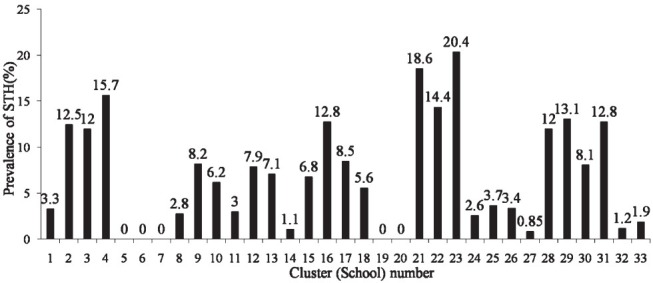
The prevalence of STH was 7.8 per cent, varying widely in schools from 0 to 20.4 per cent, in 3706 screened children. Hookworm (8.4%) rates were high in rural areas, while Ascaris (3.3%) and Trichuris (2.2%) were more prevalent among urban children. Consumption of deworming tablets (OR=0.25, P < 0.01) offered protection, while residing in a field hut (OR=6.73, P=0.02) and unhygienic practices like open air defaecation (OR=5.37, P < 0.01), keeping untrimmed nails (OR=2.53, P=0.01) or eating food fallen on the ground (OR=2.52, P=0.01) were important risk factors for STH infection.
INTERPRETATION & CONCLUSIONS: Our study indicated that school children with specific risk factors in the studied area were vulnerable subpopulation with elevated risk of STH infection. Identifying risk factors and dynamics of transmission in vulnerable groups can help to plan for effective prevention strategies.
土壤传播的蠕虫(STH)是热带和亚热带国家的一个主要公共卫生问题,影响学龄儿童的身体生长和认知发育。本研究旨在评估印度南部韦洛尔和蒂鲁瓦纳马莱地区6至14岁学童中STH感染的患病率及危险因素。
对韦洛尔和蒂鲁瓦纳马莱地区政府及政府资助学校中6至14岁的儿童(n = 33,随机选取)进行筛查,以估计STH的患病率,并对其中一部分儿童进行病例对照研究,以评估感染的危险因素。
在3706名接受筛查的儿童中,STH的患病率为7.8%,各学校之间差异很大,从0至20.4%不等。农村地区钩虫感染率(8.4%)较高,而蛔虫(3.3%)和鞭虫(2.2%)在城市儿童中更为普遍。服用驱虫药(OR = 0.25,P < 0.01)可提供保护,而居住在田间小屋(OR = 6.73,P = 0.02)以及露天排便(OR = 5.37,P < 0.01)、留未修剪的指甲(OR = 2.53,P = 0.01)或食用掉落在地上的食物(OR = 2.52,P = 0.01)等不卫生行为是STH感染的重要危险因素。
我们的研究表明,研究区域内具有特定危险因素的学童是STH感染风险较高的脆弱亚人群。识别脆弱群体中的危险因素和传播动态有助于制定有效的预防策略。