Greenland Katie, Dixon Ruth, Khan Shabbir Ali, Gunawardena Kithsiri, Kihara Jimmy H, Smith Jennifer L, Drake Lesley, Makkar Prerna, Raman Sri, Singh Sarman, Kumar Sanjay
Faculty of Infectious and Tropical Diseases, London School of Hygiene and Tropical Medicine, London, United Kingdom.
Partnership for Child Development, Imperial College, London, United Kingdom; Deworm the World, Washington, D.C., United States of America.
PLoS Negl Trop Dis. 2015 May 20;9(5):e0003790. doi: 10.1371/journal.pntd.0003790. eCollection 2015 May.
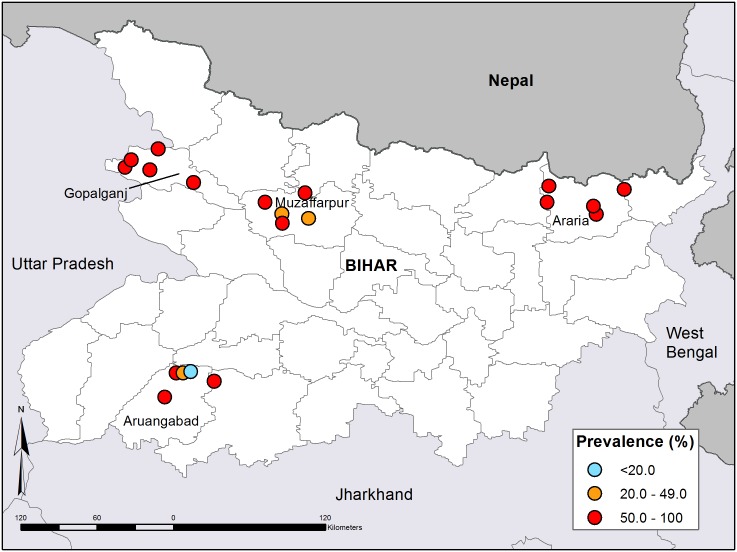
Soil-transmitted helminths (STHs) infect over a billion individuals worldwide. In India, 241 million children are estimated to need deworming to avert the negative consequences STH infections can have on child health and development. In February-April 2011, 17 million children in Bihar State were dewormed during a government-led school-based deworming campaign. Prior to programme implementation, a study was conducted to assess STH prevalence in the school-age population to direct the programme. The study also investigated risk factors for STH infections, including caste, literacy, and defecation and hygiene practices, in order to inform the development of complementary interventions.
A cross-sectional survey was conducted among children in 20 schools in Bihar. In addition to providing stool samples for identification of STH infections, children completed a short questionnaire detailing their usual defecation and hand-hygiene practices. Risk factors for STH infections were explored.
In January-February 2011, 1279 school children aged four to seventeen provided stool samples and 1157 children also completed the questionnaire. Overall, 68% of children (10-86% across schools) were infected with one or more soil-transmitted helminth species. The prevalence of ascariasis, hookworm and trichuriasis was 52%, 42% and 5% respectively. The majority of children (95%) practiced open defecation and reported most frequently cleansing hands with soil (61%). Increasing age, lack of maternal literacy and certain castes were independently associated with hookworm infection. Absence of a hand-washing station at the schools was also independently associated with A. lumbricoides infection.
STH prevalence in Bihar is high, and justifies mass deworming in school-aged children. Open defecation is common-place and hands are often cleansed using soil. The findings reported here can be used to help direct messaging appropriate to mothers with low levels of literacy and emphasise the importance of water and sanitation in the control of helminths and other diseases.
土壤传播的蠕虫(STH)感染了全球超过10亿人。在印度,估计有2.41亿儿童需要进行驱虫,以避免STH感染对儿童健康和发育可能产生的负面影响。2011年2月至4月期间,比哈尔邦政府主导的一项校内驱虫运动为1700万儿童进行了驱虫。在项目实施之前,开展了一项研究以评估学龄人口中的STH流行情况,为该项目提供指导。该研究还调查了STH感染的风险因素,包括种姓、识字率以及排便和卫生习惯,以便为制定补充干预措施提供信息。
对比哈尔邦20所学校的儿童进行了横断面调查。除了提供粪便样本以确定STH感染情况外,儿童还填写了一份简短问卷,详细说明他们通常的排便和手部卫生习惯。对STH感染的风险因素进行了探究。
2011年1月至2月,1279名4至17岁的学童提供了粪便样本,1157名儿童还完成了问卷。总体而言,68%的儿童(各学校为10%-86%)感染了一种或多种土壤传播的蠕虫。蛔虫病、钩虫病和鞭虫病的患病率分别为52%、42%和5%。大多数儿童(95%)有露天排便的习惯,且最常报告用泥土洗手(61%)。年龄增长、母亲识字率低以及某些种姓与钩虫感染独立相关。学校没有洗手设施也与蛔虫感染独立相关。
比哈尔邦的STH流行率很高,证明对学龄儿童进行大规模驱虫是合理的。露天排便是常见现象,且人们经常用泥土洗手。此处报告的研究结果可用于指导针对识字水平低的母亲的宣传,并强调水和卫生设施在控制蠕虫及其他疾病方面的重要性。