Burgess Stephen
Department of Public Health and Primary Care, University of Cambridge
Int J Epidemiol. 2014 Jun;43(3):922-9. doi: 10.1093/ije/dyu005. Epub 2014 Mar 6.
Sample size calculations are an important tool for planning epidemiological studies. Large sample sizes are often required in Mendelian randomization investigations.
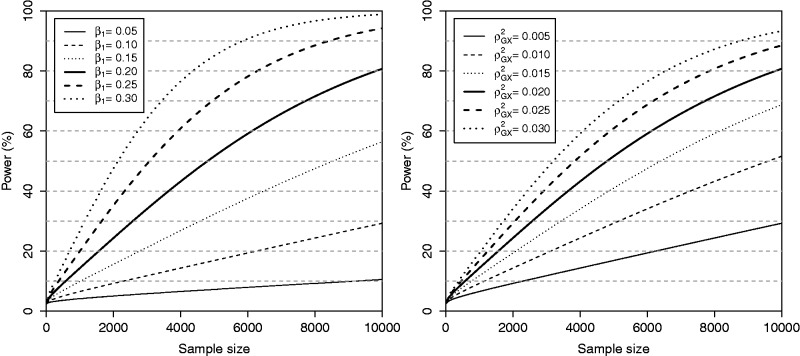
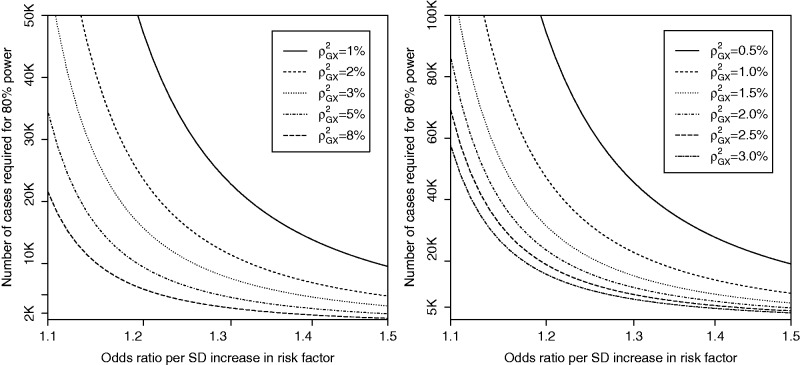
Resources are provided for investigators to perform sample size and power calculations for Mendelian randomization with a binary outcome. We initially provide formulae for the continuous outcome case, and then analogous formulae for the binary outcome case. The formulae are valid for a single instrumental variable, which may be a single genetic variant or an allele score comprising multiple variants. Graphs are provided to give the required sample size for 80% power for given values of the causal effect of the risk factor on the outcome and of the squared correlation between the risk factor and instrumental variable. R code and an online calculator tool are made available for calculating the sample size needed for a chosen power level given these parameters, as well as the power given the chosen sample size and these parameters.
The sample size required for a given power of Mendelian randomization investigation depends greatly on the proportion of variance in the risk factor explained by the instrumental variable. The inclusion of multiple variants into an allele score to explain more of the variance in the risk factor will improve power, however care must be taken not to introduce bias by the inclusion of invalid variants.
样本量计算是规划流行病学研究的重要工具。孟德尔随机化研究通常需要大样本量。
为研究人员提供了用于计算二元结局孟德尔随机化样本量和检验效能的资源。我们首先给出连续结局情况的公式,然后给出二元结局情况的类似公式。这些公式适用于单个工具变量,该变量可以是单个基因变异或包含多个变异的等位基因评分。提供了图表,以给出在给定风险因素对结局的因果效应值以及风险因素与工具变量之间的平方相关系数值时,达到80%检验效能所需的样本量。提供了R代码和在线计算器工具,用于根据这些参数计算给定检验效能水平所需的样本量,以及根据选定的样本量和这些参数计算检验效能。
给定检验效能的孟德尔随机化研究所需的样本量在很大程度上取决于工具变量所解释的风险因素方差比例。将多个变异纳入等位基因评分以解释更多风险因素方差将提高检验效能,然而必须注意避免因纳入无效变异而引入偏差。