Prashant Chandravilas Keshvan, Bhat Madhusudan, Srivastava Sandeep Kumar, Saxena Ankit, Kumar Manoj, Singh Amar, Samim Mohammed, Ahmad Farhan Jalees, Dinda Amit Kumar
Department of Pathology, All India Institute of Medical Sciences, Jamia Hamdard, New Delhi, India.
Department of Transplant Immunology and Immunogenetics, All India Institute of Medical Sciences, Jamia Hamdard, New Delhi, India.
Int J Nanomedicine. 2014 Feb 12;9:937-50. doi: 10.2147/IJN.S55892. eCollection 2014.
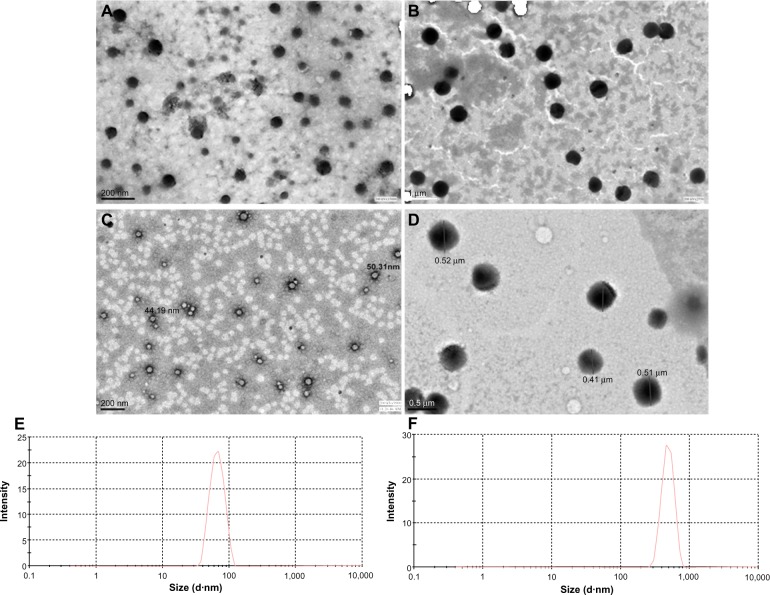
The aim of the study was to load a model antigen, tetanus toxoid (TT), in poly-ε-caprolactone nanoparticles (PCL NPs) of two size ranges, ie, mean 61.2 nm (small) and 467.6 nm (large), and study its effect on macrophage polarization as well as antigen presentation in human monocyte-derived macrophages in vitro, along with humoral and cell-mediated immune (CMI) response generated in Swiss albino mice following immunization with the TT-loaded NPs.
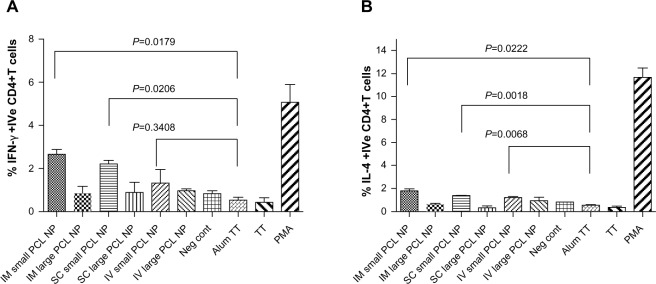
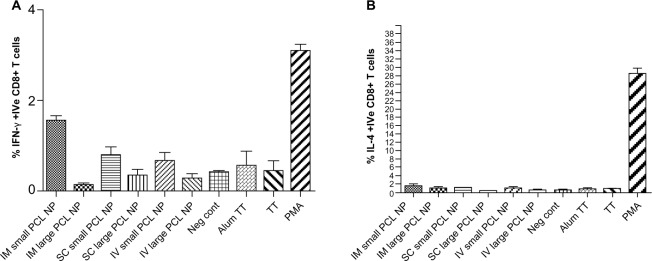
PCL NPs were synthesized by solvent evaporation. The antigen-loaded PCL NPs were characterized for size, zeta potential, and protein-release kinetics. Swiss albino mice were immunized with the antigen-loaded PCL NPs. Flow cytometry was used to quantify interferon-γ- and interleukin-4-secreting cluster of differentiation (CD)4(+) and CD8(+) T cells in the spleen, and enzyme-linked immunosorbent assay was used to quantify anti-TT antibody levels in the serum of immunized mice.
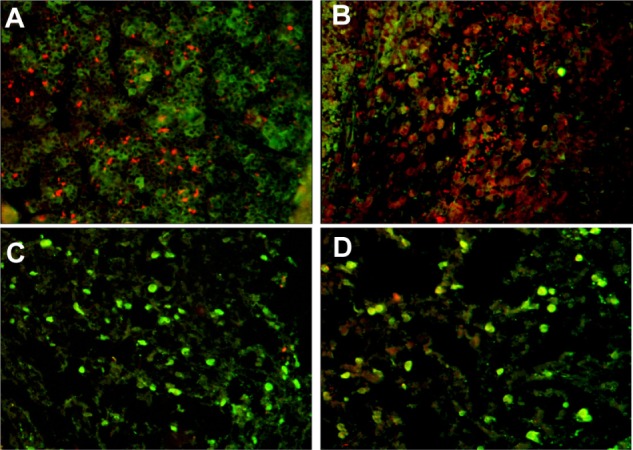
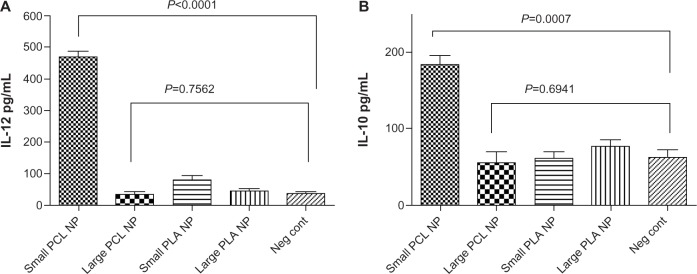
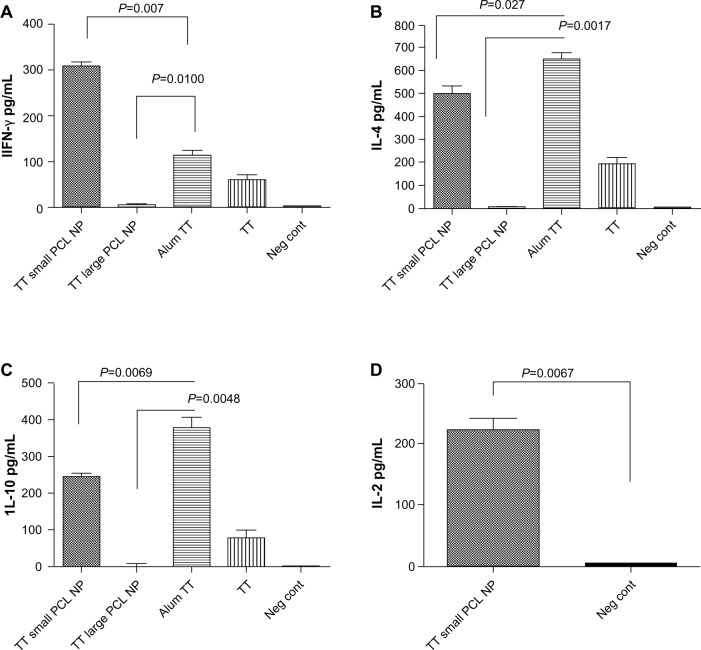
Small PCL NPs generated an M1/M2 type polarization of human blood monocyte-derived macrophages and T helper (Th)1/Th2 polarization of autologous CD4(+) T cells. Efficient CD8(+) T-cell responses were also elicited. Large PCL NPs failed to cause any type of macrophage polarization. They did not elicit efficient CD8(+) T-cell responses.
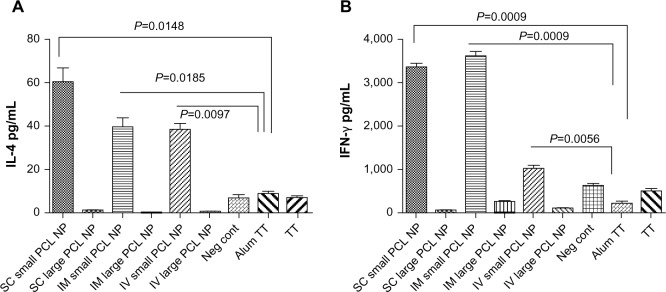
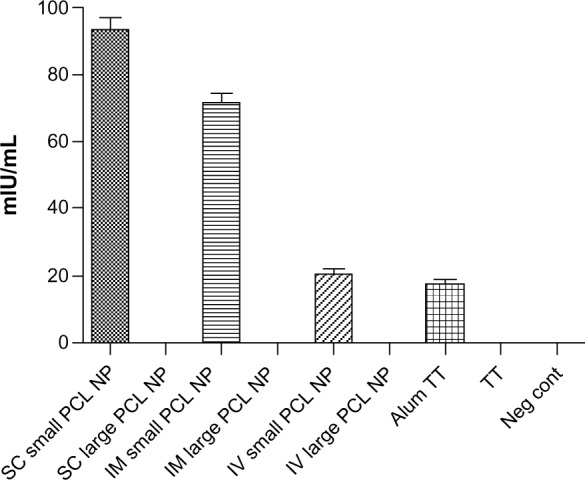
TT-loaded small PCL NPs were able to generate persistent and strong CMI and humoral responses against TT 2 months after single injection in mice without booster dose. This biodegradable nanoadjuvant system may help to develop single-shot immunization for prolonged immunity without booster doses. The capability of enhanced CMI response may have high translational potential for immunization against intracellular infection.
本研究旨在将模型抗原破伤风类毒素(TT)负载于两种尺寸范围的聚ε-己内酯纳米颗粒(PCL NPs)中,即平均粒径为61.2 nm(小)和467.6 nm(大),研究其对人单核细胞衍生巨噬细胞中巨噬细胞极化以及抗原呈递的影响,以及用负载TT的纳米颗粒免疫瑞士白化小鼠后产生的体液免疫和细胞介导免疫(CMI)反应。
通过溶剂蒸发合成PCL NPs。对负载抗原的PCL NPs进行尺寸、zeta电位和蛋白质释放动力学表征。用负载抗原的PCL NPs免疫瑞士白化小鼠。采用流式细胞术定量脾脏中分泌干扰素-γ和白细胞介素-4的分化簇(CD)4(+)和CD8(+) T细胞,并用酶联免疫吸附测定法定量免疫小鼠血清中的抗TT抗体水平。
小尺寸PCL NPs可使人血单核细胞衍生巨噬细胞产生M1/M2型极化,使自体CD4(+) T细胞产生辅助性T细胞(Th)1/Th2极化。还可有效引发CD8(+) T细胞反应。大尺寸PCL NPs未能引起任何类型的巨噬细胞极化。它们未引发有效的CD8(+) T细胞反应。
负载TT的小尺寸PCL NPs在小鼠单次注射后2个月无需加强剂量就能产生针对TT的持续而强烈的CMI和体液反应。这种可生物降解的纳米佐剂系统可能有助于开发无需加强剂量的单次注射长效免疫方法。增强CMI反应的能力对于针对细胞内感染的免疫接种可能具有很高的转化潜力。