Jo-Watanabe Airi, Ohse Takamoto, Nishimatsu Hiroaki, Takahashi Masao, Ikeda Yoichiro, Wada Takehiko, Shirakawa Jun-ichi, Nagai Ryoji, Miyata Toshio, Nagano Tetsuo, Hirata Yasunobu, Inagi Reiko, Nangaku Masaomi
Division of Nephrology and Endocrinology, Tokyo, Japan.
Aging Cell. 2014 Jun;13(3):519-28. doi: 10.1111/acel.12204. Epub 2014 Feb 24.
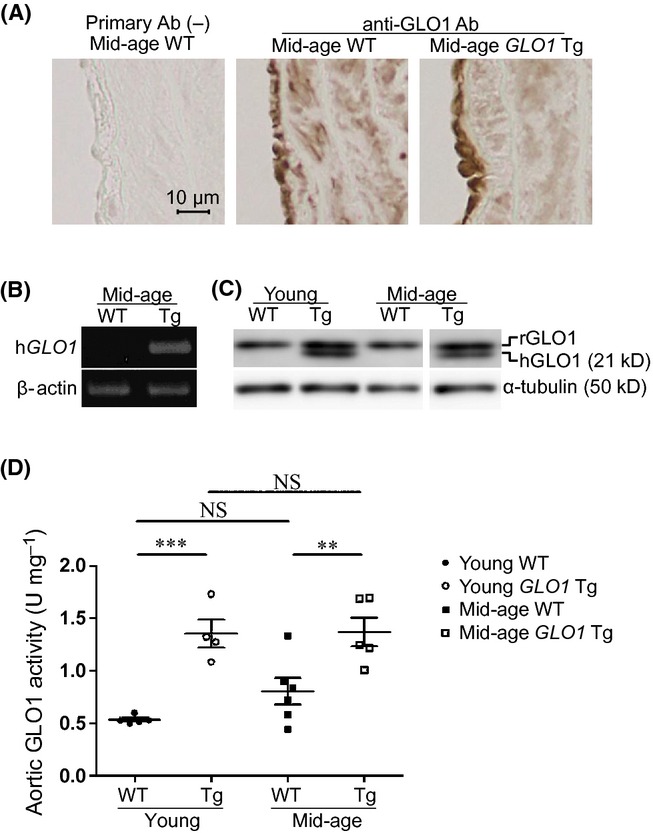
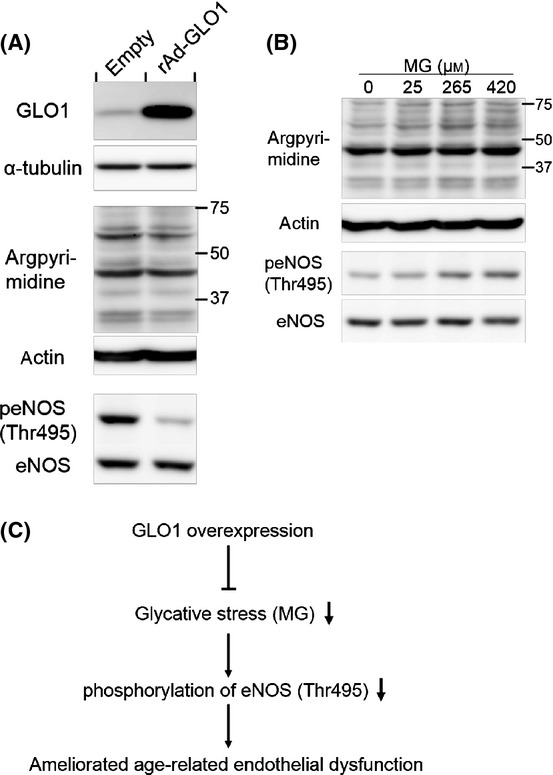
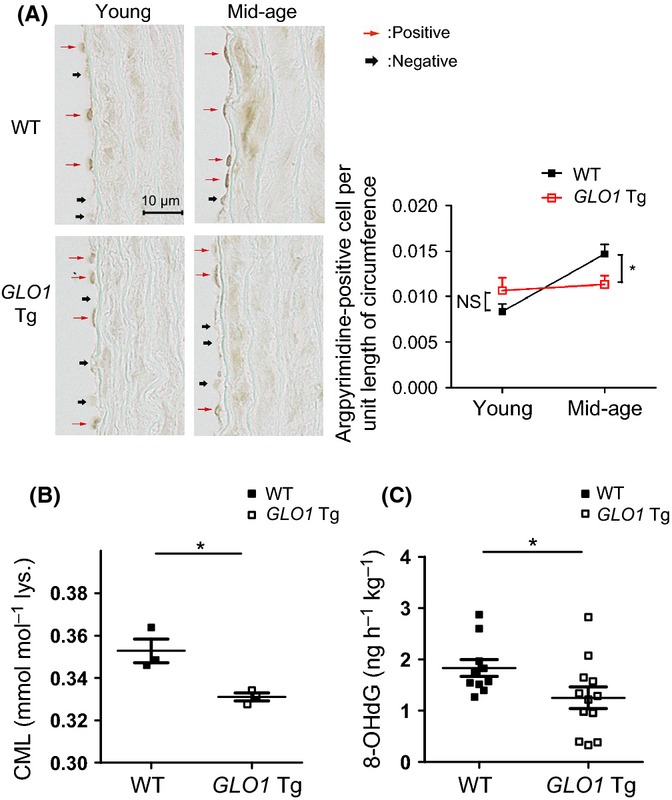
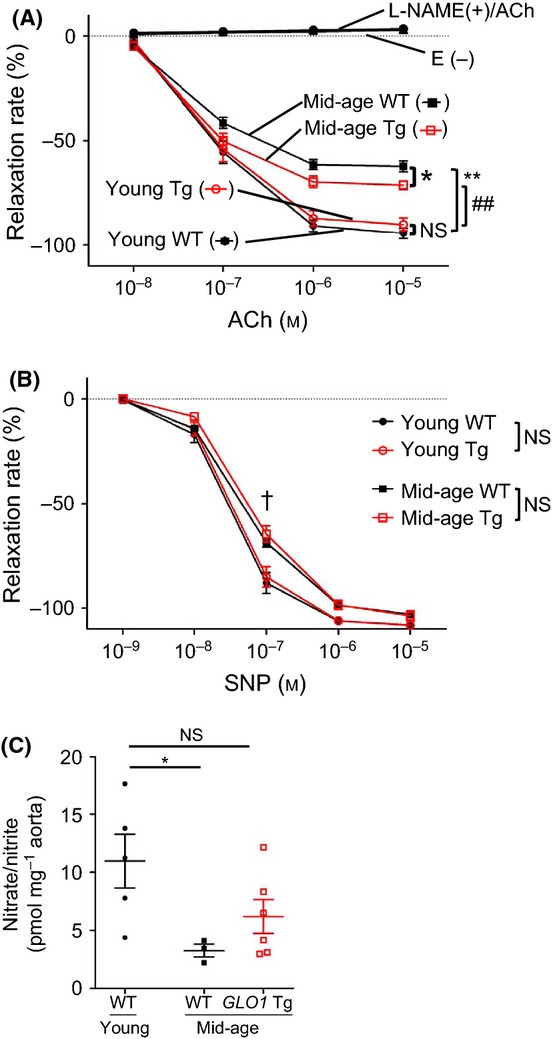
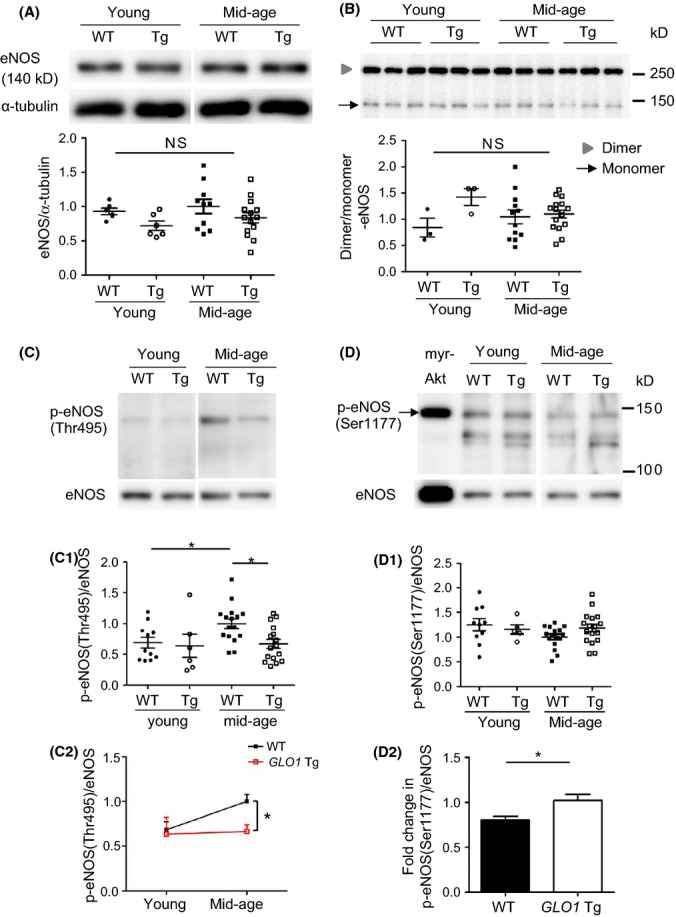
Endothelial dysfunction is a major contributor to cardiovascular disease (CVD), particularly in elderly people. Studies have demonstrated the role of glycation in endothelial dysfunction in nonphysiological models, but the physiological role of glycation in age-related endothelial dysfunction has been poorly addressed. Here, to investigate how vascular glycation affects age-related endothelial function, we employed rats systemically overexpressing glyoxalase I (GLO1), which detoxifies methylglyoxal (MG), a representative precursor of glycation. Four groups of rats were examined, namely young (13 weeks old), mid-age (53 weeks old) wild-type, and GLO1 transgenic (WT/GLO1 Tg) rats. Age-related acceleration in glycation was attenuated in GLO1 Tg rats, together with lower aortic carboxymethyllysine (CML) and urinary 8-hydroxydeoxyguanosine (8-OHdG) levels. Age-related impairment of endothelium-dependent vasorelaxation was attenuated in GLO1 Tg rats, whereas endothelium-independent vasorelaxation was not different between WT and GLO1 Tg rats. Nitric oxide (NO) production was decreased in mid-age WT rats, but not in mid-age GLO1 Tg rats. Age-related inactivation of endothelial NO synthase (eNOS) due to phosphorylation of eNOS on Thr495 and dephosphorylation on Ser1177 was ameliorated in GLO1 Tg rats. In vitro, MG increased phosphorylation of eNOS (Thr495) in primary human aortic endothelial cells (HAECs), and overexpression of GLO1 decreased glycative stress and phosphorylation of eNOS (Thr495). Together, GLO1 reduced age-related endothelial glycative and oxidative stress, altered phohphorylation of eNOS, and attenuated endothelial dysfunction. As a molecular mechanism, GLO1 lessened inhibitory phosphorylation of eNOS (Thr495) by reducing glycative stress. Our study demonstrates that blunting glycative stress prevents the long-term impact of endothelial dysfunction on vascular aging.
内皮功能障碍是心血管疾病(CVD)的主要促成因素,在老年人中尤为如此。研究已在非生理模型中证实了糖基化在内皮功能障碍中的作用,但糖基化在与年龄相关的内皮功能障碍中的生理作用尚未得到充分探讨。在此,为了研究血管糖基化如何影响与年龄相关的内皮功能,我们使用了全身过表达乙二醛酶I(GLO1)的大鼠,该酶可解毒糖基化的代表性前体甲基乙二醛(MG)。检查了四组大鼠,即年轻(13周龄)、中年(53周龄)野生型和GLO1转基因(WT/GLO1 Tg)大鼠。GLO1 Tg大鼠中与年龄相关的糖基化加速得到缓解,同时主动脉羧甲基赖氨酸(CML)和尿8-羟基脱氧鸟苷(8-OHdG)水平降低。GLO1 Tg大鼠中与年龄相关的内皮依赖性血管舒张功能障碍得到缓解,而野生型和GLO1 Tg大鼠之间的非内皮依赖性血管舒张功能没有差异。中年野生型大鼠的一氧化氮(NO)生成减少,但中年GLO1 Tg大鼠未减少。GLO1 Tg大鼠改善了因内皮型一氧化氮合酶(eNOS)第495位苏氨酸磷酸化和第1177位丝氨酸去磷酸化导致的与年龄相关的eNOS失活。在体外,MG增加了原代人主动脉内皮细胞(HAECs)中eNOS(第495位苏氨酸)的磷酸化,而GLO1的过表达降低了糖基化应激和eNOS(第495位苏氨酸)的磷酸化。总之,GLO1减少了与年龄相关的内皮糖基化和氧化应激,改变了eNOS的磷酸化,并减轻了内皮功能障碍。作为一种分子机制,GLO1通过降低糖基化应激减少了eNOS(第495位苏氨酸)的抑制性磷酸化。我们的研究表明,减轻糖基化应激可防止内皮功能障碍对血管衰老的长期影响。