Aboud Saleh Khaled, Husain Salina, Gendeh Balwant Singh
Department of Otorhinolaryngology-Head and Neck Surgery, Malaysian Allied Health Sciences Academy University, Jalan Elmu off Jalan Universiti, Kuala Lumpur, Malaysia.
Allergy Rhinol (Providence). 2014 Jan;5(1):2-8. doi: 10.2500/ar.2014.5.0075. Epub 2014 Jan 31.
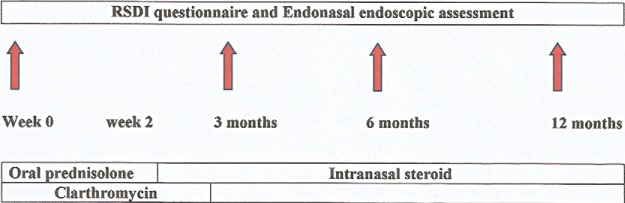
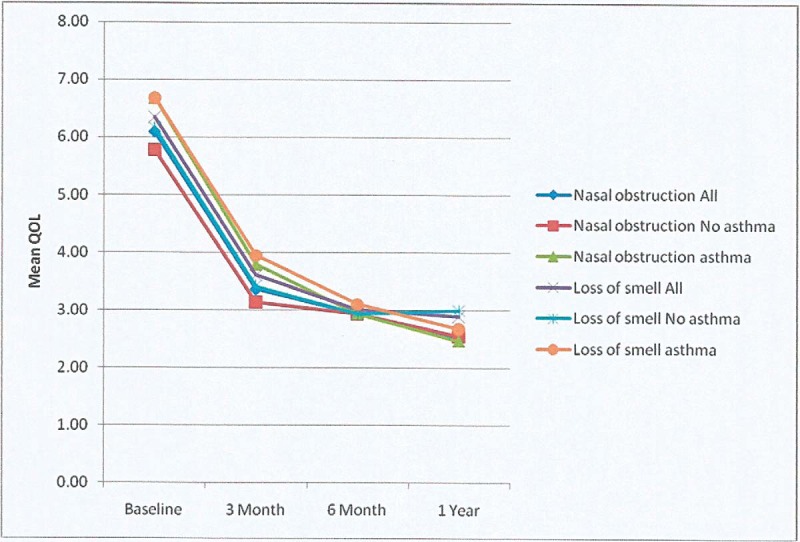
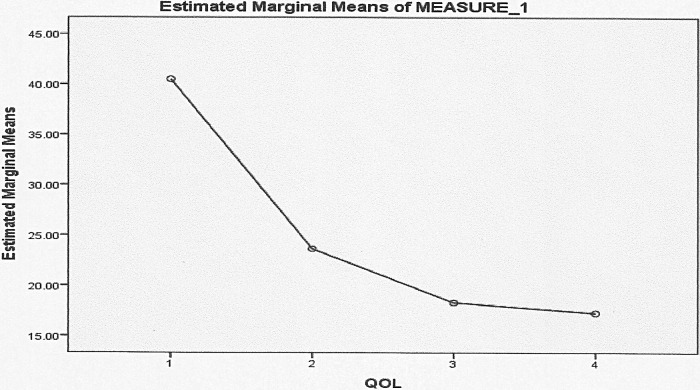
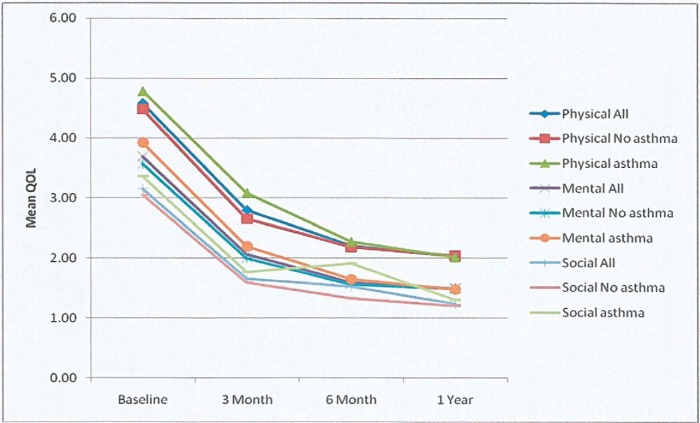
Nasal polyposis (NP) has a great impact on quality of life (QOL) and its management involves a combination of medical therapy and surgery. To the authors' knowledge, no publication has extensively examined NP after optimal medical treatment based on subjective evaluations. The aim of this prospective study was designed to evaluate the QOL in NP patients after (1) a short course of oral steroids, (2) initial 3-month course of macrolide, and (3) long-term treatment with intranasal steroids. A total of 55 patients with grades I and II NP were consecutively treated with oral prednisolone at 25 mg in a single dose for 2 weeks, macrolide at 250 mg daily for the first 3 months, and long-term intranasal steroids. Patients were followed up and evaluated at baseline and 3, 6, and 12 months for QOL measure. At baseline, patients with grade I and grade II NP showed significantly worse QOL scores on all Rhinosinusitis Disability Index domains, particularly for physical function (4.59 ± 1.41) and were significantly higher in social function (3.16 ± 1.17). At 3, 6, and 12 months of treatment, patients showed a significant improvement in all impaired QOL domains compared with baseline after optimal medical therapy (p < 0.05). These results suggest that the optimal medical treatment to improve QOL incorporates medical polypectomy with a short course of oral steroids in addition to macrolide and this can be maintained by long-term intranasal steroid therapy.
鼻息肉病(NP)对生活质量(QOL)有很大影响,其治疗包括药物治疗和手术治疗相结合。据作者所知,尚无出版物基于主观评估对最佳药物治疗后的NP进行广泛研究。这项前瞻性研究的目的是评估NP患者在(1)短期口服类固醇、(2)初始3个月大环内酯类药物疗程以及(3)长期鼻内类固醇治疗后的生活质量。共有55例I级和II级NP患者连续接受治疗,口服泼尼松龙25mg单剂量,持续2周,前3个月每日口服250mg大环内酯类药物,并长期使用鼻内类固醇。对患者进行随访,并在基线以及3、6和12个月时评估生活质量指标。在基线时,I级和II级NP患者在所有鼻窦炎残疾指数领域的生活质量得分均显著较差,尤其是身体功能方面(4.59±1.41),而社会功能方面得分显著较高(3.16±1.17)。在治疗的3、6和12个月时,与最佳药物治疗后的基线相比,患者在所有受损的生活质量领域均有显著改善(p<0.05)。这些结果表明,改善生活质量的最佳药物治疗除了大环内酯类药物外,还包括短期口服类固醇的药物性息肉切除术,并且可以通过长期鼻内类固醇治疗维持。