Medical University of South Carolina Charleston, SC, USA ; Charleston Alcohol Research Center Charleston, SC, USA.
Medical University of South Carolina Charleston, SC, USA ; Charleston Alcohol Research Center Charleston, SC, USA ; Ralph H. Johnson VA Medical Center USA.
Front Neurosci. 2014 Feb 25;8:33. doi: 10.3389/fnins.2014.00033. eCollection 2014.
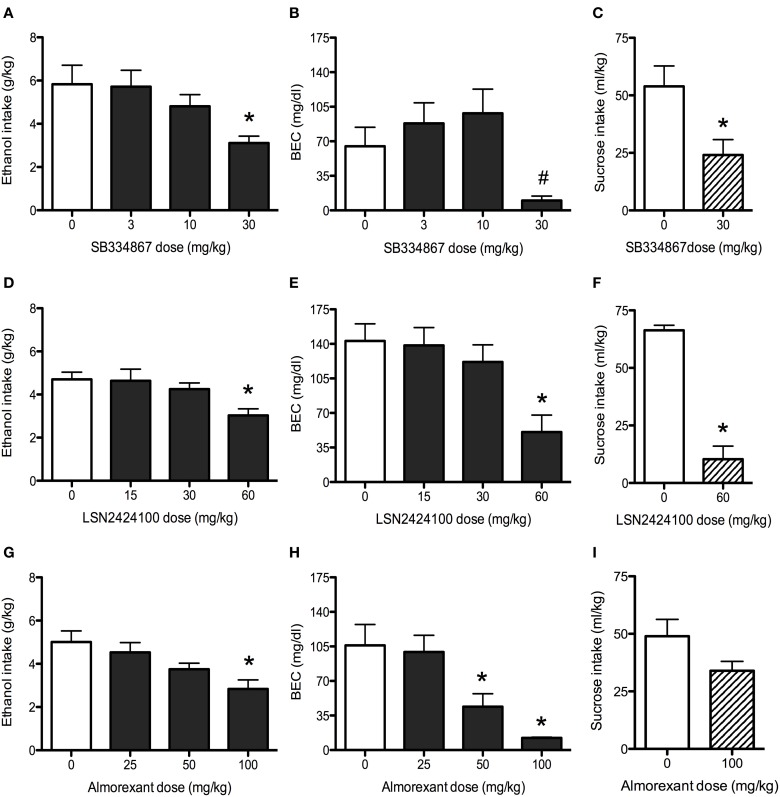
To examine the role of orexin-1 and orexin-2 receptor activity on ethanol self-administration, compounds that differentially target orexin (OX) receptor subtypes were assessed in various self-administration paradigms using high-drinking rodent models. Effects of the OX1 antagonist SB334867, the OX2 antagonist LSN2424100, and the mixed OX1/2 antagonist almorexant (ACT-078573) on home cage ethanol consumption were tested in ethanol-preferring (P) rats using a 2-bottle choice procedure. In separate experiments, effects of SB334867, LSN2424100, and almorexant on operant ethanol self-administration were assessed in P rats maintained on a progressive ratio operant schedule of reinforcement. In a third series of experiments, SB334867, LSN2424100, and almorexant were administered to ethanol-preferring C57BL/6J mice to examine effects of OX receptor blockade on ethanol intake in a binge-like drinking (drinking-in-the-dark) model. In P rats with chronic home cage free-choice ethanol access, SB334867 and almorexant significantly reduced ethanol intake, but almorexant also reduced water intake, suggesting non-specific effects on consummatory behavior. In the progressive ratio operant experiments, LSN2424100 and almorexant reduced breakpoints and ethanol consumption in P rats, whereas the almorexant inactive enantiomer and SB334867 did not significantly affect the motivation to consume ethanol. As expected, vehicle-injected mice exhibited binge-like drinking patterns in the drinking-in-the-dark model. All three OX antagonists reduced both ethanol intake and resulting blood ethanol concentrations relative to vehicle-injected controls, but SB334867 and LSN2424100 also reduced sucrose consumption in a different cohort of mice, suggesting non-specific effects. Collectively, these results contribute to a growing body of evidence indicating that OX1 and OX2 receptor activity influences ethanol self-administration, although the effects may not be selective for ethanol consumption.
为了研究食欲素-1 和食欲素-2 受体活性对乙醇自我给药的作用,使用高饮酒量啮齿动物模型,在各种自我给药范式中评估了针对食欲素(OX)受体亚型的不同化合物。在使用双瓶选择程序的乙醇偏好(P)大鼠中,测试了 OX1 拮抗剂 SB334867、OX2 拮抗剂 LSN2424100 和混合 OX1/2 拮抗剂 almorexant(ACT-078573)对笼内乙醇消耗的影响。在单独的实验中,在 P 大鼠上进行了 SB334867、LSN2424100 和 almorexant 对操作性乙醇自我给药的影响的评估,这些大鼠维持在递增比例操作性强化时间表上。在一系列的第三项实验中,将 SB334867、LSN2424100 和 almorexant 给予乙醇偏好的 C57BL/6J 小鼠,以检查 OX 受体阻断对 binge-like 饮酒(暗饮)模型中乙醇摄入的影响。在具有慢性笼内自由选择乙醇摄入的 P 大鼠中,SB334867 和 almorexant 显著减少了乙醇摄入,但 almorexant 也减少了水的摄入,这表明对摄食行为有非特异性影响。在递增比例操作实验中,LSN2424100 和 almorexant 降低了 P 大鼠的断点和乙醇消耗,而 almorexant 的无效对映体和 SB334867 则没有显著影响乙醇的摄取动机。正如预期的那样,在暗饮模型中,载体注射的小鼠表现出 binge-like 饮酒模式。三种 OX 拮抗剂都降低了与载体注射对照相比,乙醇摄入和由此产生的血液乙醇浓度,但 SB334867 和 LSN2424100 也降低了另一组小鼠的蔗糖消耗,这表明存在非特异性影响。总的来说,这些结果为越来越多的证据表明,OX1 和 OX2 受体活性影响乙醇自我给药,尽管这些作用可能不是选择性地针对乙醇消耗。