Department of Medical Imaging, St. Olavs Hospital Trondheim, Norway.
Department of Biological and Medical Psychology, University of Bergen Bergen, Norway.
Front Hum Neurosci. 2014 Feb 26;8:86. doi: 10.3389/fnhum.2014.00086. eCollection 2014.
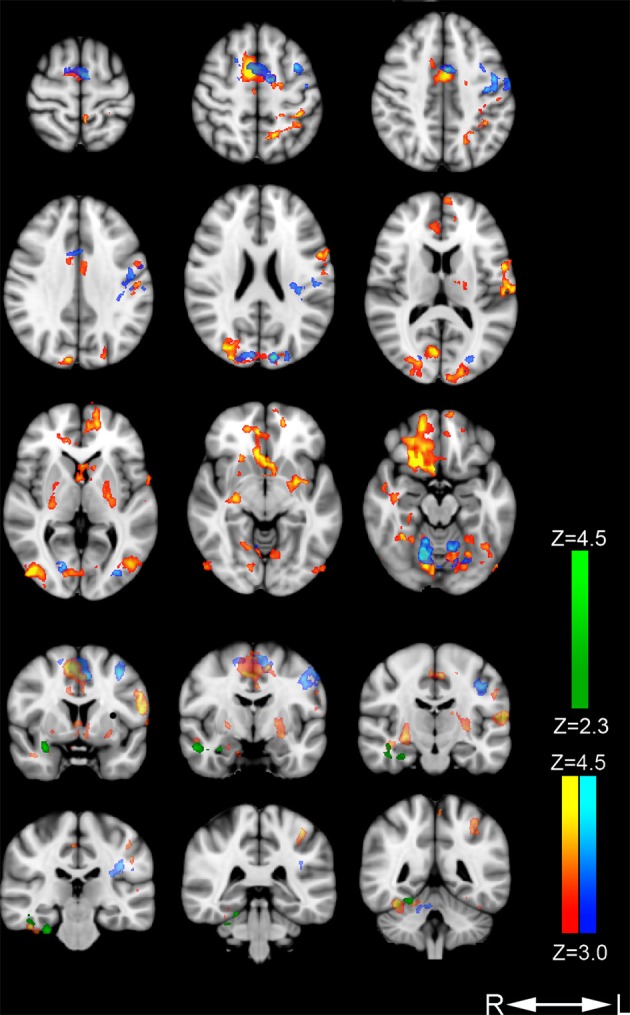
Nondirective meditation techniques are practiced with a relaxed focus of attention that permits spontaneously occurring thoughts, images, sensations, memories, and emotions to emerge and pass freely, without any expectation that mind wandering should abate. These techniques are thought to facilitate mental processing of emotional experiences, thereby contributing to wellness and stress management. The present study assessed brain activity by functional magnetic resonance imaging (fMRI) in 14 experienced practitioners of Acem meditation in two experimental conditions. In the first, nondirective meditation was compared to rest. Significantly increased activity was detected in areas associated with attention, mind wandering, retrieval of episodic memories, and emotional processing. In the second condition, participants carried out concentrative practicing of the same meditation technique, actively trying to avoid mind wandering. The contrast nondirective meditation > concentrative practicing was characterized by higher activity in the right medial temporal lobe (parahippocampal gyrus and amygdala). In conclusion, the present results support the notion that nondirective meditation, which permits mind wandering, involves more extensive activation of brain areas associated with episodic memories and emotional processing, than during concentrative practicing or regular rest.
非指导性冥想技术是以放松的注意力为基础进行练习的,这种注意力允许自发出现的想法、图像、感觉、记忆和情绪自由浮现和消逝,而不期望思维漫游会减弱。这些技术被认为有助于情绪体验的心理处理,从而有助于健康和压力管理。本研究通过功能磁共振成像 (fMRI) 对 14 名有经验的 Acem 冥想者在两种实验条件下的大脑活动进行了评估。在第一种情况下,将非指导性冥想与休息进行了比较。在与注意力、思维漫游、情景记忆检索和情绪处理相关的区域中,检测到显著增加的活动。在第二种情况下,参与者进行了相同冥想技术的集中练习,积极试图避免思维漫游。非指导性冥想>集中练习的对比表现为右侧内侧颞叶(海马旁回和杏仁核)的活性更高。总之,本研究结果支持这样一种观点,即允许思维漫游的非指导性冥想,与集中练习或常规休息相比,会引起与情景记忆和情绪处理相关的大脑区域更广泛的激活。