Plant Research Laboratory, Department of Energy, Michigan State University East Lansing, MI, USA ; Department of Plant Biology, Michigan State University East Lansing, MI, USA.
Front Plant Sci. 2014 Feb 26;5:69. doi: 10.3389/fpls.2014.00069. eCollection 2014.
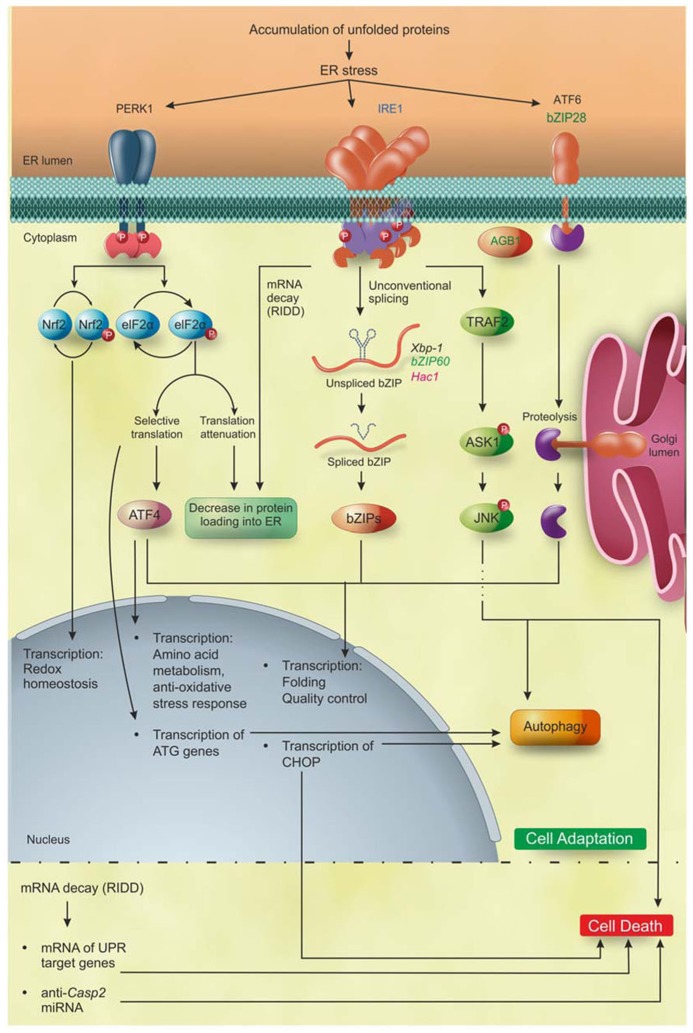
Stress caused by environmental conditions or physiological growth can lead to an accumulation of unfolded proteins in the endoplasmic reticulum (ER) causing ER stress, which in turn triggers a cytoprotective mechanism termed the unfolded protein response (UPR). Under mild-short stress conditions the UPR can restore ER functioning and cell growth, such as reducing the load of unfolded proteins through the upregulation of genes involved in protein folding and in degrading mis-folded proteins, and through autophagy activation, but it can also lead to cell death under prolonged and severe stress conditions. A diversified suite of sensors has been evolved in the eukaryotic lineages to orchestrate the UPR most likely to suit the cell's necessity to respond to the different kinds of stress in a conserved as well as species-specific manner. In plants three UPR sensors cooperate with non-identical signaling pathways: the protein kinase inositol-requiring enzyme (IRE1), the ER-membrane-associated transcription factor bZIP28, and the GTP-binding protein β1 (AGB1). In this mini-review, we show how plants differ from the better characterized metazoans and fungi, providing an overview of the signaling pathways of the UPR, and highlighting the overlapping and the peculiar roles of the different UPR branches in light of evolutionary divergences in eukaryotic kingdoms.
由环境条件或生理生长引起的应激会导致内质网(ER)中未折叠蛋白的积累,从而引发内质网应激,这反过来又触发了一种称为未折叠蛋白反应(UPR)的细胞保护机制。在轻度短期应激条件下,UPR 可以恢复 ER 的功能和细胞生长,例如通过上调参与蛋白折叠和降解错误折叠蛋白的基因,以及通过自噬激活来减少未折叠蛋白的负荷,但在长期和严重的应激条件下也会导致细胞死亡。真核生物进化出了多样化的传感器套件,以协调 UPR,最有可能以保守和物种特异性的方式适应细胞对不同类型应激的反应需求。在植物中,三种 UPR 传感器与非同源信号通路合作:肌醇需求酶蛋白激酶(IRE1)、内质网膜相关转录因子 bZIP28 和 GTP 结合蛋白β1(AGB1)。在这篇综述中,我们展示了植物与更好表征的后生动物和真菌有何不同,概述了 UPR 的信号通路,并根据真核生物王国的进化分歧,强调了不同 UPR 分支的重叠和独特作用。