Meier Raphael P H, Seebach Jörg D, Morel Philippe, Mahou Redouan, Borot Sophie, Giovannoni Laurianne, Parnaud Geraldine, Montanari Elisa, Bosco Domenico, Wandrey Christine, Berney Thierry, Bühler Leo H, Muller Yannick D
Cell Isolation and Transplantation Center, Department of Surgery, Geneva University Hospitals and University of Geneva, Geneva, Switzerland.
Division of Clinical Immunology and Allergology, Department of Internal Medicine, University Hospital and Medical Faculty, Geneva, Switzerland.
PLoS One. 2014 Mar 13;9(3):e91268. doi: 10.1371/journal.pone.0091268. eCollection 2014.
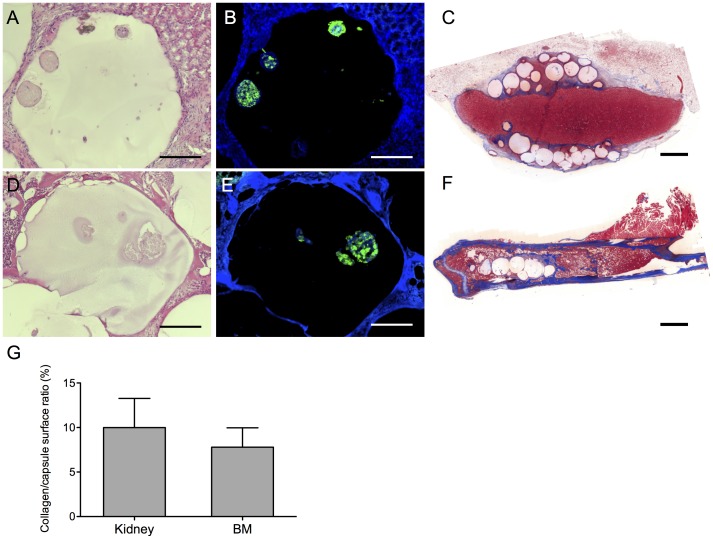
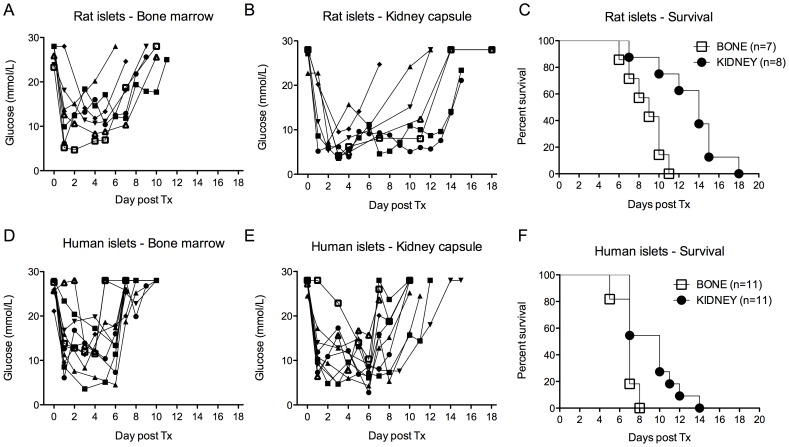
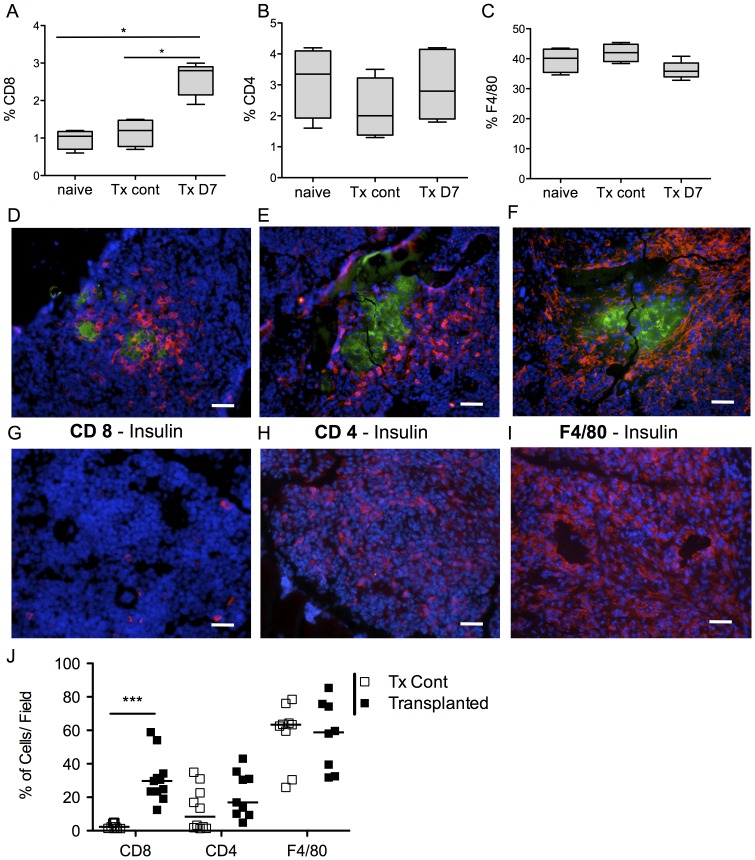
Bone marrow was recently proposed as an alternative and potentially immune-privileged site for pancreatic islet transplantation. The aim of the present study was to assess the survival and rejection mechanisms of free and encapsulated xenogeneic islets transplanted into the medullary cavity of the femur, or under the kidney capsule of streptozotocin-induced diabetic C57BL/6 mice. The median survival of free rat islets transplanted into the bone marrow or under the kidney capsule was 9 and 14 days, respectively, whereas that of free human islets was shorter, 7 days (bone marrow) and 10 days (kidney capsule). Infiltrating CD8+ T cells and redistributed CD4+ T cells, and macrophages were detected around the transplanted islets in bone sections. Recipient mouse splenocytes proliferated in response to donor rat stimulator cells. One month after transplantation under both kidney capsule or into bone marrow, encapsulated rat islets had induced a similar degree of fibrotic reaction and still contained insulin positive cells. In conclusion, we successfully established a small animal model for xenogeneic islet transplantation into the bone marrow. The rejection of xenogeneic islets was associated with local and systemic T cell responses and macrophage recruitment. Although there was no evidence for immune-privilege, the bone marrow may represent a feasible site for encapsulated xenogeneic islet transplantation.
最近有人提出,骨髓可作为胰岛移植的另一种潜在的免疫豁免部位。本研究的目的是评估游离和封装的异种胰岛移植到链脲佐菌素诱导的糖尿病C57BL/6小鼠的股骨骨髓腔或肾包膜下后的存活情况及排斥机制。移植到骨髓或肾包膜下的游离大鼠胰岛的中位存活时间分别为9天和14天,而游离人胰岛的存活时间较短,分别为7天(骨髓)和10天(肾包膜)。在骨切片中,移植的胰岛周围检测到浸润的CD8+ T细胞、重新分布的CD4+ T细胞和巨噬细胞。受体小鼠脾细胞对供体大鼠刺激细胞有增殖反应。在肾包膜下或骨髓内移植一个月后,封装的大鼠胰岛诱导了相似程度的纤维化反应,并且仍含有胰岛素阳性细胞。总之,我们成功建立了一个将异种胰岛移植到骨髓的小动物模型。异种胰岛的排斥与局部和全身的T细胞反应以及巨噬细胞募集有关。虽然没有证据表明存在免疫豁免,但骨髓可能是封装的异种胰岛移植的一个可行部位。