Paul Langerhans Institute Dresden (PLID) of Helmholtz Zentrum München at the University Clinic Carl Gustav Carus of Technische Universität Dresden, Helmholtz Zentrum München, München-Neuherberg, Germany.
German Center for Diabetes Research (DZD), München-Neuherberg, Germany.
Mol Metab. 2017 Jul 8;6(9):943-957. doi: 10.1016/j.molmet.2017.06.019. eCollection 2017 Sep.
Plasma insulin levels are predominantly the product of the morphological mass of insulin producing beta cells in the pancreatic islets of Langerhans and the functional status of each of these beta cells. Thus, deficiency in either beta cell mass or function, or both, can lead to insufficient levels of insulin, resulting in hyperglycemia and diabetes. Nonetheless, the precise contribution of beta cell mass and function to the pathogenesis of diabetes as well as the underlying mechanisms are still unclear. In the past, this was largely due to the restricted number of technologies suitable for studying the scarcely accessible human beta cells. However, in recent years, a number of new platforms have been established to expand the available techniques and to facilitate deeper insight into the role of human beta cell mass and function as cause for diabetes and as potential treatment targets.
This review discusses the current knowledge about contribution of human beta cell mass and function to different stages of type 1 and type 2 diabetes pathogenesis. Furthermore, it highlights standard and newly developed technological platforms for the study of human beta cell biology, which can be used to increase our understanding of beta cell mass and function in human glucose homeostasis.
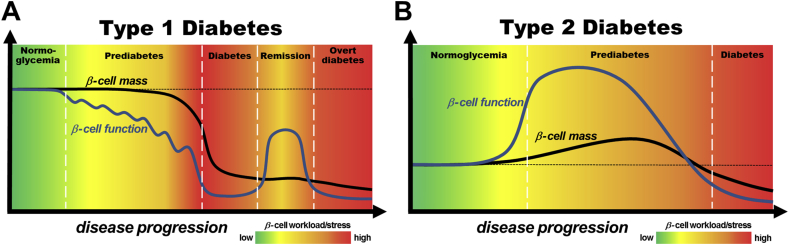
In contrast to early disease models, recent studies suggest that in type 1 and type 2 diabetes impairment of beta cell function is an early feature of disease pathogenesis while a substantial decrease in beta cell mass occurs more closely to clinical manifestation. This suggests that, in addition to beta cell mass replacement for late stage therapies, the development of novel strategies for protection and recovery of beta cell function could be most promising for successful diabetes treatment and prevention. The use of today's developing and wide range of technologies and platforms for the study of human beta cells will allow for a more detailed investigation of the underlying mechanisms and will facilitate development of treatment approaches to specifically target human beta cell mass and function.
血浆胰岛素水平主要是胰岛 Langerhans 中胰岛素产生β细胞的形态质量和这些β细胞的功能状态的产物。因此,β细胞质量或功能的缺乏,或两者兼而有之,都会导致胰岛素水平不足,导致高血糖和糖尿病。尽管如此,β细胞质量和功能对糖尿病发病机制的精确贡献以及潜在机制仍不清楚。在过去,这主要是由于适合研究难以接近的人类β细胞的技术数量有限。然而,近年来,已经建立了许多新平台来扩展可用技术,并促进对人类β细胞质量和功能作为糖尿病病因以及作为潜在治疗靶点的作用的更深入了解。
本文讨论了目前关于人类β细胞质量和功能对 1 型和 2 型糖尿病发病机制不同阶段的贡献的知识。此外,它还强调了用于研究人类β细胞生物学的标准和新开发的技术平台,这些平台可用于增加我们对人类葡萄糖稳态中β细胞质量和功能的理解。
与早期疾病模型相反,最近的研究表明,在 1 型和 2 型糖尿病中,β细胞功能的损害是疾病发病机制的早期特征,而β细胞质量的显著下降则更接近临床表现。这表明,除了晚期治疗的β细胞质量替代外,开发保护和恢复β细胞功能的新策略对于成功的糖尿病治疗和预防可能最有希望。使用当今发展和广泛的技术和平台研究人类β细胞将允许更详细地研究潜在机制,并促进针对人类β细胞质量和功能的治疗方法的开发。