Zhang Xiaoyan, Li Caixia, Gong Zhiyuan
Department of Biological Sciences, National University of Singapore, Singapore, Singapore.
PLoS One. 2014 Mar 13;9(3):e91874. doi: 10.1371/journal.pone.0091874. eCollection 2014.
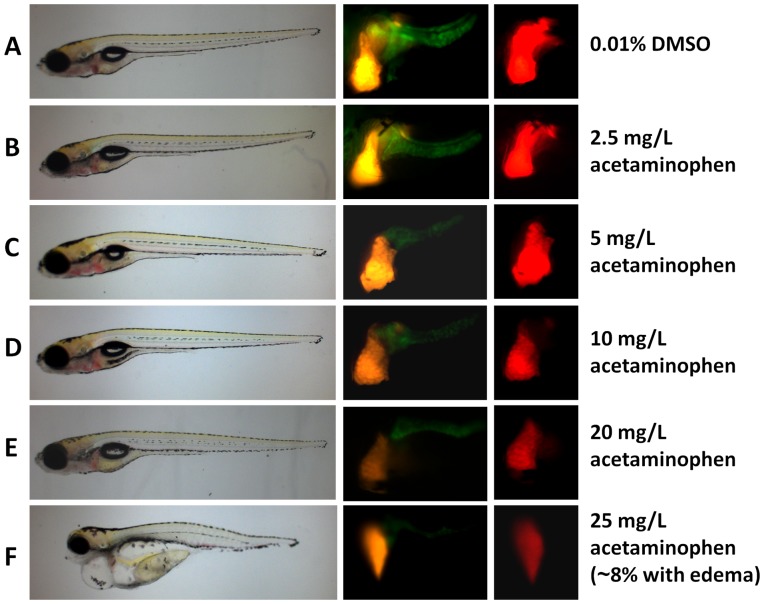
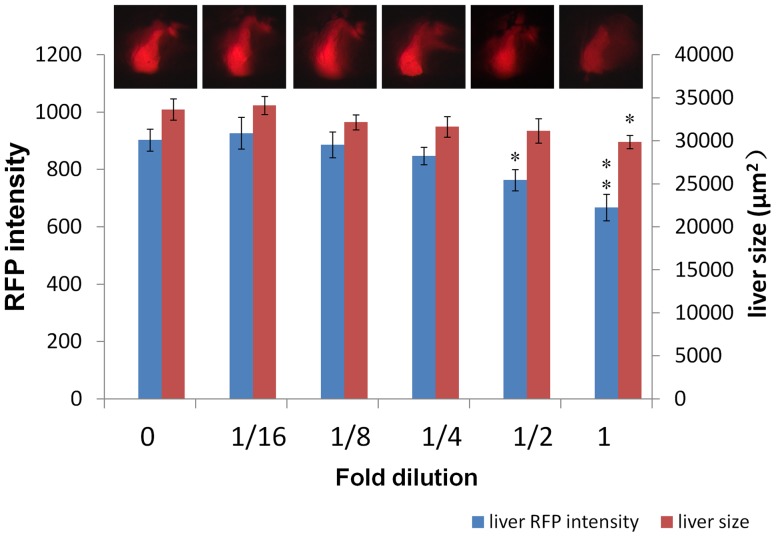
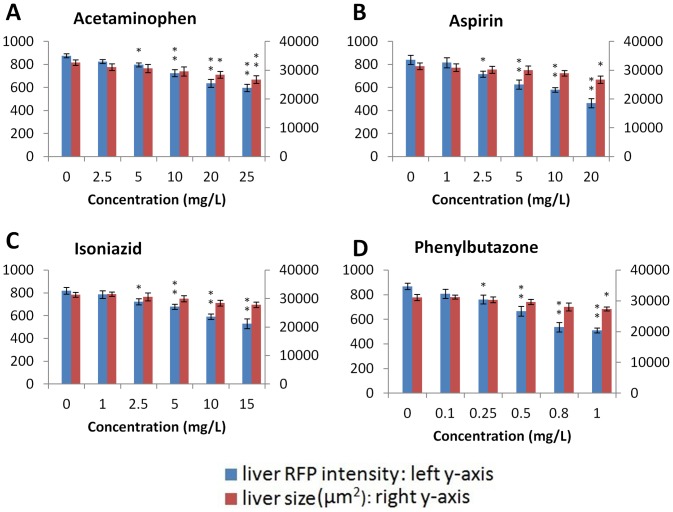
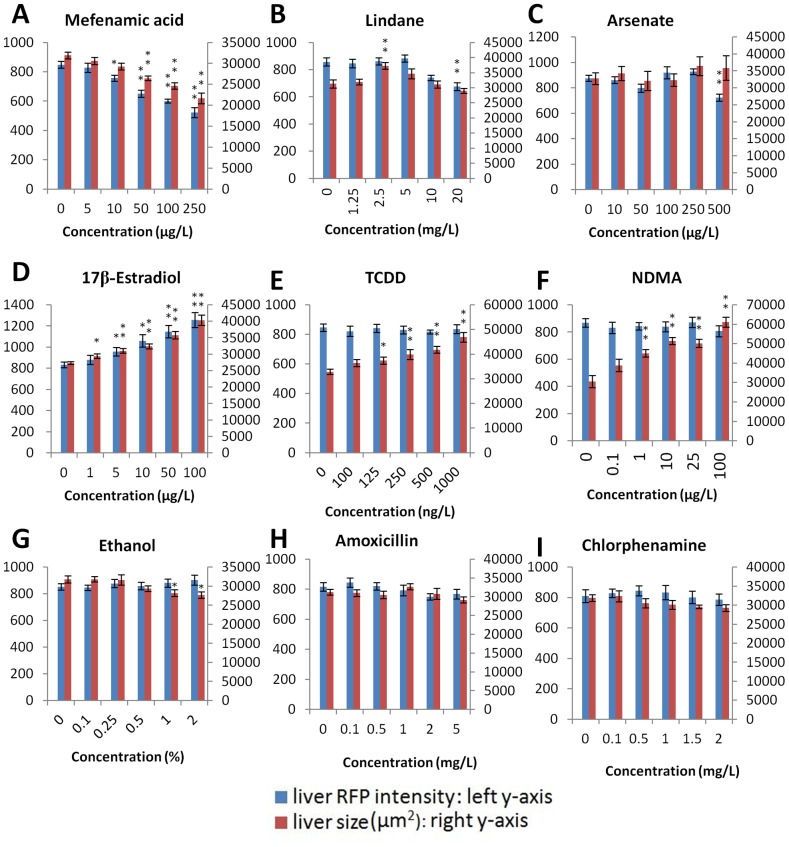
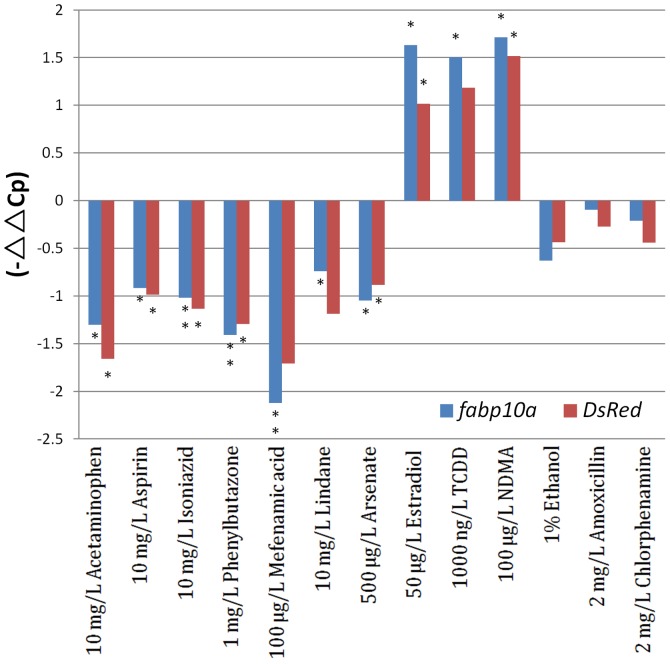
Previously we have developed a transgenic zebrafish line (LiPan) with liver-specific red fluorescent protein (DsRed) expression under the fabp10a promoter. Since red fluorescence in the liver greatly facilitates the observation of liver in live LiPan fry, we envision that the LiPan zebrafish may provide a useful tool in analyses of hepatotoxicity based on changes of liver red fluorescence intensity and size. In this study, we first tested four well-established hepatotoxins (acetaminophen, aspirin, isoniazid and phenylbutazone) in LiPan fry and demonstrated that these hepatotoxins could significantly reduce both liver red fluorescence and liver size in a dosage-dependent manner, thus the two measurable parameters could be used as indicators of hepatotoxicity. We then tested the LiPan fry with nine other chemicals including environmental toxicants and human drugs. Three (mefenamic acid, lindane, and arsenate) behave like hepatotoxins in reduction of liver red fluorescence, while three others (17β-estradiol, TCDD [2,3,7,8-tetrachlorodibenzo-p-dioxin] and NDMA [N-nitrosodimethylamine]) caused increase of liver red fluorescence and the liver size. Ethanol and two other chemicals, amoxicillin (antibiotics) and chlorphenamine (pain killer) did not resulted in significant changes of liver red fluorescence and liver size. By quantitative RT-PCR analysis, we found that the changes of red fluorescence intensity caused by different chemicals correlated to the changes of endogenous fabp10a RNA expression, indicating that the measured hepatotoxicity was related to fatty acid transportation and metabolism. Finally we tested a mixture of four hepatotoxins and observed a significant reduction of red fluorescence in the liver at concentrations below the lowest effective concentrations of individual hepatotoxins, suggesting that the transgenic zebrafish assay is capable of reporting compound hepatotoxicity effect from chemical mixtures. Thus, the LiPan transgenic fry provide a rapid and convenient in vivo hepatotoxicity assay that should be applicable to high-throughput hepatotoxicity test in drug screening as well as in biomonitoring environmental toxicants.
此前,我们利用fabp10a启动子开发了一种肝脏特异性表达红色荧光蛋白(DsRed)的转基因斑马鱼品系(LiPan)。由于肝脏中的红色荧光极大地便于在活的LiPan幼鱼中观察肝脏,我们设想LiPan斑马鱼可能会成为一种基于肝脏红色荧光强度和大小变化来分析肝毒性的有用工具。在本研究中,我们首先在LiPan幼鱼中测试了四种成熟的肝毒素(对乙酰氨基酚、阿司匹林、异烟肼和保泰松),并证明这些肝毒素能够以剂量依赖性方式显著降低肝脏红色荧光和肝脏大小,因此这两个可测量参数可作为肝毒性的指标。然后我们用包括环境毒物和人类药物在内的其他九种化学物质测试了LiPan幼鱼。其中三种(甲芬那酸、林丹和砷酸盐)在降低肝脏红色荧光方面表现得像肝毒素,而另外三种(17β-雌二醇、TCDD [2,3,7,8-四氯二苯并对二恶英] 和NDMA [N-亚硝基二甲胺])导致肝脏红色荧光和肝脏大小增加。乙醇以及另外两种化学物质阿莫西林(抗生素)和氯苯那敏(止痛药)并未导致肝脏红色荧光和肝脏大小发生显著变化。通过定量RT-PCR分析,我们发现不同化学物质引起的红色荧光强度变化与内源性fabp10a RNA表达的变化相关,表明所测得的肝毒性与脂肪酸转运和代谢有关。最后我们测试了四种肝毒素的混合物,发现在低于单个肝毒素最低有效浓度的情况下,肝脏中的红色荧光显著降低,这表明转基因斑马鱼试验能够报告化学混合物的复合肝毒性效应。因此,LiPan转基因幼鱼提供了一种快速便捷的体内肝毒性检测方法,适用于药物筛选中的高通量肝毒性测试以及生物监测环境毒物。