Goldfarb Samantha, Tarver Will L, Sen Bisakha
Department of Health Care Organization and Policy, School of Public Health, University of Alabama at Birmingham, Birmingham, AL, USA.
Psychol Res Behav Manag. 2014 Feb 15;7:53-66. doi: 10.2147/PRBM.S40461. eCollection 2014.
Previous literature has asserted that family meals are a key protective factor for certain adolescent risk behaviors. It is suggested that the frequency of eating with the family is associated with better psychological well-being and a lower risk of substance use and delinquency. However, it is unclear whether there is evidence of causal links between family meals and adolescent health-risk behaviors.
The purpose of this article is to review the empirical literature on family meals and adolescent health behaviors and outcomes in the US.
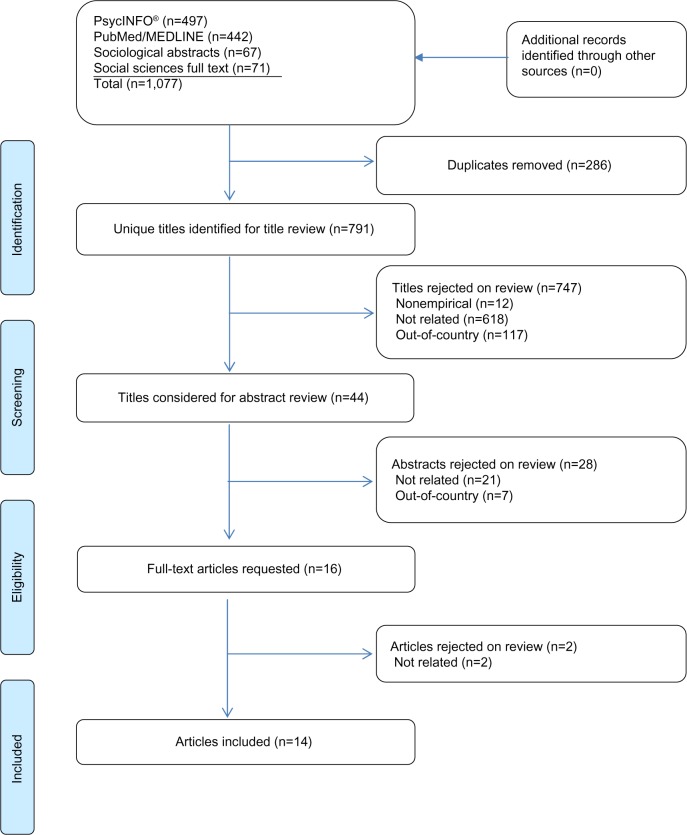
A SEARCH WAS CONDUCTED IN FOUR ACADEMIC DATABASES: Social Sciences Full Text, Sociological Abstracts, PsycINFO®, and PubMed/MEDLINE.
We included studies that quantitatively estimated the relationship between family meals and health-risk behaviors.
Data were extracted on study sample, study design, family meal measurement, outcomes, empirical methods, findings, and major issues.
Fourteen studies met the inclusion criteria for the review that measured the relationship between frequent family meals and various risk-behavior outcomes. The outcomes considered by most studies were alcohol use (n=10), tobacco use (n=9), and marijuana use (n=6). Other outcomes included sexual activity (n=2); depression, suicidal ideation, and suicide attempts (n=4); violence and delinquency (n=4); school-related issues (n=2); and well-being (n=5). The associations between family meals and the outcomes of interest were most likely to be statistically significant in unadjusted models or models controlling for basic family characteristics. Associations were less likely to be statistically significant when other measures of family connectedness were included. Relatively few analyses used sophisticated empirical techniques available to control for confounders in secondary data.
More research is required to establish whether or not the relationship between family dinners and risky adolescent behaviors is an artifact of underlying confounders. We recommend that researchers make more frequent use of sophisticated methods to reduce the problem of confounders in secondary data, and that the scope of adolescent problem behaviors also be further widened.
以往文献称家庭聚餐是某些青少年风险行为的关键保护因素。有人认为与家人一起用餐的频率与更好的心理健康以及较低的物质使用和犯罪风险相关。然而,家庭聚餐与青少年健康风险行为之间是否存在因果关系的证据尚不清楚。
本文旨在综述美国关于家庭聚餐与青少年健康行为及结果的实证文献。
在四个学术数据库中进行了检索:社会科学全文数据库、社会学文摘数据库、心理学文摘数据库(PsycINFO®)和医学期刊数据库(PubMed/MEDLINE)。
我们纳入了定量估计家庭聚餐与健康风险行为之间关系的研究。
提取了关于研究样本、研究设计、家庭聚餐测量、结果、实证方法、研究结果和主要问题的数据。
十四项研究符合综述的纳入标准,这些研究测量了频繁家庭聚餐与各种风险行为结果之间的关系。大多数研究考虑的结果包括饮酒(n = 10)、吸烟(n = 9)和使用大麻(n = 6)。其他结果包括性行为(n = 2);抑郁、自杀意念和自杀未遂(n = 4);暴力和犯罪(n = 4);与学校相关的问题(n = 2);以及幸福感(n = 5)。在未调整的模型或控制基本家庭特征的模型中,家庭聚餐与感兴趣的结果之间的关联最有可能具有统计学意义。当纳入其他家庭联系度量时,关联不太可能具有统计学意义。相对较少的分析使用了可用于控制二次数据中混杂因素的复杂实证技术。
需要更多研究来确定家庭晚餐与青少年危险行为之间的关系是否是潜在混杂因素的产物。我们建议研究人员更频繁地使用复杂方法来减少二次数据中混杂因素的问题,并且青少年问题行为的范围也应进一步扩大。