Department of Food and Nutrition, and Sport Science, University of Gothenburg, Box 300, 405 30, Göteborg, Sweden.
BMC Public Health. 2020 Feb 5;20(1):187. doi: 10.1186/s12889-020-8295-7.
Dieting is a risk factor of both eating disorders and obesity. The aim was to examine time trends of dieting in Swedish adolescents, and explore how dieting and body weight dissatisfaction are related to self-reported health, wellbeing and health behaviours.
Analyses of cross-sectional Swedish data from HBSC (Health Behaviour in School-aged Children) surveys 1994-2014. In total, about 30,000 girls and boys in the age of 11, 13 and 15 years participated. Data was collected by using classroom administered questionnaires in 5th, 7th and 9th grade. Logistic regressions was used to analyse secular trends of dieting, and how dieting and body dissatisfaction were associated with self-reported overall health, health behaviours, BMI and various physical, psychological and social aspects of health in 2014.
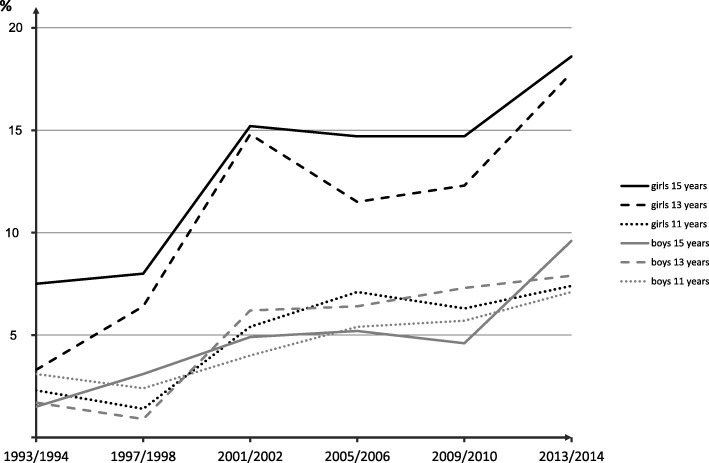
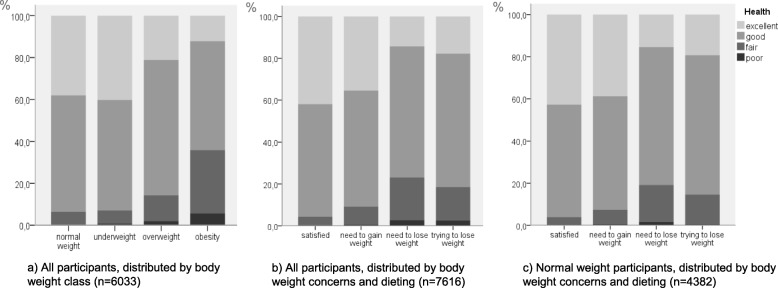
Dieting increased from 1994 to 2014 in both girls and boys in all age groups, and in 2014, the prevalence was 14% in girls and 8% in boys. The prevalence of body satisfaction was 65% respectively 69%. Body weight dissatisfaction and dieting were present in all body weight classes and were associated with self-reported poor health and many other negative health aspects. In comparison with the participants that were satisfied with their body weight the odds ratio (95% CI) for self-reported poor health was 3.4 (2.6-4.4) in dieters, 4.9 (3.8-6.4) in participants who perceived a need to lose weight and 2.1 (1.5-2.8) in those who perceived a need to gain weight, when adjusting for age, sex and body weight class.
When promoting health among school age children body weight dissatisfaction and dieting ought to be considered. Furthermore, it is important to support girls and boys in all weight classes to reach and maintain a healthy body image and weight.
节食是饮食失调和肥胖的一个风险因素。本研究旨在探讨瑞典青少年节食的时间趋势,并探讨节食和对体重不满与自我报告的健康、幸福感和健康行为之间的关系。
对 HBSC(青少年健康行为纵向研究)调查 1994-2014 年的瑞典青少年进行横断面数据分析。共有约 30000 名 11、13 和 15 岁的女孩和男孩参与了研究。研究数据通过在 5 年级、7 年级和 9 年级时使用课堂问卷调查收集。采用逻辑回归分析了节食的时间趋势,以及 2014 年节食和身体不满与自我报告的整体健康、健康行为、BMI 以及各种身体、心理和社会健康方面的关系。
在所有年龄组的女孩和男孩中,从 1994 年到 2014 年,节食的比例都有所增加,2014 年女孩的比例为 14%,男孩的比例为 8%。身体满意度的比例分别为 65%和 69%。身体不满和节食在所有体重类别中都存在,与自我报告的健康状况不佳和许多其他负面健康方面有关。与对体重满意的参与者相比,节食者自我报告健康状况不佳的比值比(95%CI)为 3.4(2.6-4.4),认为需要减肥的参与者为 4.9(3.8-6.4),认为需要增重的参与者为 2.1(1.5-2.8),调整了年龄、性别和体重类别。
在促进学龄儿童健康时,应该考虑到身体不满和节食的问题。此外,支持所有体重类别的女孩和男孩建立并维持健康的身体形象和体重非常重要。