Chodon Thinle, Comin-Anduix Begoña, Chmielowski Bartosz, Koya Richard C, Wu Zhongqi, Auerbach Martin, Ng Charles, Avramis Earl, Seja Elizabeth, Villanueva Arturo, McCannel Tara A, Ishiyama Akira, Czernin Johannes, Radu Caius G, Wang Xiaoyan, Gjertson David W, Cochran Alistair J, Cornetta Kenneth, Wong Deborah J L, Kaplan-Lefko Paula, Hamid Omid, Samlowski Wolfram, Cohen Peter A, Daniels Gregory A, Mukherji Bijay, Yang Lili, Zack Jerome A, Kohn Donald B, Heath James R, Glaspy John A, Witte Owen N, Baltimore David, Economou James S, Ribas Antoni
Authors' Affiliations: Departments of Medicine, Surgery, Pathology and Laboratory Medicine, Microbiology, Immunology and Molecular Genetics, and Molecular and Medical Pharmacology; Jonsson Comprehensive Cancer Center; Department of Ophthalmology, Jules Stein Eye Institute; Eli and Edythe Broad Center for Regenerative Medicine and Stem Cell Research; Howard Hughes Medical Institute, University of California, Los Angeles (UCLA); The Angeles Clinic Research Institute, Los Angeles; Department of Medicine, University of California San Diego (UCSD) Moores Cancer Center, La Jolla; Divisions of Chemistry and Biology, California Institute of Technology, Pasadena, California; Department of Medical and Molecular Genetics, Indiana University, and the Indiana University Viral Production Facility (IU VPF), Indianapolis, Indiana; Comprehensive Cancer Centers of Nevada, Las Vegas, Nevada; Mayo Clinic Scottsdale, Scottsdale, Arizona; Department of Medicine, University of Connecticut Health Center, Farmington, Connecticut; and Center for Immunology, Roswell Park Cancer Institute, Buffalo, New York.
Clin Cancer Res. 2014 May 1;20(9):2457-65. doi: 10.1158/1078-0432.CCR-13-3017. Epub 2014 Mar 14.
It has been demonstrated that large numbers of tumor-specific T cells for adoptive cell transfer (ACT) can be manufactured by retroviral genetic engineering of autologous peripheral blood lymphocytes and expanding them over several weeks. In mouse models, this therapy is optimized when administered with dendritic cell (DC) vaccination. We developed a short 1-week manufacture protocol to determine the feasibility, safety, and antitumor efficacy of this double cell therapy.
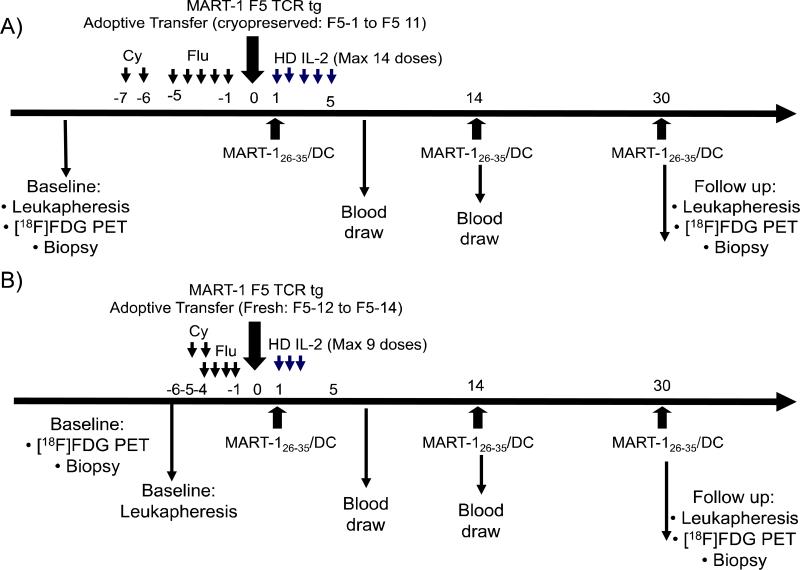
A clinical trial (NCT00910650) adoptively transferring MART-1 T-cell receptor (TCR) transgenic lymphocytes together with MART-1 peptide-pulsed DC vaccination in HLA-A2.1 patients with metastatic melanoma. Autologous TCR transgenic cells were manufactured in 6 to 7 days using retroviral vector gene transfer, and reinfused with (n = 10) or without (n = 3) prior cryopreservation.
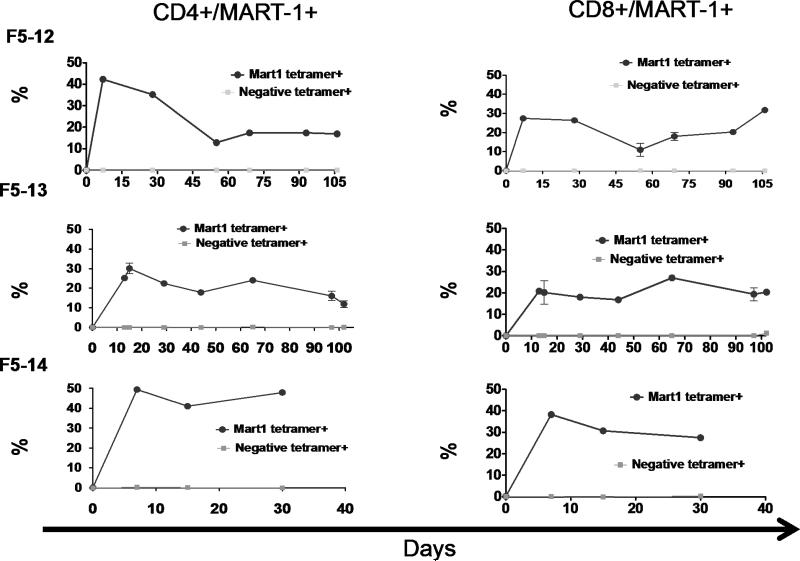
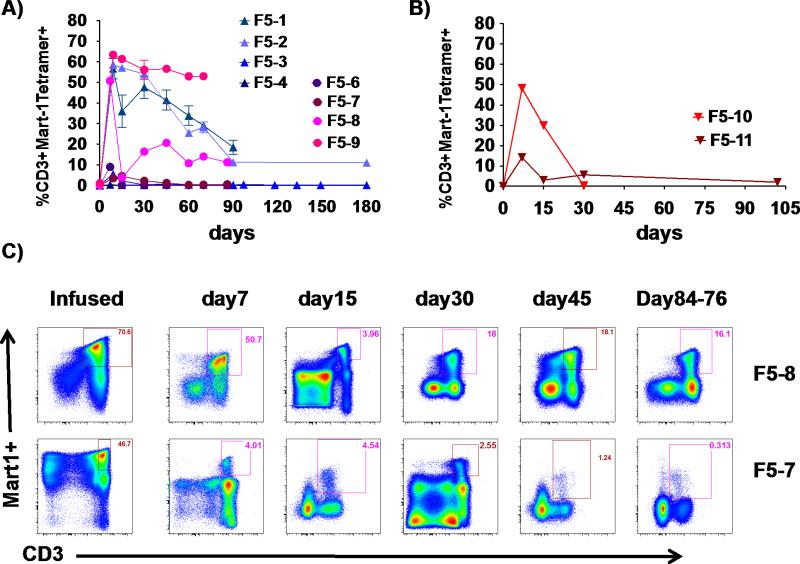
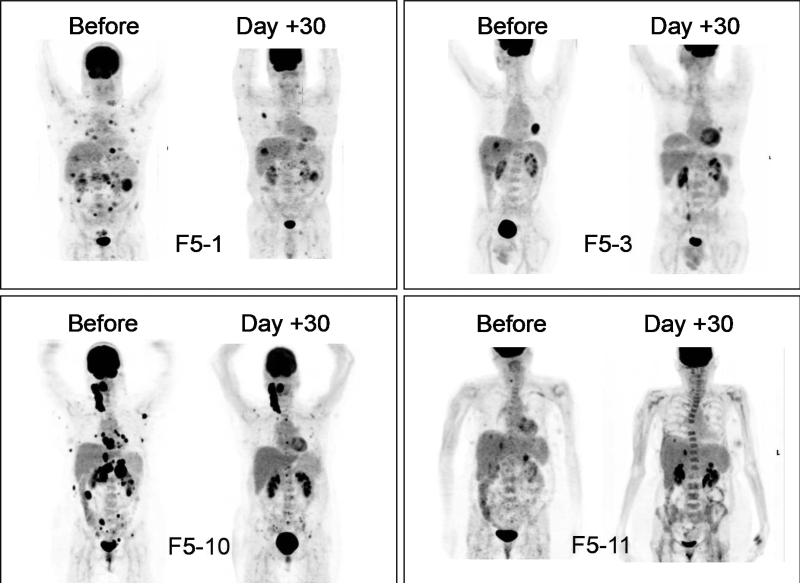
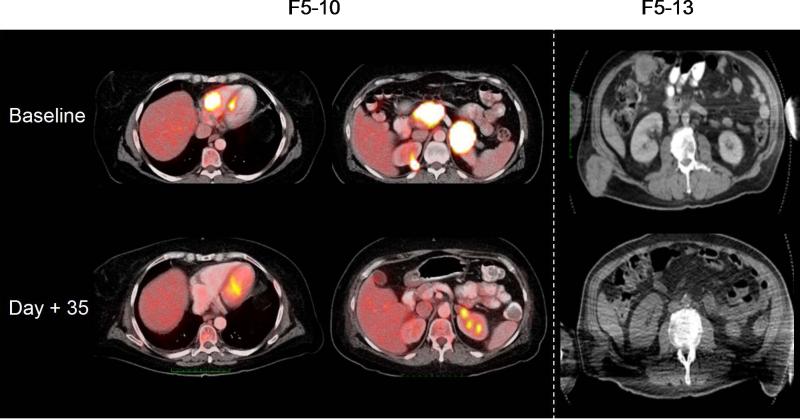
A total of 14 patients with metastatic melanoma were enrolled and 9 of 13 treated patients (69%) showed evidence of tumor regression. Peripheral blood reconstitution with MART-1-specific T cells peaked within 2 weeks of ACT, indicating rapid in vivo expansion. Administration of freshly manufactured TCR transgenic T cells resulted in a higher persistence of MART-1-specific T cells in the blood as compared with cryopreserved. Evidence that DC vaccination could cause further in vivo expansion was only observed with ACT using noncryopreserved T cells.
Double cell therapy with ACT of TCR-engineered T cells with a very short ex vivo manipulation and DC vaccines is feasible and results in antitumor activity, but improvements are needed to maintain tumor responses.
已证明,通过对自体外周血淋巴细胞进行逆转录病毒基因工程改造并在数周内进行扩增,可制造出大量用于过继性细胞转移(ACT)的肿瘤特异性T细胞。在小鼠模型中,这种疗法与树突状细胞(DC)疫苗联合使用时效果最佳。我们开发了一种为期1周的简短制造方案,以确定这种双细胞疗法的可行性、安全性和抗肿瘤疗效。
一项临床试验(NCT00910650),在HLA-A2.1的转移性黑色素瘤患者中,过继性转移MART-1 T细胞受体(TCR)转基因淋巴细胞并联合MART-1肽脉冲DC疫苗接种。使用逆转录病毒载体基因转移在6至7天内制造出自体TCR转基因细胞,并在冷冻保存前(n = 10)或未冷冻保存(n = 3)的情况下重新注入。
共纳入14例转移性黑色素瘤患者,13例接受治疗的患者中有9例(69%)出现肿瘤消退迹象。ACT后2周内,MART-1特异性T细胞在外周血中的重建达到峰值,表明其在体内迅速扩增。与冷冻保存的T细胞相比,注入新鲜制造的TCR转基因T细胞后,血液中MART-1特异性T细胞的持久性更高。仅在使用未冷冻保存的T细胞进行ACT时,观察到DC疫苗接种可导致体内进一步扩增的证据。
采用体外操作时间非常短的TCR工程化T细胞进行ACT与DC疫苗的双细胞疗法是可行的,并可产生抗肿瘤活性,但仍需改进以维持肿瘤反应。