Johnson Todd D, Dequach Jessica A, Gaetani Roberto, Ungerleider Jessica, Elhag Dean, Nigam Vishal, Behfar Atta, Christman Karen L
Department of Bioengineering, Sanford Consortium for Regenerative Medicine, University of California, San Diego, La Jolla, CA 92037.
Department of Bioengineering, Sanford Consortium for Regenerative Medicine, University of California, San Diego, La Jolla, CA 92037 ; Department of Cardiology, HLCU, University Medical Center Utrecht, Utrecht, the Netherlands.
Biomater Sci. 2014;2014:60283D. doi: 10.1039/C3BM60283D.
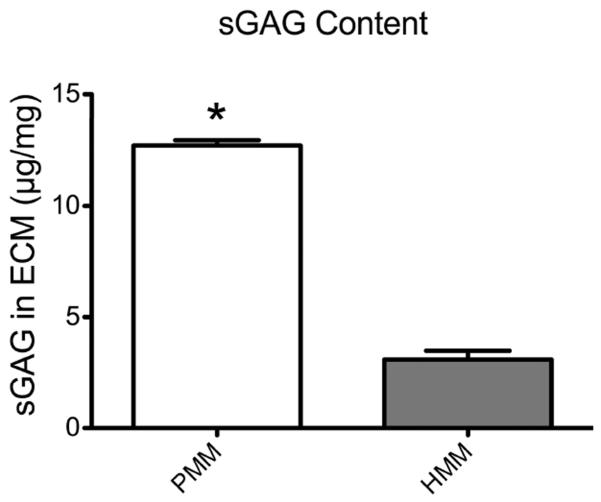
Heart failure (HF) after myocardial infarction (MI) is a leading cause of death in the western world with a critical need for new therapies. A previously developed injectable hydrogel derived from porcine myocardial matrix (PMM) has had successful results in both small and large animal MI models. In this study, we sought to evaluate the impact of tissue source on this biomaterial, specifically comparing porcine and human myocardium sources. We first developed an analogous hydrogel derived from human myocardial matrix (HMM). The biochemical and physical properties of the PMM and HMM hydrogels were then characterized, including residual dsDNA, protein content, sulfated glycosaminoglycan (sGAG) content, complex viscosity, storage and loss moduli, and nano-scale topography. Biochemical activity was investigated with studies for the proliferation of vascular cells and differentiation of human cardiomyocyte progenitor cells (hCMPCs). Next, gelation and material spread were confirmed for both PMM and HMM after intramyocardial injection. After extensive comparison, the matrices were found to be similar, yet did show some differences. Because of the rarity of collecting healthy human hearts, the increased difficulty in processing the human tissue, shifts in ECM composition due to aging, and significant patient-to-patient variability, these studies suggest that the HMM is not a viable option as a scalable product for the clinic; however, the HMM has potential as a tool for cell culture.
心肌梗死后的心力衰竭(HF)是西方世界主要的死亡原因,迫切需要新的治疗方法。一种先前开发的源自猪心肌基质(PMM)的可注射水凝胶在小型和大型动物心肌梗死模型中均取得了成功结果。在本研究中,我们试图评估组织来源对这种生物材料的影响,特别是比较猪和人心肌来源。我们首先开发了一种源自人心肌基质(HMM)的类似水凝胶。然后对PMM和HMM水凝胶的生化和物理特性进行了表征,包括残留双链DNA、蛋白质含量、硫酸化糖胺聚糖(sGAG)含量、复数粘度、储能模量和损耗模量以及纳米级形貌。通过血管细胞增殖和人心肌祖细胞(hCMPCs)分化的研究来研究生化活性。接下来,确认了心肌内注射后PMM和HMM的凝胶化和材料扩散情况。经过广泛比较,发现这些基质相似,但确实存在一些差异。由于收集健康人心脏的稀缺性、处理人体组织的难度增加、由于衰老导致的细胞外基质成分变化以及患者之间的显著差异,这些研究表明HMM作为一种可扩展的临床产品不是一个可行的选择;然而,HMM有作为细胞培养工具的潜力。