Kurth Florian, Luders Eileen, Sicotte Nancy L, Gaser Christian, Giesser Barbara S, Swerdloff Ronald S, Montag Michael J, Voskuhl Rhonda R, Mackenzie-Graham Allan
Department of Neurology, David Geffen School of Medicine at UCLA, Los Angeles, CA, USA ; Brain Mapping Center, David Geffen School of Medicine at UCLA, Los Angeles, CA, USA.
Department of Neurology, David Geffen School of Medicine at UCLA, Los Angeles, CA, USA ; Department of Neurology, Cedars-Sinai Medical Center, Los Angeles, CA, USA.
Neuroimage Clin. 2014 Mar 6;4:454-60. doi: 10.1016/j.nicl.2014.03.001. eCollection 2014.
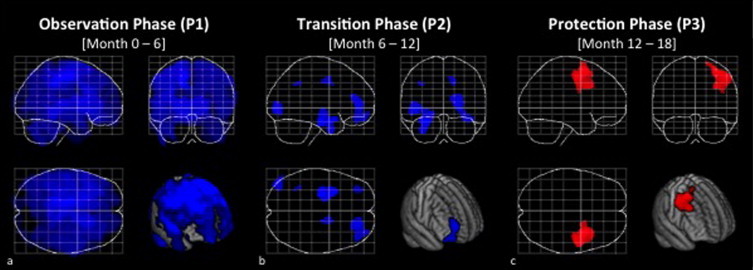
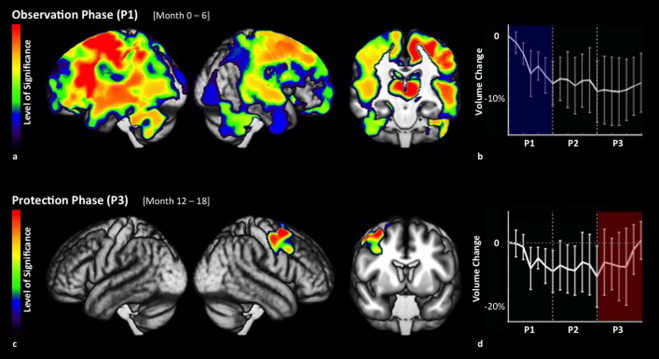
Multiple sclerosis (MS) is an inflammatory and neurodegenerative disease of the central nervous system. While current medication reduces relapses and inflammatory activity, it has only a modest effect on long-term disability and gray matter atrophy. Here, we have characterized the potential neuroprotective effects of testosterone on cerebral gray matter in a pilot clinical trial. Ten men with relapsing-remitting MS were included in this open-label phase II trial. Subjects were observed without treatment for 6 months, followed by testosterone treatment for another 12 months. Focal gray matter loss as a marker for neurodegeneration was assessed using voxel-based morphometry. During the non-treatment phase, significant voxel-wise gray matter decreases were widespread (p≤ 0.05 corrected). However, during testosterone treatment, gray matter loss was no longer evident. In fact, a significant gray matter increase in the right frontal cortex was observed (p≤ 0.05 corrected). These observations support the potential of testosterone treatment to stall (and perhaps even reverse) neurodegeneration associated with MS. Furthermore, they warrant the investigation of testosterone's neuroprotective effects in larger, placebo controlled MS trials as well as in other neurodegenerative diseases. This is the first report of gray matter increase as the result of treatment in MS.
多发性硬化症(MS)是一种中枢神经系统的炎症性和神经退行性疾病。虽然目前的药物可以减少复发和炎症活动,但对长期残疾和灰质萎缩的影响不大。在此,我们在一项试点临床试验中对睾酮对脑灰质的潜在神经保护作用进行了表征。十名复发缓解型MS男性患者被纳入这项开放标签的II期试验。受试者在未接受治疗的情况下观察6个月,随后接受睾酮治疗12个月。使用基于体素的形态学测量法评估作为神经退行性变标志物的局灶性灰质损失。在未治疗阶段,广泛存在显著的逐体素灰质减少(校正后p≤0.05)。然而,在睾酮治疗期间,灰质损失不再明显。事实上,观察到右侧额叶皮质灰质显著增加(校正后p≤0.05)。这些观察结果支持睾酮治疗可能延缓(甚至逆转)与MS相关的神经退行性变。此外,它们保证了在更大规模的、安慰剂对照的MS试验以及其他神经退行性疾病中对睾酮神经保护作用进行研究。这是关于MS治疗导致灰质增加的首次报告。